
Law firm marketing ROI is calculated by comparing the revenue generated as a result of marketing activities to the cost of those marketing activities. To calculate ROI, you'll want to be tracking metrics like cost per lead, cost per new client, lead-to-client conversion rate, and the revenue generated from those clients' cases. It's not enough to simply be tracking website traffic or the number of inquiries your firm is receiving; you need to know if your marketing efforts are paying off! By tying marketing efforts to the number of clients retained and fees collected, you'll be able to see which marketing efforts are paying off (and which ones aren't).
At GLP Marketing, we help law firms make smarter marketing decisions through strategies focused on measurable results. Whether you are investing in SEO, paid advertising, or content marketing, understanding your return on investment can help you get more value from your marketing budget. Reach out to us now!
Below you'll find the law firm marketing ROI formula, an explanation of the metrics you should be tracking, an overview of some helpful law firm marketing analytics tools, common law firm marketing measurement challenges (and how to avoid them!), and some tips for improving your law firm's marketing ROI.
What Is Marketing ROI for a Law Firm?
Marketing return on investment (ROI) measures how much money a law firm makes from its marketing compared with what that marketing costs. It answers a simple question: is the money going into SEO, Google Ads, content and social media coming back as profitable work?
To answer it, you have to keep four stages apart. Marketing activity is visits, impressions and engagement. Leads are people who contact the firm. Client acquisition happens when an inquiry signs an engagement agreement. Revenue is what the firm collects for the work. A campaign can produce hundreds of leads and still lose money if few of them hire you, or if the cases they bring are small.
So don't stop at lead volume. Look at what each new client costs to acquire, what their matter brings in, and what it costs to deliver the work. Attention is easy to buy, but profit is the test.
Why Is Measuring Law Firm Marketing ROI Important?
Tracking helps you determine if your ad budget is actually benefiting your firm. Without tracking you’ll never know if you’re throwing money at advertising that gets you name recognition, but not clients.
Here is what measurement gives you:
- A clear view of which channels work: Identify which channel (SEO, Google Ads, referrals or another source) attracts your most valuable customers.
- Less wasted ad spend: Understand which campaigns are producing leads and which ones aren’t converting and adjust or eliminate those that aren’t.
- Better budget decisions: Compare acquisition costs to identify where you can squeeze the most bang for your buck from your next dollar. Segment acquisition costs by channel.
- A real client acquisition cost: you’ll know what it costs you to convert leads into clients, and if that’s a sustainable business model for you.
- Grounded planning: Make sure your business’ goals, revenue forecasts and future investment are based on facts and figures, not gut instinct or best guesses!
The legal industry has a particular gap here. In the American Bar Association's 2023 Websites & Marketing TechReport, only 35% of surveyed lawyers said a client had retained their firm directly through its website, up from 25% in 2022. If firms aren't recording where clients come from, the true figure is anyone's guess. That's the problem good tracking solves.
How Do You Calculate Law Firm Marketing ROI?
Marketing ROI (return on investment) for law firms is calculated by comparing the return on a particular marketing campaign with the total cost of that campaign. The ROI formula looks like this:
Marketing ROI (%) = [(Revenue Generated - Marketing Cost) / Marketing Cost] × 100
Start with the total expenses associated with the campaign, including agency fees, ad spend, content production costs, SEO services, marketing software and anything else the campaign required. For revenue, use total revenue from clients reasonably attributable to the campaign. If possible, base this number on fees collected, not projected case values, because not every case pays what it was expected to.
A hypothetical example
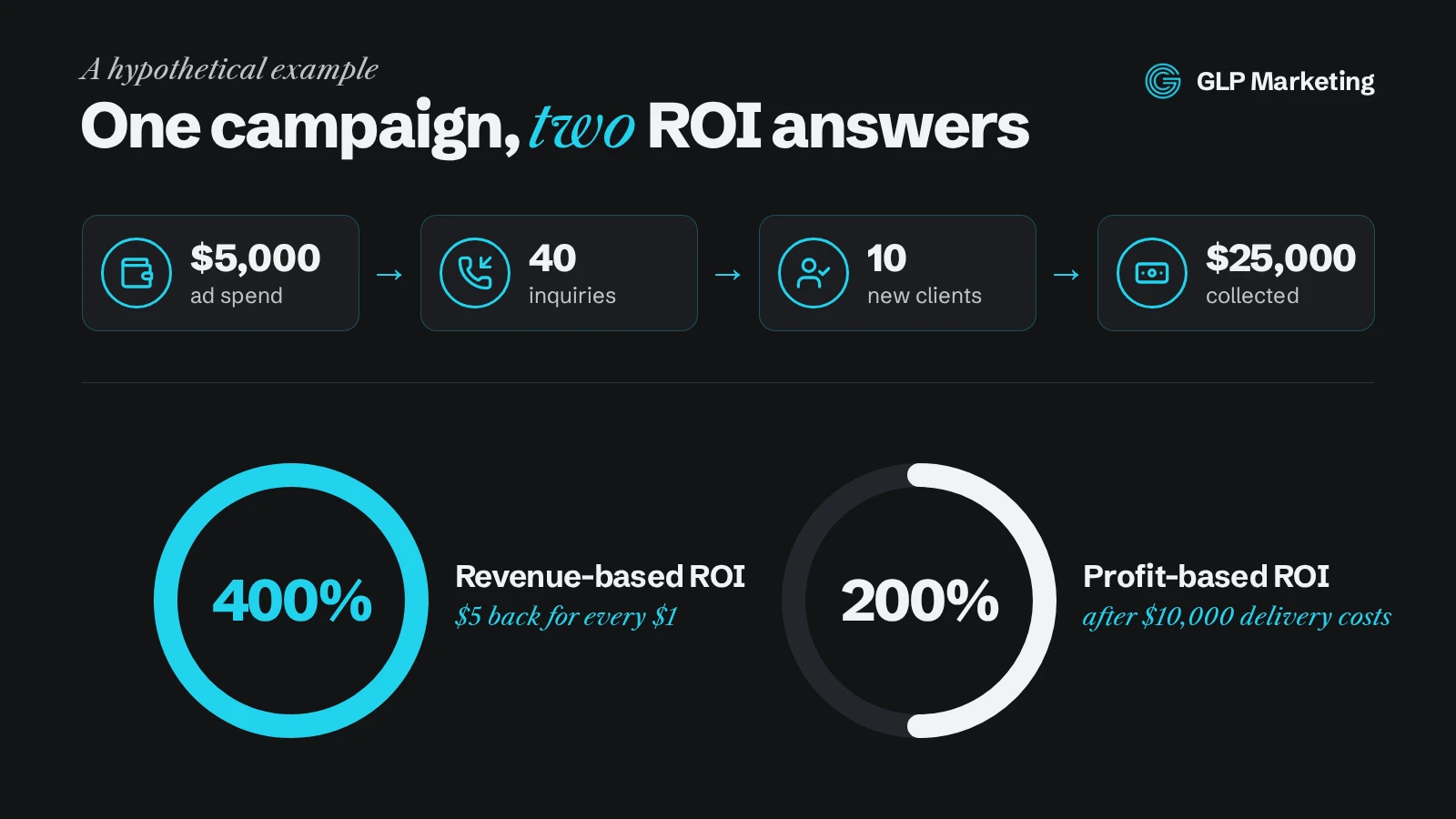
For example, let’s say a law firm spends $5,000 on Google Ads over the course of three months. During that time, the campaign generates 40 new client inquiries, resulting in 10 new signed clients. These new clients generate $25,000 in collected revenue that can be attributed to the Google Ads campaign.
Using the revenue-based formula:
Revenue Generated = $25,000
Marketing Cost = $5,000
ROI = [($25,000 - $5,000) / $5,000] × 100
ROI = ($20,000 / $5,000) × 100
ROI = 400%
That's a 400% revenue-based ROI. Put simply, the firm brought in $5 of revenue for every $1 of marketing.
But revenue isn't profit. Suppose the firm spends another $10,000 delivering those cases. Its contribution after delivery costs is $15,000, and the profit-based calculation looks like this:
Revenue Generated = $25,000
Case Delivery Costs = $10,000
Profit Before Marketing Cost = $15,000
Marketing Cost = $5,000
ROI = [($15,000 - $5,000) / $5,000] × 100
ROI = ($10,000 / $5,000) × 100
ROI = 200%
The results, while still impressive, are more telling because they take into account the amount of money that the firm spent to do the work.
Revenue-based ROI vs. profit-based ROI
Revenue-based ROI compares a campaign's revenue with its marketing cost. Profit-based ROI subtracts the cost of delivering the legal work first. Both are worth reviewing. If you only look at one, use profit-based ROI. It shows whether the campaign actually improved the firm's finances.
What Metrics Should Law Firms Track to Measure Marketing ROI?
To get a true picture of your firm’s ROI, look at the following metrics.
These numbers provide insight into your costs for generating a prospect, conversion rates (prospects into clients), and the revenue those clients bring in. Each metric will give you different pieces of information about your marketing efforts’ effectiveness; do not just focus on one!
| Metric | What It Measures | What It Reveals About Marketing Performance |
|---|---|---|
| Cost Per Lead (CPL) | Total marketing spend divided by the number of leads. | What the firm pays for each inquiry. A low CPL can signal efficient lead generation, but it says nothing about whether the leads are any good. |
| Cost Per Qualified Lead | Total marketing spend divided by the number of leads that meet the firm's intake criteria. | Whether campaigns reach people who need your services and fit your practice areas. |
| Cost Per Signed Client | Total marketing spend divided by the number of new clients who sign a retainer or engagement agreement. | What an actual client costs. Usually more useful than CPL, because it ties spend to acquisition. |
| Lead-to-Client Conversion Rate | The percentage of leads that become clients. | How well the firm turns inquiries into paying work. A low rate can point to weak leads, slow follow-up or intake problems. |
| Consultation Booking Rate | The percentage of leads who schedule a consultation. | How well marketing and intake move people to the next step, and where inquiries drop off. |
| Client Lifetime Value (LTV) | The estimated total revenue from a client over the whole relationship. | The long-term value of winning a client. Especially useful for firms with repeat matters or ongoing relationships. |
| Revenue Per Case | The average revenue from completed or collected cases. | The financial value of clients from each channel and practice area, and the context for judging acquisition cost. |
| Marketing-Attributed Revenue | Revenue from clients whose inquiries can be linked to a specific channel or campaign. | How much revenue marketing contributes, and which campaigns return the most. |
Compare cost per lead (CPL), cost per client, conversion rates and revenues generated, not just in aggregate, but by channel and practice area where possible (what may be a highly effective channel for personal injury cases might not be so for estate planning, for example). A channel that drives a relatively low CPL could still prove very expensive if very few of those leads convert into clients (as might happen, for example, with Google Ads campaigns).
How to Measure ROI Across Different Law Firm Marketing Channels
Different marketing channels will see a return on investment (ROI) at different rates. For example, paid advertising on Google Ads might see results in a few days, while SEO and content marketing efforts might take months. To determine if your efforts are paying off, it’s important to look at ROI metrics for each individual channel and give yourself enough time to see if your efforts are working.
Search Engine Optimization (SEO)
Law firm SEO brings in clients through organic search. Make sure you’re tracking your progress from top to bottom, from organic traffic, keyword rankings and leads to consultations booked, new clients won and revenue generated. And don’t forget to factor in all of your SEO costs: agency retainer, content creation, website fixes and link building.
SEO is a long game, so check in on your results at least quarterly. Rankings and visibility can take several months to show results, so judging it after a few weeks almost always undersells it. Follow organic leads all the way to retained cases; that’s the only way you’ll be able to work out if your SEO campaign is bringing you more clients or just better rankings.
Google Ads and Paid Search
Law firm PPC moves quickly because you pay to appear when someone searches for the service you offer. Pay attention to metrics such as cost per click (CPC), click-through rate (CTR), cost per lead, number of qualified leads, cost per new client, conversion rate and revenue generated from each advertising campaign.
While it’s important to note the number of clicks you’re getting, that alone doesn’t mean you’re having a successful advertising campaign. Pay attention to which campaigns and keywords are generating website visits that become qualified leads and ultimately become retained clients. Monitor your results regularly (such as on a weekly basis), but don’t write off a campaign as a failure (or success) until you’ve had time to follow up with leads and see how many booked consultations and made it through the intake process.
Content Marketing
Content marketing for law firms draws people in by answering their questions and explaining legal processes in plain language. Content can make a big difference long-term, as that blog post on personal injury may not bring in many readers or leads straight away, but over a year can be one of your most reliable sources of traffic. Monitor organic traffic to your articles, user interaction with your content, enquiries originating from content pages, number of consultations booked, assisted conversions and revenue generated from clients who viewed your content on their journey.
Content rarely gets the credit it deserves. People read a blog post, don’t make an enquiry, come back a week later and book a consultation, but that blog post doesn’t get counted as having anything to do with that consultation! Look at assisted-conversion reports in analytics (and ask your new clients what content they’ve read!).
Local SEO and Google Business Profile
Local SEO helps potential clients find your law firm when they’re searching for a local attorney. Monitor Google Business Profile regularly to measure the success of your local SEO efforts. Pay attention to metrics such as website clicks, calls, direction requests, profile interactions, local search visibility, messages (if applicable), and reviews.
A profile interaction alone isn’t a success though, and to measure how effective Google Business Profile really is for your business, link calls and other enquiries with your intake records so you can see how many enquiries lead to consultations or clients. I’d recommend reviewing the data at least once a month as it can take a couple of weeks for increases in local search visibility to translate into more calls or enquiries.
Social Media Marketing
Social media builds awareness and credibility and keeps your firm visible between legal needs. Measure what matters: Focus on metrics like reach, impressions, engagement rate, profile visits, website clicks, inquiries, consultation bookings and clients attributed to social. While important, don’t only focus on the number of followers or likes a post receives as these metrics indicate interest, not ROI. Instead, look at how many people from each social platform visit your firm’s website, inquire about services or book a consultation. Also, don’t forget to ask new clients whether social media played a part and give social media credit for the influence it has on later decisions as well as the direct conversions. Many potential clients may have been following your firm on social for months before they actually needed legal services.
Email Marketing and Client Referrals
Email keeps your firm in touch with past clients, nurtures prospects and, where appropriate, encourages repeat work and referrals. Monitor your results. For email, this means keeping tabs on delivery rate, open rate, click-through rate, number of consultations booked, number of inquiries and ultimately, the amount of business (and dollars) generated as a result of each email campaign. It’s important to track leads from the moment an email is received all the way through to engagement since it’s unlikely that someone will click on an email and immediately retain your firm. Instead, you want to make sure you’re attributing the engagement to the proper source. Likewise, make sure you’re tracking the number of referrals you receive, the number that end up being good fits, the number that retain your firm and the amount of business (and dollars) they ultimately generate. Again, keep in mind that it’s unlikely that someone will refer a potential client to your firm and that person will immediately retain you, as there will likely be a number of discussions before the decision is made.
Why Conversion Timelines Matter
Paid channels like PPC ads often have a shorter sales cycle than others such as SEO, content or social media marketing. Some legal matters can take weeks to convert from the initial phone call to client signing.
Applying the same 30-day report across the board would result in every channel being judged by the same yardstick, which skews the picture. Monitor performance metrics for every channel, such as website visitors, click-throughs and leads, in addition to lagging indicators such as new clients, collected revenue and profits. Make sure your CRM software tracks source of lead consistently so you’re able to correlate PPC and other marketing efforts with new clients and profits.
How Do You Track Marketing Leads and Conversions?
Lead and Conversion Tracking: Lead tracking helps you tie each lead to its source and follow it through to a signed contract. It shows you which marketing efforts are producing quality leads, how effectively your intake process is converting those leads, and which efforts are actually translating into business.
Here is a step-by-step process:
Step 1: Set Up Call Tracking
Use call tracking to measure which campaigns and channels (e.g. Google Ads, SEO, local) are generating enquiries. With call tracking software you can allocate a different number to each channel or campaign (e.g. one for Google Ads, one for SEO landing pages and one for local) and when a call comes in the software tracks which number (and therefore which channel or campaign) it relates to.

Step 2: Configure Google Analytics 4
Implement Google Analytics 4 (GA4) to track user behavior on your website. Define and track key events, e.g. filling out the contact form, booking a consultation, clicking your phone number, to measure enquiries. Use UTM campaign parameters on links in ads, emails and social media posts to identify the source of website visits.
Step 3: Track Website Forms and Consultation Bookings
Log all website form submissions, bookings and phone enquiries. Include the date, name, contact information, type of legal service enquired about and how they found you. This will help you work out how many enquiries and potential clients you’re attracting, not just website visitors.
Step 4: Use CRM Software to Follow Leads
Use a customer relationship management (CRM) system to track leads and manage the client intake process from initial contact to executed engagement letter. CRM systems are software applications that help manage and track potential clients through your firm’s intake process. Leads should be categorized as new inquiries, qualified leads, unqualified leads and retained clients. Track a lead’s source, practice area, whether or not a consultation took place, follow-ups and ultimately the outcome.

Step 5: Apply Consistent Lead Source Attribution
Be sure to use the same source categories in your marketing efforts and intake forms. For example: organic search, Google Ads, referral, social media, email, direct. Always ask new customers “How did you hear about us?” Write it down. Log it in your CRM. Compare what people tell you to your digital marketing tracking data. People’s memories aren’t perfect, but combining the two will get you closer to the truth than relying on just one.
Step 6: Review Lead-to-Client Conversions
Break down enquiries by channel each month: how many enquiries you received, how many were qualified, attended a consultation, and signed up, and analyze each channel’s enquiry conversion rate, cost per enquiry, cost per new client and revenue generated to reveal your marketing efforts’ ROI.
What Tools Can Law Firms Use to Measure Marketing ROI?
With the right tools, you can connect your marketing efforts to your business results. There are tools to help with every step of the customer journey, from landing on your website to paying your invoice. Here are six worth having.
1. Google Analytics 4
By setting up GA4’s “key events” you can see things like phone number clicks, form submissions and consultation bookings. GA4 provides a wealth of information about your website visitors: where they’re coming from, what pages they land on, how they navigate and engage with your site. It can show you which channels and content are leading to action (based on your key events). What it can’t show you is if those actions turned into clients, and you’ll need your CRM for that!
2. Google Ads Conversion Tracking
Google Ads conversion tracking records what people do after clicking an ad: calls, form submissions, bookings and other actions you define.
Use it to analyze which keywords and campaigns are generating enquiries, how much each conversion is costing you and where your money is best being spent. Import customer data (e.g. signed clients or qualified leads) from your CRM into Google Ads, and Google Ads will be able to report on these rather than just conversions (e.g. form completions).
3. Google Search Console
Google Search Console reports on your visibility in organic search: queries, impressions, clicks, click-through rate and average position.
Search Console is your gateway to understanding your SEO efforts. See the keywords your site ranks for, the performance of your practice area pages, and opportunities to improve your site’s content. When used alongside GA4 and lead tracking solutions, you’ll be able to tell if improved rankings are leading to more inquiries.
4. Call Tracking Platforms
Call tracking tools give you a unique phone number for each traffic source, ad, marketing campaign, or landing page so you can see exactly which efforts are driving calls. Some also offer call recording and transcription capabilities, making it easier for intake to understand the quality of leads and what prospects are looking for. If phone calls are your primary source of inbound inquiries, these solutions can be indispensable.
5. Legal CRM and Client Intake Software
Legal CRM and intake software tracks prospects from initial inquiry to consultation to engagement and then the case itself. These programs track practice area, how the potential client found the firm, consultation outcomes, whether or not the client signed an agreement with the firm and other client details. For ROI, this is the most important tool on the list, since it’s at this point that marketing and client acquisition meet. You can see how many leads from Google Ads, SEO, or even referrals turned into clients, and how much it cost you to acquire each one.
6. Marketing Reporting Dashboards
A reporting dashboard compiles marketing and sales data from different sources (Google Analytics, ad accounts, call tracking and your CRM) so you don’t have to visit each one individually to figure out what’s going on. A useful reporting dashboard should include metrics such as ad spend, website visitors, leads, qualified leads, consultations, new clients, cost per acquisition and attributed revenue. Dashboards make it easier to compare performance across channels, identify fluctuations and trends, and make budget decisions.
How Do These Tools Work Together?
Call tracking, CRM data, GA4, Search Console, and Google Ads conversion tracking each provide part of the story. Your CRM will tell you which enquiries turned into clients; GA4 and Search Console give insights into how users discover and engage with your website; Google Ads conversion tracking and call tracking can uncover which campaigns are driving enquiries.
Pull it all together in one dashboard and you can start comparing ad spend to actual clients won and revenue. You might be surprised what you uncover, for example that whilst SEO is delivering fewer enquiries than Google Ads, a higher percentage of them are turning into retained clients, at a lower cost per acquisition.
Why Is Law Firm Marketing ROI Sometimes Difficult to Measure?
Law firm marketing can be tricky to track, especially since many clients don’t hire immediately and interact with multiple channels before reaching out. Long decision cycles: Clients don’t always convert right away, especially for law firms.
If they’re dealing with a difficult situation (personal injury, family law or a complex business legal issue), they’ll likely take their time and do their research before hiring an attorney. This means they may have seen an ad from your firm, but it could be weeks or months down the line that they decide to schedule a consultation. If you’re not giving yourself enough time to see results in your reporting, you may think a campaign isn’t performing as well as it actually is.
Customers can also interact with your business in different ways before they decide to reach out. For example, maybe they first found your website organically, but came back later because they saw a Google ad. They may have read an article on your website and checked out your Google Business Profile before finally deciding to call. If you’re only looking at last-click attribution, you might give credit to one channel when multiple channels actually played a role in nurturing that customer.
Not tracking leads by source: You can’t accurately calculate ROI if you don’t know where your leads are coming from! Make sure you’re tracking which leads came from SEO, PPC, referrals or social media. The ABA's 35% website-retention figure above is a symptom of this: if nobody is asking, nobody knows.
Not using call tracking: Some customers may find out about your firm from a friend, former client, or another attorney. Other customers may interact with your ads or website, but choose to call instead of filling out a form. Implement call tracking and have your team ask every customer how they found out about your firm so you’ll have a clearer idea of where your leads are coming from. Log this information in your CRM so you can keep track of it!
Not waiting long enough to see ROI: Depending on your practice area, it may take months or even years to close a case. The final payout might be different than what you initially predicted. An injury law firm might sign several clients from a campaign and not see settlement money until much later. Calculating ROI based on potential payouts instead of what you actually collected can paint a rosier picture than the bank account will.
Some channels, like SEO and content marketing, take months before they start generating enough visibility to attract relevant website visitors. Not all leads convert right away. Leads that show up this month may have been generated by marketing last month or earlier. Different marketing channels have different payback periods. Make sure you’re measuring performance over an appropriate time frame and monitoring leading indicators as well as lagging indicators like collected revenue.
How Can Law Firms Improve Their Marketing ROI?
Most firms improve marketing ROI by moving budget toward the channels that produce qualified clients, converting more of the inquiries they already get, and cutting spend that reaches the wrong people.
Review which channels consistently bring in people who need your services. Measure and compare CAC, number of qualified leads, number of consultations scheduled, number of cases retained and revenue generated from different marketing channels and ad campaigns (instead of focusing on things like website traffic and total number of leads or inquiries). If SEO produces fewer inquiries than paid ads but more clients at a lower cost, it probably deserves a bigger share of your law firm marketing budget.
Examine the landing pages people are visiting on your website. Do they have a clear idea of what services you offer and how to get in touch with you? Are your CTAs and contact information prominent? Is your website mobile-friendly and easy to navigate? Do your forms ask for too much information? Do you have dedicated landing pages for different practice areas? Determine if your website is effectively answering people’s questions and addressing their needs and concerns. Does it explain what happens next after contacting your firm? Where are people dropping off before taking action?
Evaluate your firm’s speed of response when it comes to returning phone calls and responding to web form submissions, emails and website chat inquiries. Chances are, people are contacting two or three other firms at the same time when seeking legal representation, and you want to be the first one to get back with them! Set response time goals for your team and consider implementing some sort of automatic response system (with follow-up from a person on your team, of course). A fast, personal reply tells the prospect their problem is being taken seriously.
Assess your intake process. Good marketing can’t fix a weak intake process. Make sure the people responsible for handling inquiries are properly trained and know how to: gather pertinent information, qualify potential clients, determine if the case falls within your firm’s practice areas, schedule consultations with an attorney, follow up with potential clients. Log every inquiry in your firm’s CRM and track the number of inquiries you’re receiving, how many are qualified, how many consultations are being scheduled, and ultimately how many are retained. If you’re receiving good leads but not seeing great conversion and retention rates, the issue isn’t with your marketing efforts; it’s something that’s happening during the intake process.
Tighten your targeting. Assess your current ad campaigns and make sure they’re reaching people you can actually serve. For example, if you’re a Los Angeles personal injury law firm, you don’t want to be showing ads to people in a market three states away; that’s burning money. Refine your geographic targeting, keywords, audiences and practice-area campaigns, exclude irrelevant search terms, and shape your ads around the cases you want.
Regularly check in on marketing efforts and performance, monthly or quarterly based on the type of marketing channel and the amount of data being tracked. Compare marketing expenditures to the number of sales-qualified leads, new clients won, client acquisition costs and amount of revenue collected from marketing efforts. If marketing tactics are continually underperforming, dig in to determine why and reallocate funds accordingly.
When Should a Law Firm Change Its Marketing Strategy?
Change your marketing strategy when acquisition costs climb without a matching rise in case value, when lead quality or conversion rates fall, or when a channel produces plenty of activity and almost no retained clients.

Rising acquisition cost is the first warning sign. If each new client costs more and case values haven't kept pace, campaigns are losing efficiency. Look at ad costs, keyword competition, conversion rates and lead quality to find the cause.
Falling lead quality is another warning sign. More inquiries isn’t automatically good news. If more people are calling but fewer have cases you can take, your campaigns are reaching the wrong audience. Revisit your targeting (keywords, ad copy, landing pages and geographic focus) and make sure you’re attracting the right audience.
If qualified leads keep coming but few sign, look at your conversion process. Make sure you’re responding to leads in a timely manner, make it easy for potential clients to schedule a consultation with you, and educate potential clients about the services you offer and the process you use to help clients. Also consider how easy it is for website visitors to take action (schedule a consultation, call you or request more information).
Watch for campaigns that look busy and produce nothing: You’re seeing activity (website traffic, ad impressions, clicks and engagement), but it’s not translating into new clients. Blogs can also lead to new clients: 29% of lawyers at blogging firms told the ABA that clients had retained their firms directly or through a referral from their blogs. The point is to track it well enough to know whether yours does.
If you notice that one or more of your marketing campaigns isn’t producing results, don’t immediately write it off; if it has potential, fix it first. Google Ads: You’re getting inquiries about cases you handle, but not many of those people end up scheduling a consultation. Check the landing page, the calls to action and intake before you give up on the channel. SEO: Your firm’s website is getting more of the right traffic, but it doesn’t seem to be translating into many new clients yet. Look at your practice area pages, content quality and conversion paths. In some cases, it may just need some time to get going (especially when it comes to SEO), so watch for real progress along the way. In other cases, it may just need some fine-tuning.
Once an existing channel has been properly tuned and still brings in poor-quality leads or costs too much per client, try something new. It’s also worth rethinking your mix if your audience isn’t responding to your current approach or you’re noticing your competitors are successfully connecting with their target clients in other ways. Experimentation may look like this: your firm leans heavily on paid search, so you decide to allocate resources to experimenting with local SEO, content marketing, or developing a referral program. Before moving serious budget, you set specific goals and KPIs for a controlled experiment and track its success in comparison to your other channels. Change should follow the data. Experiment with your marketing channels and efforts, monitor where leads may be falling through the cracks, and adjust your strategy accordingly toward your client acquisition and revenue goals.
Need Help Improving Your Law Firm's Marketing ROI?
Knowing what’s working, what’s not and where there are opportunities to maximize your budget is where better results start. That’s where GLP Marketing can help. We audit marketing activity for law firms and identify any channels that aren’t performing as well as they could be along with new areas for growth to attract more suitable clients.
From SEO and PPC through to content marketing and local search, we focus on building marketing strategies for law firms based on results that matter such as qualified enquiries, consultations booked, clients retained and ultimately revenue attributable to different channels. Vanity metrics such as website traffic and clicks come second.
Wondering how to get more from your marketing budget? Talk to GLP Marketing about a strategy built around the growth aspirations of your firm.
Frequently Asked Questions About Law Firm Marketing ROI
Here are short answers to common questions about calculating, tracking and improving marketing returns.
What Is a Good Marketing ROI for a Law Firm?
Break-even: your cost of winning business has to be less than the profit (after deduction of practice-specific delivery costs) that piece of business will make. Anything above that level is positive ROI. It’s worth keeping track of this for a few quarters and then setting targets for each area of practice and source of business. There’s no one-size-fits-all approach here; different practices will have dramatically different average case values, fee structures and costs of delivery.
How Do You Calculate Marketing ROI?
Subtract total marketing costs from the revenue they generated, then divide by marketing costs. The result can be expressed as a percentage by multiplying by 100. Marketing ROI (%) = [(Revenue Generated - Marketing Cost) / Marketing Cost] × 100.
What Is the Difference Between ROAS and Marketing ROI?
Return on ad spend (ROAS) measures the amount of revenue generated for every dollar you spend on ads. Marketing return on investment (ROI) takes into account all your marketing costs, and measures what’s left after deducting those costs from your marketing-related revenue.
How Much Should a Law Firm Spend to Acquire a New Client?
The total cost to market for and acquire new clients divided by the number of new clients should be less than the expected value or profit that those clients will provide the firm. Make sure to take a look at this number and compare it to the average case value and delivery costs.
How Long Does It Take to See ROI From Law Firm SEO?
SEO for law firms is a long-term strategy. It generally takes several months before you’ll see a significant difference in your firm’s online visibility, website traffic, leads and new clients. Your particular timeline will vary based on your website’s current status (authority, technical SEO and content), your competition and the practice areas you’re targeting.
How Do You Track Where New Clients Come From?
Use Google Analytics 4, call tracking and a legal CRM to track leads from source through conversion to client. During intake, ask every new client how they heard about your firm and record that information.
Which Marketing Channel Has the Best ROI for Law Firms?
No one channel wins for every firm. Results depend on practice area, location, competition and audience. Compare SEO, PPC, referrals, content marketing and local search on qualified leads, retained clients, acquisition cost and revenue, and let your own data decide.
Why Is My Law Firm Getting Leads but Not New Clients?
The usual causes are unqualified leads, slow response times, or problems with consultations and intake. Review lead quality, follow-up, conversion rates and campaign targeting to find where prospects drop out.