
Marketing a law firm on social media involves choosing the right platforms, sharing educational legal content, engaging potential clients, and demonstrating your legal expertise. Done well, it builds trust, widens your firm's reach, and produces real inquiries, all while staying inside the advertising and ethics rules that govern lawyers.
At GLP Marketing, we collaborate closely as a consulting CMO for law firms, with a focus on AI SEO and full marketing attribution so that every channel leads directly to signed contracts. Our work helped Onyx Law Group, a family and estate litigation firm, grow its Google clicks from 3,299 to 15,835 for the same 28-day window year over year, a 380% increase. We also turned Cali Lemon Lawyers from no organic-search revenue through organic search into about half a million dollars a month in roughly a year. If your firm wants to win in both traditional search and AI-powered results, request a free audit and growth plan.
This guide walks through how to market a law firm on social media, from picking platforms and planning posts to protecting client confidentiality, staying compliant, measuring results, and turning engagement into signed clients.
Step-by-Step Process of Marketing a Law Firm on Social Media
Social media gives law firms a way to show credibility and expertise before a prospective client ever picks up the phone. Posting regularly is only part of that. A firm also needs to know what its prospective clients are trying to figure out, which platforms they use, and how a reader gets from a post to a consultation request. Every step has to fit within professional conduct rules as well as advertising laws and the duty of confidentiality.
The steps below lay out a practical social media strategy that supports your reputation, reaches the right audience, and contributes to measurable growth.
Choose the Right Social Media Platforms for Your Law Firm
Choosing which platforms to use is one of the first decisions a law firm makes when planning for social media. The right choice depends on your practice area, your audience, where your clients live, your budget, and how much content your attorneys can realistically produce. A family law firm serving one city may get more from Facebook and Instagram, while a corporate firm courting business clients will usually lean on LinkedIn.
Audience data helps. In their 2025 survey of U.S. adults, Pew Research Center found that 84 percent of respondents use YouTube, 71 percent use Facebook, 50 percent use Instagram and 37 percent use TikTok. Those numbers indicate potential reach, but widespread use doesn't automatically mean they come from high-quality legal inquiries.
Start with one or two platforms where your ideal clients spend time, post on a steady schedule, and add more only when you have the people to run them. Your website should remain the main source of detailed information about your services, credentials as an attorney and for making requests for consultations.
Which Social Media Platforms Work Best for Different Law Firms?
Each platform suits a different kind of practice and a different goal. This table below connects common kinds of practices with what they usually align with regarding platforms, formats, and goals.
| Platform | Best suited for | Content formats to prioritize | Primary marketing objective |
|---|---|---|---|
| Corporate law, employment law, commercial litigation, and business-focused practices | Professional commentary, articles, case law updates, and attorney insights | Professional networking, referral development, and B2B credibility | |
| Family law, personal injury, estate planning, and community-focused practices | Educational posts, firm updates, community content, videos, and relevant group discussions | Local visibility, community engagement, and prospective client inquiries | |
| Family law, estate planning, immigration, and consumer-focused legal services | Reels, carousels, short videos, infographics, and attorney introductions | Brand awareness, accessible legal education, and trust building | |
| TikTok | Consumer-facing practices that target audiences who react to short educational videos. | Short videos, answers to common questions, myth-busting, and legal explainers | Reach, discovery, and introducing legal concepts to new audiences |
| YouTube | Firms handling complex matters that need detailed explanation, including litigation, estate planning, and business law | Long-form videos, FAQs, webinars, attorney interviews, and Shorts | Search visibility, in-depth education, and demonstrating expertise |
Pair each platform with a specific objective. LinkedIn works for networking and reaching business decision-makers, and Facebook supports local visibility. Instagram and TikTok both give concise explanations while YouTube provides space for lawyers to work through complex matters.
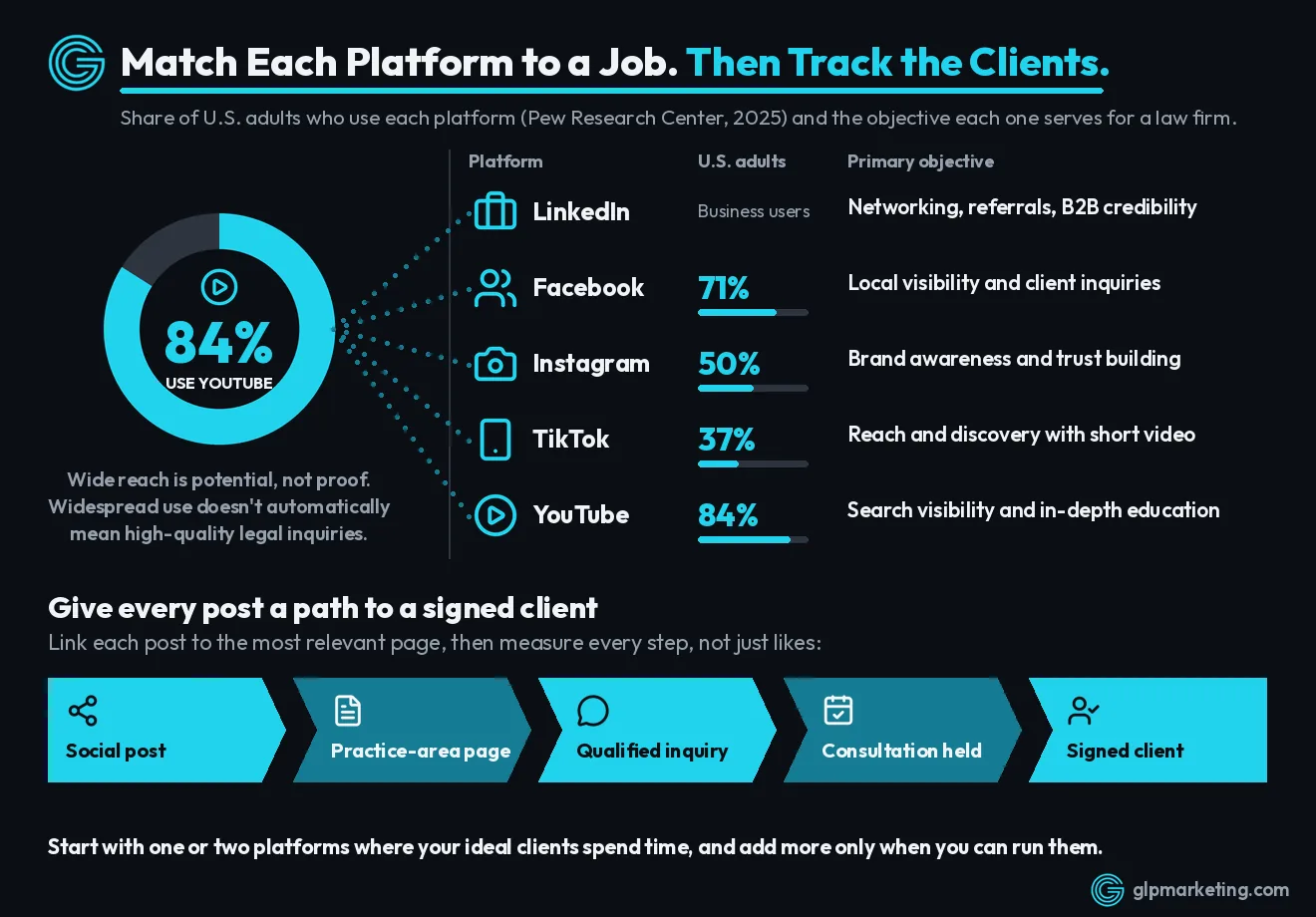
For instance, an insurance firm for personal injuries could post a short video showing how to act after a car crash and direct people to a full article on its website. A corporate firm could share a LinkedIn post about a regulatory change and link to an attorney's deeper analysis. Because each platform does a different job, resist the urge to show up everywhere before you have a plan.
Develop a Social Media Content Strategy Around Your Ideal Clients

A good content strategy begins by focusing on the questions and concerns that draw people to a law firm. General legal trivia won't make much of an impact. Instead, pin down the specific problems your audience is trying to understand and create posts that help them take the next step with confidence.
Your best topic list is already inside the firm. Look at consultation notes, intake questions, FAQs, and the inquiries that come in by phone and email. If you get asked repeatedly about custody arrangements, what to do in case of workplace injuries, or how to begin estate planning, these topics are ready for future posts for you.
Then see what other firms in your practice area publish. Look for unanswered questions, outdated explanations, missing local context, and topics competitors raise without giving practical guidance. The point is to find gaps your firm can fill with its own expertise, not to copy whatever is popular. We also have a detailed guide on content marketing for law firms that goes into this research process further.
It helps to plan content around three stages of a client's decision:
- Recognizing a legal problem: warning signs, common misconceptions, and when someone may need a lawyer.
- Exploring possible solutions: legal processes, options, deadlines, and what to prepare before a consultation.
- Choosing legal representation: your practice areas, attorney experience, consultation process, and what working with your firm looks like.
Interviews with lawyers, hypothetical situations, legal updates and explanations all feed through these stages. A 20-minute interview with an employment lawyer, for instance, can become several short videos, a LinkedIn article, an Instagram carousel, and a handful of FAQ posts.
Give every post a job. Some raise awareness, some demonstrate expertise and others direct readers to helpful resources or pages for consultations. That blend gets the right audience for you without turning your feed into nothing but pitches for sales.
How to Build a Law Firm Social Media Marketing Strategy
A written strategy turns good intentions into a process your team can repeat. It starts with measurable objectives. Decide what social media should do for the firm, whether that's more qualified inquiries, stronger local brand awareness, better referral relationships, or more booked consultations. Record where you stand today and set a realistic target and timeframe.
Next, define who you're trying to reach: the people or businesses you serve, their likely legal concerns, where they live, and what they need to know before contacting a lawyer. A firm that targets small businesses needs an entirely different strategy compared to one focusing on family law clients. Choose platforms that fit that audience and your team's capacity, and review what comparable firms post, how often, and how their audiences respond. That review usually shows where you can offer clearer explanations or more useful resources.
With groundwork laid out, build a content calendar mixing educational pieces, legal alerts, comments from lawyers, firm news, community engagement and also some promotional content. Publishing two to three posts per week is a reasonable start for most companies as long as that pace stays sustainable and those posts continue to be useful. A law firm marketing plan template can help you work together with other channels as well.
Set up an approval process before anything goes live. Assign people who draft content, who check for legal accuracy, who review confidentiality and advertising compliance, who publish it, and who answer comments. Then build the path from post to inquiry, linking each post to the most relevant practice-area page, guide, or consultation form rather than your homepage.
Finally, measure engagement, website visits, qualified inquiries, consultations held, and signed clients, and adjust topics, posting schedules, platforms, and calls to action based on what the numbers show. Writing this all out helps you manage social media more easily and highlights which activities do align with business goals.
Create Social Media Content That Builds Trust

Strong law firms show that they are trustworthy and demonstrate their expertise through social media. Constant advertising works against that. Before reaching out, prospective clients want to know before contacting lawyers if those lawyers understand their specific problem, can explain things clearly and have dealt with similar cases before.
Education starts naturally, and confidentiality has to be an integral part of that process. In Formal Opinion 480, the American Bar Association warned that lawyers who blog or comment publicly still owe clients full confidentiality, including for information that is already public, and that a hypothetical can breach that duty if readers could work out who the client is.
Attorney-led videos and commentary are among the most effective formats. An attorney can explain a new regulation or a recent court decision in plain language and add the context that shows why they matter. Answers to frequently asked questions work well too, as long as they stay general and encourage readers to get advice about their own situation.
Using hypothetical situations helps show how the law works in real life. Use fictional examples rather than lightly disguised real cases, since removing a client's name alone may not prevent identification, and get client consent where your rules require it. Firm milestones, such as new attorneys, speaking engagements, recognitions, and community work, give followers a sense of who you are, provided you don't overstate them. Clear explanations of your services, covering what a practice area includes, how the process usually works, and how fees or billing are handled, answer questions people are often hesitant to ask. Behind-the-scenes content introducing attorneys and staff or showing community events can humanize the firm without exposing private documents or client work. Strong attorney bios on your website give these posts somewhere useful to send people.
Good content should be valuable enough that people who haven't yet hired a lawyer can still read it. Keep headlines clear and use captions as you can. Include a relevant call to action. Never promise an outcome or suggest that a general post is legal advice for a specific situation.
Turn Social Media Engagement Into Qualified Client Inquiries
Likes, comments, shares and new followers indicate that people are interested, but they do not sign themselves up as clients directly. Your social media should make it easy for people who are interested to find relevant information, understand what you do and then take the next step.
Make sure each promotional post has a clear call to action. Depending on the post, this might involve going to a practice area page, reading an article that relates to that topic, downloading a checklist, or asking for a consultation.
Then make sure the destination does its part. A post about estate planning should link to an estate planning page, not a catch-all services page. That page should explain the service, establish the firm's credibility, answer common questions, and offer an easy way to get in touch. Building a strong law firm website turns more traffic from society into inquiries.
Set up an intake workflow so every inquiry gets a prompt, professional reply. Assign who will monitor messages and contact forms, and determine how incoming inquiries flow through and who handles follow-ups. Use a consistent process to check whether each inquiry fits the firm's practice areas, jurisdiction, and capacity.
Messages sent directly need special care. Do not ask for personal details of sensitive cases in public discussions or insecure channels and do not assume that talking online means you have an attorney-client relationship. Provide clear instructions on how to contact the company securely.
Finally, track which posts and campaigns generate high-quality leads and signed clients signing on. That's how you separate content that earns casual engagement from content that grows the practice.
Use Paid Social Media Advertising Strategically
Over time, organic content gains visibility; paid ads allow you to stretch your reach and target people who need your specific services directly. A successful campaign takes more than boosting a post or targeting an entire metro area.
Begin with a defined objective. A family law firm may want consultation requests from its service area, while a corporate firm may want to reach business owners and executives. Choose the campaign type, audience, and platform to match.
Make each campaign focus on specific needs of a client or service. Keep the messaging accurate, explain the service, and give people a relevant next step. Avoid any language that promises a result or implies that everyone with a certain problem will qualify for representation.
The landing page should match the ad copy. If you're promoting business contract services in an ad, the landing page should describe those services, highlight any relevant experience the company has and show people how to schedule a consultation. Mismatching costs money and also reduces the quality of inquiries received.
Spend based on results, not assumptions. Start with a controlled test, compare audiences and creative, and track the cost of each qualified inquiry and signed client. A campaign that produces lots of cheap leads can still lose money if few of them fit your practice or become paying clients. The same level of discipline applies across different channels as we explain in our guides for law firm PPC and for setting up a law firm marketing budget.
Before going live with your launch, check into the policies of each platform regarding ads and also review any applicable legal rules for advertising. If a campaign uses retargeting, touches on sensitive legal situations, or collects personal information, confirm that your targeting and data practices are appropriate and compliant.
Protect Your Law Firm's Reputation and Comply With Advertising Rules
Social media allows lawyers to show off their expertise but every post, comment, response to reviews and direct message also matters professionally and ethically. Firms have to balance being approachable with the rules that govern legal advertising, client communication, and professional conduct.
Lawyers perform their duties entirely online now. The American Bar Association's Model Rules of Professional Conduct prohibit false or misleading statements about services offered by lawyers (Rule 7.1), and also protect confidentiality for clients (Rule 1.6). The Model Rules are a template, though, and each state adopts its own version, so your state bar's rules are what actually bind you.
Companies based in California have tougher requirements now. Effective January 1, 2026, California SB 37 classifies social posts, paid ads on social media, landing pages, and lead capture forms as legal advertisements. Each one must name a responsible California-licensed lawyer or the firm and list an office location. The law bans guarantees and predictions of case outcomes, restricts claims about past results to those that are objectively verifiable, bars awards that required a fee, and gives consumers a private right of action. Its definition of "lawyer" also reaches out-of-state lawyers who advertise to consumers in California too.
Reviews and endorsements abide by certain federal rules too. The FTC's rule banning fake reviews and testimonials, announced in August 2024, prohibits fake or AI-generated reviews, buying reviews, and undisclosed insider reviews. Every testimonial you share should be genuine, and every statement about past results should be accurate, properly qualified, and permitted where you practice. Never suggest that a future client will get the same result.
Day-to-day habits matter as much as the rules. Never post client details, documents, private messages, or anything that could identify a case without proper authorization. Make sure to verify every claim about your experience, credentials, and any awards you want to put out there. Reply to reviews, good or bad, politely and without confirming that the reviewer was a client or discussing their matter, and invite them to contact the firm privately. In direct messages, avoid giving specific legal advice, explain the limits of general information, and show people how to book a formal consultation.
Make compliance an integral part of your workflow finally. Train attorneys, marketers and external agencies on firm policies; proofread content before publication; and ensure those in charge of accounts understand their duties. These safeguards let a firm stay approachable online without putting its license or reputation at risk.
Measure the Business Impact of Your Social Media Marketing

Measuring performance tells you whether social media is actually helping the firm. Likes, shares, comments, and follower growth show audience interest, but they shouldn't be the only yardstick. The most important metrics link social engagement with high-quality leads, consultations that happen and signed clients who sign on.
The table below lists the metrics worth tracking and what each one tells you.
| Metric | What it measures | Why it matters |
|---|---|---|
| Engagement rate | Interactions divided by a chosen base, such as reach or impressions | Shows whether the content connects with the audience |
| Reach | The number of unique accounts that saw a post, as each platform defines it | Shows how far your content is spread |
| Link clicks | The number of times users click links in your posts | Shows whether posts prompt further research |
| Follower growth | The change in followers over a set period | Shows whether your presence is drawing an audience. |
| Qualified inquiries | Inquiries that fit the firm's practice areas, jurisdiction, and client criteria | Shows whether marketing attracts the right prospective clients |
| Consultation attendance | The number or share of booked consultations that occur | Reflects the quality of the inquiry and how well the follow-up works. |
| Signed clients | New clients assigned to social media through your tracking method | Connects marketing to business development |
| Client acquisition cost | Attributable marketing and intake costs divided by new clients acquired | Shows how efficiently your marketing budget works. |
Link these numbers into your firm's overall attribution system. Using tracked links, specific landing pages for campaigns, analytics data collection and having a consistent "how did you hear about us?" question at intake time all show how people find you as a client. Where you can, note whether social media introduced the client, supported their research, or played a part in a later conversion.
Review performance monthly comparing with previous periods. If short videos get plenty of reach but few qualified inquiries, strengthen the calls to action or send viewers to more relevant practice-area pages. If LinkedIn keeps producing valuable business referrals, put more into the formats and conversations that drive them.
Keep in mind that most clients touch several channels before they hire a firm. Social media might introduce your name, a search engine might bring them to your website, and a consultation might seal the engagement. Good attribution gives each touchpoint its share of the credit instead of handing it all to the last click.
Want a Law Firm Marketing Partner?
Marketing a law firm on social media takes more than posting on a schedule. It takes a clear strategy, useful legal content, campaigns built for each platform, and attribution that shows which activities produce qualified inquiries and signed cases. Embed targeted ads alongside high-quality educational content, follow ethical standards and honest metrics and you'll earn the trust of new clients and grow steadily.
GLP Marketing helps law firms connect their marketing spend to business results through consulting CMO services, AI SEO, and full marketing attribution. Get a free audit from GLP Marketing and a marketing plan that uses your firm's practice areas, markets and growth objectives.
Frequently Asked Questions
Social media can help law firms build credibility, reach prospective clients, and generate qualified inquiries when it's backed by a clear plan. This set of responses talks about picking platforms, creating content, following advertising rules and gauging results too.
How Often Should a Law Firm Post on Social Media?
A good starting point for most law firms is to post two to three times a week; this works well if you can fit it with your resources and target audience. Consistent posts that answer real client questions do more than frequent posts with no clear purpose.
Which Social Media Platform Is Best for Lawyers?
That depends on your practice area, your target audience and your goals. LinkedIn usually suits professional networking and business clients, while Facebook and Instagram help consumer-focused firms build local visibility. YouTube and TikTok do well at explaining legal concepts via both long and short videos.
How Can Small Law Firms Market Themselves on Social Media With a Limited Budget?
Small firms can focus on one or two platforms, post educational content based on common client questions, and share attorney insights without paying for ads. Converting one interview with an attorney into short videos, slideshows and text posts can save them time and keep their feed lively.
Can Lawyers Advertise Their Services on Social Media?
Yes. Lawyers can generally advertise on social media as long as their content follows their state's professional conduct and advertising rules and each platform's policies. That means no misleading promises, no breach of privacy for clients and also that any testimonials and result claims follow ethical standards. In California, SB 37 requires specific disclosures in every social media post.
What Should a Law Firm Post on Social Media?
Some good things to have are educational legal tips, answers to typical questions, new legal information, introductions of lawyers, firm news, community engagement, and easy-to-understand explanations of legal procedures. Posts should speak directly to real client concerns and demonstrate expertise without making specific promises of results or offering personalized legal advice.
How Can Law Firms Get Clients From Social Media?
Publish relevant content and include clear calls to action. Send interested readers to landing pages that let them find out about services or request consultations. A reliable intake process that responds quickly, qualifies inquiries, and tracks follow-ups turns that interest into signed clients.
How Can Law Firms Measure Social Media Marketing ROI?
Track quality leads, consults that have been had, deals signed and attribution for marketing costs to measure how social media impacts business performance. Likes, shares, reach, and follower growth are useful supporting signals, but they shouldn't replace measures of client acquisition and revenue.