
Law firms often ask us at the outset how soon they might see results. Honestly speaking, that depends on which marketing channels they use. Advertising that uses paid media can generate leads in just weeks; organic search (SEO) and producing good content usually takes months before you get some solid visibility. However, a law firm shouldn't have to wait for six months to decide if an agency is delivering quality work. Improvement varies along with the course of the campaign.
At GLP Marketing, we help law firms build marketing strategies around measurable progress rather than vague promises of "results." If you want a marketing partner that can show you what is improving, what needs work, and how those efforts connect to lead generation, GLP can help. Our case studies include helping a family law and estate litigation firm grow from 3,299 to 15,835 monthly organic visitors in 12 months and a lemon law firm whose monthly organic visitors went from 240 to 54,700, as reported from Search Console screenshots captured at the time. We currently manage 8 figures in marketing spend for our clients annually. If your firm wants to show up in traditional search and AI-powered results, get a free audit.
This guide will break down realistic timelines for paid search (PPC), SEO, content marketing, local SEO and other marketing channels of law firms. We will also detail what goals firms should set at different stages and how to tell when campaign growth is normal versus when something about your marketing strategy needs adjusting.
How Long Does Law Firm Marketing Take to Work?

Marketing for law firms does not have one consistent timeline because different approaches work differently. Pay Per Click (PPC) campaigns start generating activity within days. Search Engine Optimization (SEO), content creation, and building reputation typically take longer to get going. Here's a simple breakdown:
| Marketing channel | When early signals may appear | When meaningful results may develop |
|---|---|---|
| PPC | Days to weeks | 1-3 months of optimization |
| Local SEO | Weeks to months | 3-6+ months |
| SEO and content | Several weeks to months | 6-12+ months |
| Website/conversion optimization | Weeks | 1-3 months |
| Reputation/review strategy | Weeks to months | Ongoing |
Planning ranges are just that: plans, not guarantees. Factors such as competition level, where you start out, your specialty, location, budget size, quality of your website, and technical setup all can affect when marketing services from a law firm start to show results. What's most important is to recognize appropriate signs at different stages instead of expecting that different marketing channels will always generate immediate clients on the same schedule.
What Should a Law Firm See in the First 90 Days?
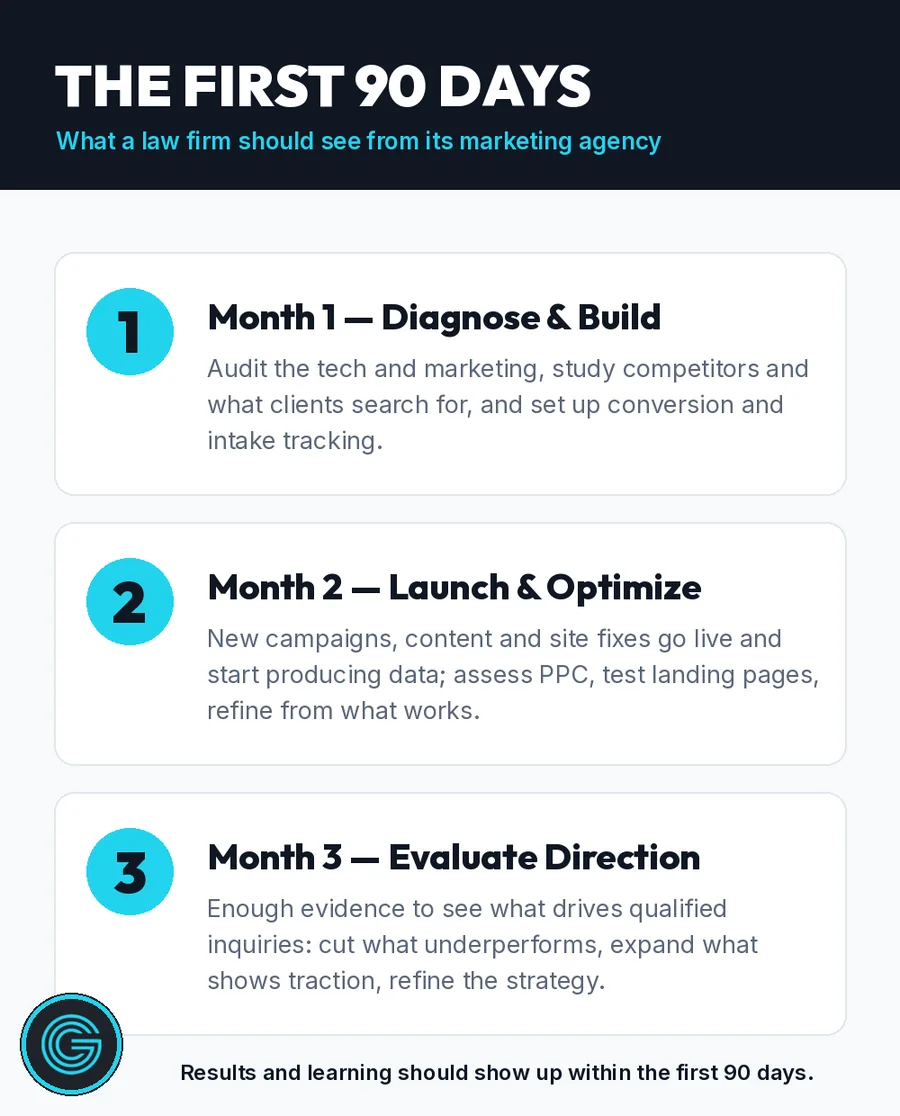
When working with a law firm marketing agency for the first ninety days, it shouldn't just be measured by how many new clients you get. Rather, success should also mean that they are laying down solid groundwork, collecting valuable data, and figuring out what is actually contributing to making marketing efforts effective.
Here's a 3 months breakdown we typically give our clients:
Month 1: Diagnose and Build
For the first month you want to get a good grasp of where things stand now. This includes doing a thorough audit of technology and marketing, looking at what other companies are doing and what people are searching for, setting up or improving tracking of conversions and intake, and reorganizing campaigns or accounts if needed. Also establish clear baseline Key Performance Indicators (KPIs).
Month 2: Launch and Optimize
Starting in the second month, new campaigns, content or website optimization should start producing good data. By this time an agency should be assessing performance of paid search (PPC), testing improvements to landing pages, looking at how people use searches, and looking for any noticeable differences in visibility before waiting passively for the campaign to get going.
Month 3: Evaluate Direction
By the third month, there should be enough evidence to identify which activities are generating qualified inquiries and which aren't. Underperforming campaigns can be adjusted or cut, opportunities showing traction can be expanded, and the broader marketing strategy can be refined based on actual performance.
The key thing is that results and learning should show up within the first 90 days. An SEO campaign hasn't necessarily brought in big numbers yet, but a good agency should be able to demonstrate what they've found out, what has improved, what is currently performing well, and also what their next steps will be.
When Should a Law Firm Expect Actual Leads?

When assessing marketing performance of a law firm, distinguishing between visibility and lead generation is important. An advertising campaign may increase search rankings, attract organic traffic, or enhance visibility locally before that results in a steady stream of high quality inquiries.
PPC and paid search can produce inquiries relatively quickly, sometimes within days or weeks of launching a campaign, because the ads can immediately reach people searching for relevant legal services. However, early leads are not necessarily evidence that the campaign is fully optimized; the first few months are usually about improving targeting, ad copy, landing pages, bidding, and lead quality. The American Bar Association's 2023 technology survey found that 8% of respondents identified AdWords/PPC as a source of marketing leads, compared with 28% for SEO, illustrating that firms use multiple channels to generate opportunities.
SEO and content marketing usually take longer. A law firm may see impressions, rankings, and organic clicks before it sees consistent inquiries from those efforts, particularly when competing for difficult legal keywords. The ABA's 2024 survey found that 90% of responding firms had a website, while 80% reported using social media as a marketing tool, showing how established digital channels have become within legal marketing.
Visibility for local results works similarly too: a company's listing on Google Business and other local listings can start to get better visibility before those results consistently result in consultations or bookings. This is also true for content too; people might find you via an informative article and then leave your site and come back at a later time from a branded search or a direct visit before they call you.
What's important is that visibility and ranking are early signs of things rather than final results. A really good marketing agency should show how visibility is improving along with tracking calls, form completions, high quality leads, consultations and ultimately new customers. This way they can gauge if visibility is really pushing the business forward.
When Should You Expect Marketing to Generate a Return?
Marketing ROI shouldn't rely on just traffic counts; simply having more visitors or higher rankings on search results shows your campaign has gained visibility but does not show whether the company is in fact earning more money. What matters more is this path: marketing budget spent -> leads generated -> qualified leads -> meeting -> signed client -> revenue from cases.
For instance, an advertising campaign of one law firm may yield 200 leads but the number of consultations is small because many leads are outside the firm's practice areas or they live in other service areas that the firm does not cover. Another firm might generate just 50 leads, but they convert a much higher percentage into consultations and actually closed business. So even if there are fewer leads, this firm can still do better financially speaking.
That's why a marketing agency needs to look at more than just clicks, views, traffic and just raw numbers of leads. They need to find out which channels result in getting people to ask questions, which of those questions are high quality ones, which of those consults result in people signing on for services.
Attribution is important here. If data is available, marketing platforms should be integrated with the intake system so that the firm can trace a potential customer from where they first come in contact through the intake process all the way to when revenue comes in. This allows the firm to have a better overall view of whether marketing efforts are bringing in business versus just activity.
What If Your Law Firm Is Getting Traffic but No Clients?
Traffic doesn't guarantee conversion into clients; the problem could lie between when someone lands on your site and gets through your intake process. If a law firm ranks well and attracts high quality visitors who ask for information, they still might miss out on potential clients if their website, landing page or process for handling leads is hard to navigate.
Start by looking at search intent. If a personal injury firm is attracting visitors searching for general information rather than someone actively looking for legal representation, high traffic may produce very few consultations. The same issue can occur when a campaign targets keywords that are relevant to the legal industry but do not match the firm's actual practice areas, case criteria, or geographic coverage.
A landing page can also create a gap: visitors who click on an ad or on a search result need to quickly see what a company does, where they serve customers, why that is important to them personally, and what they should do next. Weak calls to action, confusing navigation, slow loading pages, or generic landing pages waste potential customers too.
There is also intake. Results from the ABA's 2023 Legal Technology Survey indicate that 73% of responding firms collect phone numbers via their websites while only 15% report that they allow potential clients to schedule a first meeting directly online. That difference matters because getting a contact is just the start of trying to acquire new clients.
Responses and follow-ups need attention too. If a company spends money on leads but they don't get a timely response or have to go through a complicated intake process or they are handed over to people who can't quickly decide if something fits their firm, then spending more money on marketing might just result in more lost opportunities anyway for that intake process.
Quality of leads is very important too. They could live outside the firm's service area, want a practice area that the firm doesn't specialize in, look for cases the firm can't take on or they might fail to meet criteria set by the firm. A marketing campaign did what it was supposed to and brought an inquiry but this inquiry wasn't really an actual opportunity for that firm at all.
The ABA research highlights why companies need to go beyond just superficial marketing metrics. In their 2023 report they found that fewer than 20% of respondents receive regular performance reports for marketing activities. Specifically, the ABA strongly recommends regularly tracking marketing data so you can figure out what works and where there are things that need changing.
Marketing creates opportunities but it's intake that decides which of those opportunities will result in actual clients. Before concluding that something like SEO or PPC doesn't work, you need to follow the entire path from when someone searches through advertisements to when they get to your landing page, inquire, respond, qualify their interest, consult with a representative and then sign on the dotted line. A thorough analysis can tell you if the main issue is that you're not drawing the right people, poor conversion of visitors, or just not turning genuine leads into actual clients.
How Do You Know If Your Marketing Agency Is Actually Making Progress?

Before a law firm experiences a big rise in signed cases, a marketing agency should be showing improvement. The main thing is figuring out what metrics improve first and if those improvements are pushing the firm towards better business performance.
Early indicators
In the beginning, look for signs of solid foundations being built. The tracking has to work properly so that the agency can measure things like call responses, submission forms, consultations and other meaningful actions. As the agency learns what keywords, target audience, locations and campaigns produce relevant traffic they should also get more precise targeting.
Technical issues must be pinpointed and solved too. For Search Engine Optimization (SEO), this might involve things like improving indexing speed, internal linking and other issues with the website. Keywords need to start appearing and showing up in search results. Meanwhile, PPC campaigns should collect enough data to figure out which searches, ads, and landing pages are successful. We should also test conversion rates, not just consider them static. Improvements won't happen overnight and won't necessarily result in a big spike of signed cases right away, but we will get better at understanding what works and what needs to change.
Business indicators
The bigger question is whether such improvements actually result in better business performance. Companies should keep track of whether high quality leads rise, if costs per lead that is good quality become more efficient, and if there's an increase in the number of consultations.
The next step is tying together these consultation meetings with actual signed matters. Marketing sources should be followed up during intake so that the firm can figure out which marketing campaigns or channels are contributing to signing cases. Over time the agency should also be able to help the firm assess whether the cost of getting new signed cases is reasonable in comparison to the value of those cases being obtained.
| What to monitor | What it tells you |
|---|---|
| Tracking accuracy | Whether performance data can be trusted |
| Keyword visibility | Whether SEO efforts are reaching relevant searches |
| PPC campaign data | Whether paid campaigns are generating useful performance signals |
| Conversion rate | Whether traffic is taking the desired action |
| Qualified leads | Whether marketing is attracting the right prospects |
| Cost per qualified lead | How efficiently the firm is acquiring viable opportunities |
| Consultation volume | Whether leads are progressing through intake |
| Signed cases | Whether marketing is contributing to actual clients |
| Cost per signed case | Whether acquisition costs make financial sense |
A key test of accountability for an agency isn't just whether they submit reports every month. They also need to explain why certain metrics change. If organic traffic rises, they need to show what factors are behind that rise. If spending on PPC goes up, they have to explain if competition level went up, bids changed, targeting improved or decreased, or something else caused that change. When they see a drop in quality leads, they need to trace where that drop happens along the funnel and explain actions taken to address this issue.
A good marketing report accomplishes more than just showing if sales or other numbers went up or down. It ties those changes to actions taken by the company, explains why this matters to the overall goals of the business, and says what will be done in the future. Metrics alone on a dashboard don't measure accountability as well as that.
When Should a Law Firm Reconsider Its Marketing Strategy?
A key warning sign is the absence of clear measurement of progress or learning. If over time there has been no discernible improvement in targeting, qualified traffic, conversion rates, quality leads, search visibility or other important metrics, it seems like something is amiss. The ABA also recommends that law firms keep track of marketing data and review them regularly to figure out what works and what doesn't and also decide when to shift investments into marketing. However, results of their 2023 survey show that around just 20% of respondents receive regular performance reports from either outside agencies or internal marketing teams.
Another worry is simply reporting statistics without any explanation. A report that shows higher impressions, clicks, rankings or website traffic might look good, but just having high numbers doesn't show that you're acquiring clients better. A marketing agency needs to explain why there was a change; whether that change matters to their goals and what they plan to do next. If performance goes down, they need to identify the likely reasons behind it and explain how they are adjusting their strategy.
The firm should also carefully consider the quality of leads. Just because you get lots of inquiries doesn't mean your marketing efforts are great if they're coming from the wrong specialty area, region or case type. Reports on marketing need to separate raw inquiries from qualified opportunities and link these opportunities to meetings and signed deals as much as the systems of the firm permit.
It is also very important to be accountable regarding account access. A law firm should know who manages things like advertising, analytics, websites and profiles on Google Business as well as other important marketing assets. Having proper access to these accounts reduces reliance on agencies for basic visibility into the firm's digital assets and makes it easier to check what is really going on.
As results keep coming back consistently poor, a strategy needs to adapt. If you're still running the same keywords, campaigns, landing pages and approach with a low return on investment year after year, it's no longer just about marketing taking time. A good strategy should be responsive to performance data rather than sticking rigidly to a predetermined plan forever.
Especially be careful about guaranteed results for rankings or volume of cases. Google makes clear that nobody can actually guarantee number one rank; they advise people not to trust SEOs who promise specific ranking numbers. Google also says third party SEO firms can't guarantee results either. So when we're dealing with competitive legal SEO where results aren't within an agency's control, any claims of quick guaranteed high ranks should sound like a red flag rather than evidence of quality.
It's not about just switching agencies if results are not good. What we want to do is evaluate whether they have a strong plan with clear learning that they report openly and are willing to change their approach if there is evidence for doing so. If those criteria aren't met over time, then it makes sense for a law firm to reevaluate its marketing approach or agency arrangement.
How Long Should a Law Firm Commit to a Marketing Agency?
There is no single fixed length of time that suits all law firms universally. Length of commitment should be determined based on marketing channels used, how strong your digital presence has become, how competitive your practice area is, and how quickly you can collect meaningful performance data.
Paid campaigns start to generate clicks and leads fairly quickly but initial results do not mean they are always at their best performance. An agency has to spend time figuring out what search terms are irrelevant, adjusting targeting and bids, testing different ad copy, and refining landing pages to figure out which campaigns are leading to high quality leads. Therefore, an organization should look at performance progress rather than hoping for immediate full optimization.
SEO takes longer to evaluate. Generally speaking, organic visibility takes time to develop especially for keywords that are highly competitive or popular in certain markets. Value from SEO builds up as relevant pages become visible and get links, establish credibility on topics and then draw organic traffic. Therefore, an evaluation period lasting longer is preferable rather than making quick judgments about an entire strategy just after a short time frame.
We can often assess improvements for websites sooner. Changes to home pages or buttons that users click on, form design, navigation paths, loading times of pages, and ways people get into information processing can result in concrete changes before a bigger SEO campaign is really underway. So we can have shorter goals in a longer marketing project too.
A good approach for a comprehensive campaign is to set both short term goals and long term goals. In the early months, you might work on tracking performance, fixing technical issues, restructuring campaigns, refining targeting and improving conversions. Later on you focus more on things like volume of high quality leads, consultation rates, signed deals and organic growth along with acquisition cost.
It's much better to set a specific deadline of six months rather than just picking one randomly. An attorney should understand clearly what results or accomplishments are expected at each phase, which metrics will be used to evaluate progress, and also what decisions will be made if data indicates something isn't going well.
The goal for marketing commitments should therefore be long enough so that the chosen channels can show what they can do, but also short enough that the company doesn't spend months on a strategy that it can't really assess. The duration is important, but milestones, transparency, and the ability to adjust strategy is equally key.
Ready to Know Whether Your Law Firm Marketing Is Working?
Marketing for law firms shouldn't just focus on driving traffic, clicks, and monthly reports. You also want to see what's working, understand where potential clients are dropping off along the way, and determine if your marketing spending is actually getting you qualified leads, consultations, and new cases.
At GLP Marketing, we can audit your current marketing performance, identify gaps across your SEO, PPC, content, website, and conversion strategy, and uncover opportunities to improve results. If you want a clearer picture of what your marketing is actually delivering, get a free audit. A real person sends it within 48 hours.
FAQs
Here are answers to common questions law firms ask when evaluating how long marketing should take to produce results.
How Quickly Can a Law Firm Get Leads From Marketing?
A law firm gets leads through paid ads in days or weeks. Through Search Engine Optimization (SEO), content marketing and local search efforts, however, it usually takes longer to consistently get inquiries. Also important are things like practice specialty, location, competition level, budget, targeting specifics, and how good the firm is at converting those who show interest into clients.
How Long Does Law Firm SEO Take To Show Results?
SEO from a law firm starts to show some signs of improvement quite quickly, like better rankings, higher impressions and traffic that comes naturally. Generating leads consistently takes longer especially if competition is stiff.
Can a Law Firm Get Results From PPC Immediately?
PPC ads generate clicks and leads very quickly after launching campaigns because ads show up when people actively look for legal help. But campaigns typically require continued testing and refining to improve targeting, lead quality, conversion rates and cost per lead.
How Long Should a Law Firm Give an SEO Agency?
SEO needs time to show real improvement so a law firm shouldn't judge results after just a few weeks. Performance should be measured not just by technical health, ranking for keywords, traffic from organic sources and quality leads but also on longer term growth in search visibility as well.
What Should a Law Firm Expect From Its Marketing Agency After 90 Days?
At the end of 90 days, a law firm should see clear results showing what has actually happened: what was implemented, what lessons were learned, what is working better, and what needs further adjustment. Depending on what mix of channels they used, that could mean doing better targeting, making technical improvements, getting some early ranking advantages, seeing performance from Pay Per Click (PPC), conducting conversion tests and having a better understanding of quality leads.
Why Is My Law Firm Getting Traffic But No Clients?
Traffic isn't converted if you're trying to attract the wrong intent, using subpar landing pages, targeting the wrong geography or practice areas, or offering an unsatisfactory intake process. The firm should follow the journey of traffic through inquiries, qualification, consultations and matters that get signed up to see where prospects are dropping off along the way.