
Discover how a law firm marketing plan template can transform your strategies, enhance visibility, and ensure your firm's lasting success.
In short
A law firm marketing plan template turns scattered ideas into a documented strategy: goals, target clients, budget, channels, and the metrics you'll track. It keeps a firm's marketing consistent and accountable instead of reactive. Start by defining who you serve and what a client is worth, then give each channel a role, an owner, and a number to hit.
A law firm marketing plan template gives your firm one place to plan, run, and measure its marketing. A useful one covers who you are trying to reach, what your competitors are doing, the goals you are chasing this year, how much you will spend, the numbers you will watch, and the specific tactics meant to bring in cases. Skip the blank-page problem and you save weeks. You also give everyone at the firm the same reference point, instead of a marketing effort that lives in one person's head.
At GLP Marketing, we have spent the last five-plus years helping law firms grow through SEO, content, paid ads, and AI-search visibility. Some firms come to us for a full marketing strategy. Others just want an SEO checklist or an advertising plan that keeps them onside with bar rules. Either way, the goal is the same: more of the right calls, not just more traffic. Start with a free audit and we'll show you where your firm stands first.
This guide walks through the parts of a marketing plan that actually earn their place: setting goals, defining who your ideal client is, budgeting, content, social, paid ads, referrals, SEO, reviews, and the reporting that tells you whether any of it worked. By the end you will have a template you can fill in and a way to judge progress that does not rely on gut feel.
What Is a Law Firm Marketing Plan Template?
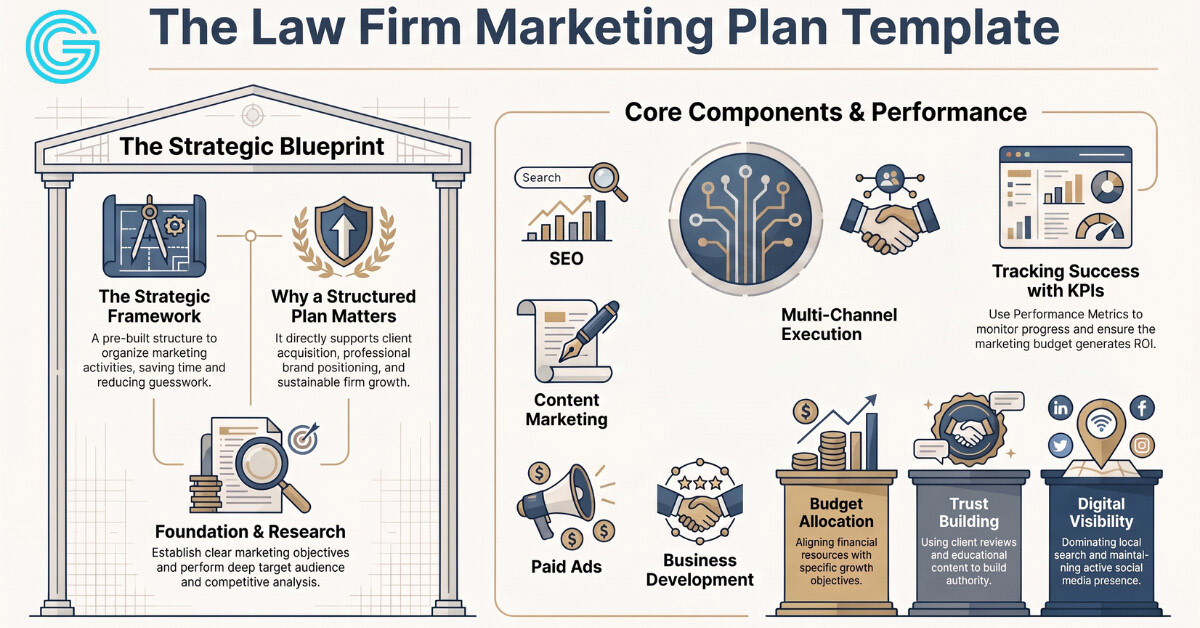
Think of the template as a ready-made outline for your marketing. It gives you a place to write down the strategy, track what is happening, decide where the money goes, and check the results. The firms we work with tend to like it for a simple reason: nothing important slips through the cracks when it is all written in one document.
Instead of starting cold, you fill in the pieces. Who you serve, what you want to achieve, the budget, the metrics, and the campaigns you have planned. A complete template also carves out room for content, SEO, social posts, paid ads, referrals, reviews, and business development. When it all sits in one file, the partner, the office manager, and your marketing vendor are finally reading from the same page.
The U.S. Small Business Administration's Marketing & Sales Guide boils good marketing down to three jobs: know your customers, know your competitors, and build tactics to reach the people you want. A template turns those jobs into a repeatable process instead of a scramble every time you decide to run a campaign.
Most templates open with an executive summary, then move through a client profile, a competitive breakdown, your objectives, the budget, a timeline, and the metrics you will report on. Read top to bottom, it should answer one question: how does this firm plan to win more of the right cases, and how will it know the plan is working?
The right template handles both the old-school and the digital side of the practice. That means SEO, content, Google Ads, social campaigns, in-person networking, referral programs, and review management. A piece like "Web Content for Lawyers" slots into the content section; "Why Does SEO for Personal Injury Lawyers Matter?" belongs with your SEO checklist. The template just tells you where each effort lives.
A template is only as useful as the numbers attached to it. Website traffic, conversion rate, cost per lead, return on ad spend, and consultation requests are the ones worth watching. Check them on a schedule and the guesswork drops out of your next budget decision.
How Do You Create a Law Firm Marketing Plan?

A marketing plan sounds like a big lift until you break it into steps. The firms that grow treat marketing as a standing part of the business, not a project they will get to after the current caseload clears. Build the plan once, keep it current, and it does three things at once: keeps the team pointed the same way, tells you where the budget should go, and gives you a yardstick for progress.
“The firms that grow consistently are the ones with a clear plan. Marketing works best when every tactic supports a larger business objective.”
Matthew Khorsandi, CEO of GLP Marketing
Start with market research. Who is your ideal client, what legal problem sent them looking, and where do they search once they decide they need a lawyer? Google? A referral from a friend? A Facebook group? Answer that and you stop spending money in front of people who will never hire you. While you are at it, look hard at the two or three firms you keep losing clients to. What are they doing that you are not?
Next, run a SWOT analysis covering strengths, weaknesses, opportunities, and threats. It is a short exercise that surfaces where you are already ahead and where you are exposed. A packed referral pipeline is a strength. A website that ranks nowhere for your practice area is a weakness worth naming out loud.
With that picture in hand, set objectives you can actually check. The SMART format keeps them honest: specific, measurable, achievable, relevant, and time-bound. "Grow" is not a goal. "Lift organic traffic 25% by Q2" or "sign 20 new clients from SEO and content this year" is. The Small Business Administration makes the same point, noting that measurable goals are what let you judge performance later instead of arguing about it.
Now build the strategy that gets you there. For most firms that means some mix of SEO, content, social posts, referrals, reviews, networking, and paid ads. The website sits under all of it. If it is slow, hard to read on a phone, or invisible for the keywords your clients type, the rest of the plan leaks. Content pieces like "Great Books for Lawyers" give you something worth linking to and sharing, instead of another thin service page.
Then put real numbers behind it with a budget. Spell out what goes to content, Google Ads, SEO, social, and branding, month by month. A budget on paper does something a budget in your head cannot. It forces a decision when two channels want the same dollar, and it makes the end-of-quarter ROI conversation short.
Decide up front which key performance indicators tell the story. Traffic, conversion rate, consultation requests, cost per lead, return on investment, and what it costs you to land one client. Pick the handful that map to your goals and ignore the vanity numbers. If a metric would not change a decision, it does not belong on the report.
Put it all on a calendar. A plan with no dates is a wish list. Content usually runs on a monthly rhythm; SEO you measure over six months or more, because that is how long it takes to move. Assign each task an owner and a due date, or it quietly does not happen.
Last, review the numbers and adjust. A plan is not a document you write once and file. Client behavior shifts, competitors move, Google changes the rules. Sit down with the data every month, keep what is working, cut what is not, and the plan stays useful instead of becoming a PDF nobody opens.
Implementation Tools

A plan is only as good as your ability to run it, and the right software does a lot of the heavy lifting. Most firms end up with a stack that covers five jobs: a CRM, a social scheduler, analytics, SEO research, and something to keep projects moving. Here is what tends to work, and why.
CRM software is where most firms should start. It tracks every lead, keeps client communication in one thread, and automates the follow-ups that otherwise fall through. Clio Grow, Lawmatics, HubSpot CRM, and Salesforce are the names you will hear most. Lawmatics, for instance, handles scheduling, email sequences, and lead nurturing on autopilot, which matters because the firm that answers an inquiry first usually wins it.
Social media schedulers keep you visible without someone logging in every morning to post. Hootsuite, Buffer, Sprout Social, and Later let you queue a month of posts across Facebook, LinkedIn, Instagram, and X in one sitting, then watch engagement from a single dashboard. Batch the work once a month and social stops being the thing you always forget.
Analytics is how you find out what is actually driving cases. Google Analytics 4 shows where visitors come from, what they do on the site, and which pages turn into contact-form fills. Google Search Console covers the search side: what you rank for, how often people click, and any technical issues holding you back. Both are free, and together they answer the question every partner asks. Where are the clients coming from?
SEO tools take the guesswork out of keyword research and competitor analysis. Ahrefs, SEMrush, Moz, and Surfer SEO all do the core work: finding the terms your clients search, showing who ranks for them, and flagging what is broken on your site. Ahrefs is strong on backlinks and competitor tracking. SEMrush adds position tracking, site audits, and a look at what your rivals spend on ads.
Email platforms keep you in front of the people who already know you: past clients, live leads, and referral partners. Mailchimp, ActiveCampaign, Constant Contact, and HubSpot Marketing Hub handle newsletters, drip campaigns, and the automated check-ins that turn a closed case into a referral six months later.
Project management tools keep the marketing from stalling. Asana, Monday.com, ClickUp, and Trello track deadlines, hand out assignments, and show you at a glance what is late. One shared board beats a dozen email threads. Pick a single system and make everyone use it.
Reputation tools matter more every year. Birdeye, Podium, and Grade.us automate review requests, pull your ratings from Google and Yelp into one place, and flag new feedback so nothing sits unanswered. Most people read reviews before they ever call a lawyer, so this belongs in the plan, not on a someday list.
Conversion tools tell you why visitors leave without calling. Hotjar records anonymized sessions and builds heatmaps, so you can watch where people give up on your contact page. VWO and Optimizely let you test two versions of a landing page against each other and keep the one that books more consultations.
AI tools have earned a spot in the stack, used with a light hand. ChatGPT, Jasper, Grammarly, and MarketMuse speed up drafting, editing, research, and content planning. They can also help you show up in AI search results, where a growing share of clients now start. Just keep a human, ideally an attorney, reviewing anything that goes out under the firm's name.
Law Firm Marketing Plan Template
- Copy the sections below into a document and fill in the blanks. It follows the same order as the plan above.
Executive Summary
- Firm Name: Riverside Injury Law
- Practice Areas: Car accidents, slip-and-fall, wrongful death
- Primary Goal: Book 20 qualified consultations per month
- Target Market: Injured adults across the Riverside metro area
- Timeframe: 12 months
- Budget: $8,000/month ($96,000/year)
- Key Success Metrics: Qualified leads, cost per lead, signed cases
Law Firm Overview
- Mission Statement: Guide injured people through the claims process with honest advice and steady advocacy.
- Unique Value Proposition: Direct attorney access and same-day case reviews for injury claims.
- Competitive Advantages: Local reputation, contingency-fee representation, bilingual intake team
- Geographic Service Area: Riverside County and the surrounding metro
Target Audience
- Ideal Client Profile: Adults recently injured in a vehicle or premises accident
- Legal Needs: Help with medical bills, lost wages, and insurance negotiation
- Pain Points: Mounting medical bills, lowball insurer offers, a confusing claims process
- Demographics: Adults 25-64 within a 30-mile radius
- Awareness Channels: Google search, referrals, social media, Google Business Profile
- Decision-Making Factors: Reviews, response speed, clear fees, local presence
Competitive Analysis
| Competitor | Strengths | Weaknesses | Opportunities |
|---|---|---|---|
| Competitor 1 | Large ad budget, ranks top 3 for core injury terms | Generic content, few recent Google reviews | Outrank on long-tail injury terms they overlook |
| Competitor 2 | Strong Google Business Profile, 400+ reviews | Slow, dated website; weak on mobile | Win mobile searchers with a faster site |
| Competitor 3 | Active on social, recognizable local brand | Thin practice-area pages, no blog | Publish deeper content for research-stage clients |
SWOT Analysis
Strengths
- Strong referral pipeline from past clients and local physicians
- Five-star average across 180+ Google reviews
Weaknesses
- Website ranks on page three for core practice-area keywords
- No consistent content schedule; blog last updated months ago
Opportunities
- Competitors have thin local content for nearby suburbs
- Rising volume of voice and AI-search queries for injury help
Threats
- A larger firm is bidding aggressively on our top Google Ads keywords
- Climbing cost per click across personal-injury search terms
Marketing Objectives
| Objective | KPI | Target | Deadline |
|---|---|---|---|
| Increase website traffic | Organic sessions | +25% organic sessions | Q3 2026 |
| Generate new clients | Qualified leads | 20 qualified leads/month | Q2 2026 |
| Improve visibility | Keyword rankings | Top 3 for 8 core keywords | Q4 2026 |
| Increase consultations | Contact form submissions | +30% form submissions | Q2 2026 |
Marketing Strategy
SEO and Website Optimization
- Optimize website for relevant keywords.
- Complete a law firm SEO checklist.
- Improve website speed and mobile usability.
- Publish practice area pages and blog content.
Content Marketing
- Publish blog posts.
- Create legal guides and FAQs.
- Develop case studies and success stories.
- Build a content calendar.
Social Media Marketing
- Platforms: Google Business Profile, Facebook, LinkedIn, YouTube
- Posting Frequency: 3x per week
- Content Types: Client FAQs, injury safety tips, attorney intros, short video
- Engagement Goals: Reply within 24 hours; grow followers 15% per quarter
Paid Advertising
- Google Ads Budget: $2,000/month
- Social Media Ads Budget: $500/month
- Target Keywords: car accident lawyer, personal injury attorney near me
- Landing Pages: Practice-area pages for auto, premises, and wrongful death claims
Referral and Networking Strategy
- Referral Partners: Chiropractors, physical therapists, past clients
- Bar Associations: State bar and county trial lawyers association
- Community Organizations: Local chamber of commerce and road-safety nonprofits
- Networking Events: Quarterly bar mixers and community sponsorships
Reputation Management
- Review Generation Process: Automated text and email request after each closed case
- Google Review Goal: 10 new reviews per month
- Response Strategy: Reply to every review within 48 hours, professional and specific
Marketing Budget
| Activity | Monthly Budget | Annual Budget |
|---|---|---|
| SEO | $2,500 | $30,000 |
| Content Marketing | $1,500 | $18,000 |
| Google Ads | $2,000 | $24,000 |
| Social Media | $600 | $7,200 |
| Website Maintenance | $400 | $4,800 |
| CRM Software | $300 | $3,600 |
| Other Marketing Activities | $700 | $8,400 |
Implementation Timeline
| Activity | Month 1 | Month 2 | Month 3 | Month 4-6 |
|---|---|---|---|---|
| SEO | Technical audit and keyword map | On-page fixes to core pages | Build local citations and links | Track rankings and refine |
| Content Creation | Content calendar and briefs | Publish 4 blog posts | Add 2 practice-area pages | Ongoing 4 posts per month |
| Paid Advertising | Set up campaigns and tracking | Launch Google Ads, test copy | Optimize bids and keywords | Scale the ad groups that convert |
| Social Media | Profile cleanup and content plan | Post 3x per week, reply to comments | Add short-form video | Hold cadence, review reach |
| Review Campaigns | Set up review-request workflow | Ask recent clients for reviews | Automate the follow-ups | Target 8-10 new reviews per month |
Key Performance Indicators
- Website Traffic
- Organic Search Traffic
- Cost Per Lead (CPL)
- Return on Investment (ROI)
- Lead Conversion Rate
- Consultation Requests
- New Clients Acquired
- Google Business Profile Performance
- Keyword Rankings
Evaluation and Reporting
- Weekly Performance Review
- Monthly KPI Report
- Quarterly Strategy Evaluation
- Budget Review
- Campaign Optimization Plan
Notes and Action Items
- Assign each channel an owner and a monthly reporting date.
- Check that all ad copy and landing pages meet state bar advertising rules.
- Set up GA4 and call tracking before campaigns launch.
- Review budget quarterly and shift spend toward the lowest cost per lead.
What Are the Benefits of a Law Firm Marketing Plan?

“The most successful law firms don't market randomly. They follow a plan that connects every marketing activity to a larger business objective.”
Matthew Khorsandi, CEO of GLP Marketing
The first payoff is visibility. A firm with a real plan shows up: in search results, in social feeds, in front of someone the moment they type "car accident lawyer near me." SEO, content, social, and paid ads each put you in that path. The SBA frames marketing as the work of building awareness and setting yourself apart from competitors. For a law firm, that translates directly into more of the right people finding your website before they find someone else's.
A plan also sharpens client acquisition and retention. When you know exactly who you are talking to, your campaigns speak to a real person with a real problem instead of shouting into the void. Those campaigns pull better leads because they are aimed. And the same discipline, timely follow-up and a check-in after the case closes, keeps past clients sending you the next one.
Budget control is the quiet benefit. Write down where the marketing money goes and overspending gets obvious fast. Every dollar has a job and a number attached to it, which makes the ROI question, is this channel worth it, something you can answer with data instead of a shrug.
A plan gets everyone rowing the same direction. When the whole firm can see the goals, marketing stops being one person's side project. Fewer crossed wires, less duplicated work, faster execution. A shared template does most of that on its own, because the priorities are written down where anyone can check them.
Planning also forces you to look outward. Sizing up competitors, spotting the gaps they have left open, and pinning down what makes your firm the obvious choice sharpens your positioning. It is hard to stand out when you have never actually studied who you are standing next to.
Then there is measurable tracking. Traffic, consultation requests, conversion rate, cost per lead, return on investment: real numbers you can point to. They show what is working, flag what is not, and turn marketing decisions into data calls. As the SBA notes, the businesses that watch their performance are the ones that adapt in time to hit their goals.
Last, a plan strengthens your reputation. Bake in a system for requesting reviews, answering feedback, and putting testimonials where prospects will see them, and the social proof compounds. When someone is deciding between you and two other firms, a wall of recent five-star reviews often makes the call for them.
What Challenges Might You Face?
Every plan hits friction once it meets the real world. The firms that keep moving are the ones that saw the common snags coming and built around them. Here are the ones we run into most, and how to handle each.
The table below pairs each common challenge with a fix that works.
| Challenge | Why It Happens | Potential Impact | Recommended Solution |
|---|---|---|---|
| Budget Constraints | Most firms juggle marketing spend against payroll, rent, and case costs. | Campaigns get delayed, scaled back, or never gain traction. | Stay flexible and fund the high-impact work first, usually SEO, content, and referrals. Let measured return decide where the next dollar goes. |
| Evolving Market Dynamics | Client expectations, trends, and competitor moves shift constantly. | Tactics that worked last year quietly stop pulling their weight. | Keep researching the market and your rivals. Read the performance data often and change the plan when the conditions change. |
| Regulatory Compliance Requirements | Legal marketing has to clear state bar advertising rules and conduct standards. | A misstep risks reputational damage and possible discipline. | Run marketing materials through a compliance checklist before they go live, and loop in your ethics counsel when a claim is borderline. |
| Generating Consistent Leads | Lead volume swings with seasonality, competition, and the economy. | Uneven lead flow makes revenue hard to predict. | Spread your effort across SEO, content, referrals, social, and paid ads so no single channel can sink the month. |
| Low Website Traffic | Weak SEO, thin content, or a dated site keeps you off page one. | Fewer prospects ever find you through search. | Invest in SEO and write content that targets the terms clients actually search. A resource like "Estate Law SEO Services" is a good place to start. |
| Difficulty Measuring Success | Many firms lack clear KPIs or any real reporting system. | Decisions get made on hunches instead of evidence. | Track traffic, conversion rate, cost per lead, and ROI. Review them on a set schedule and adjust from what you see. |
| Maintaining Consistent Branding | Several people or vendors touch the marketing, and the message drifts. | Recognition and trust erode over time. | Write brand guidelines and hold every piece of marketing to them. Consistency is what makes a firm memorable. |
| Limited Time and Internal Resources | Attorneys are billing hours, not building campaigns. | Marketing gets postponed, then dropped. | Lean on templates, automation, and project management tools. Hand the specialized work to an outside team when it makes sense. |
| Managing Online Reputation | A few bad reviews, or no review system at all, drags on credibility. | Prospects pick the firm with the stronger profile. | Run a steady process that asks happy clients for reviews and answers every piece of feedback professionally. |
| Keeping Up With Digital Marketing Changes | SEO, social algorithms, AI search, and ad platforms keep moving. | Firms that stand still fall behind the ones that don't. | Watch the trends and adapt. A piece like "SEO for Family Law and Estate Law" helps you stay current. |
None of these are dealbreakers. Flexible budgeting, steady market research, honest performance tracking, a willingness to change tactics, and a compliance habit will carry a firm through almost all of them.
What Are the Best Practices for Law Firm Marketing?
Start with the fundamentals: a website that ranks and content worth reading. Optimize your site for the terms clients actually search, then back it with genuinely useful writing, such as blogs, plain-English legal guides, FAQs, and short case studies. That is what earns the authority Google rewards, and it is what a nervous prospect reads at 11 p.m. before deciding to call.
Use social media like a person, not a billboard. Facebook and LinkedIn are good places to answer questions, share something useful, and stay familiar to people who might need you later. Post to be helpful. The firm that only ever sells gets scrolled past.
Put your reviews to work. Social proof is still one of the strongest nudges in a client's decision. A steady stream of recent testimonials reassures the person comparing you against two other attorneys. Build a simple, repeatable way to ask for reviews, then feature them on your site, your Google Business Profile, and your ads.
Feed your referral network. A lot of good cases still come from past clients, fellow attorneys, and people who know your work. Stay in touch with a quick note, a coffee, or a thank-you when they send someone your way, and those relationships keep producing.
Let the data drive. Traffic, conversion rate, consultation requests, cost per lead, and return on investment tell you where to put the next dollar. The SBA's guidance is blunt on this point: keep measuring, because that is how you learn what is working and where to adjust. Numbers beat opinions every time the budget comes up.
Keep tuning it. Nothing about marketing holds still. Clients change, trends shift, and search engines rewrite the rules. A monthly look at what each campaign actually did keeps you honest and points to the next fix. You are refining based on results, not on what felt right in the planning meeting.
Make those updates routine rather than reactive. When search behavior shifts or AI-driven results change how people find lawyers, your content and SEO should move with it instead of trailing a year behind.
Finally, keep the branding consistent. Your site, your social profiles, your ads, and your client emails should sound like the same firm and make the same promise. That repetition is what makes you recognizable, and what keeps you top of mind the day someone finally needs a lawyer.
Want to Elevate Your Law Firm's Marketing Strategy?
A real marketing plan is what keeps a firm competitive when everyone in town is bidding on the same keywords. Done well, it lifts your visibility, brings in new clients, deepens the relationships you already have, and, because the KPIs are built in, actually shows you the return. The firms that write it all down tend to grow more steadily than the ones running on instinct.
The firms that pull ahead do not treat SEO, content, social, referrals, and reviews as separate errands. They wire them into one strategy that feeds itself. A template is how you get there without reinventing the wheel: it organizes the work, keeps the budget honest, tracks the metrics, and holds the team to the same goals. Whether you are chasing traffic, better leads, or name recognition, the plan is the frame that holds it together.
Ready to move faster? GLP Marketing does this for law firms every day, from SEO and content to paid ads, website optimization, and growth strategy built around how legal clients actually search and hire. Contact us today and we'll point you to the quickest wins for your firm.
FAQs
A few questions come up again and again when firms sit down to build a plan. Here are straight answers to the ones we hear most.
What Are The Key Components of a Law Firm Marketing Plan Template?
At minimum: an executive summary, a target-audience profile, your objectives, the budget, a competitive analysis, and the KPIs you will track. Good ones go further and spell out the specific tactics, a month-by-month timeline, and exactly how you will measure whether it worked.
How Can I Create a Successful Marketing Strategy For a Law Firm?
Start with research into who your ideal client is and where they look for a lawyer, then set measurable, SMART goals. From there, build a strategy that blends SEO, content, social, paid ads, and referrals, and commit to checking the numbers so you can adjust as you go.
Are There Any Free Law Firm Marketing Plan Templates Available Online?
Plenty. Agencies, bar associations, and business sites all publish free templates, including the one in this guide. The catch is that a generic template only gets you started. Tailor it to your practice areas, your clients, and your goals, or it stays generic.
What Are The Best Practices For Promoting a Law Firm Through Digital Marketing?
Get the online basics right first: SEO, useful content, real engagement on social, and active review management. Publish consistently, watch what the analytics tell you, and adjust. That combination is what steadily pulls in qualified leads.
How Can Social Media Be Leveraged in a Law Firm Marketing Plan?
It is mostly about trust and staying visible. Sharing plain-English legal insight on Facebook and LinkedIn builds credibility, keeps you familiar to people who might need you later, and sends interested readers back to your site. Think relationships first, promotion second.
Using a law firm marketing plan template: common questions
What should a law firm marketing plan template include?
At minimum: who you're trying to reach, your goals with real numbers, the channels you'll use and the budget behind each, who owns what, and how you'll measure results. A good template also has a spot for your practice-area focus and your competitors. The point is a one-page view of what you're doing and how you'll know it's working.
How is a template different from an actual strategy?
The template is the container; the strategy is what you put in it. A blank template won't tell you to prioritize search over billboards or which practice area to push; those are judgment calls you make. Think of the template as the questions and your strategy as the answers. Filling it in honestly is what forces the real thinking.
How often should I update the plan?
Review it quarterly and rewrite it once a year. Marketing plans go stale when they sit in a drawer after being written once. A quick quarterly check (what's working, what's not, where's the budget going) keeps it useful. The annual pass is where you reset goals and reallocate based on what the year actually taught you.
Who at the firm should own the marketing plan?
One person, named in the plan. It can be the managing partner, an office manager, or an outside partner, but shared ownership usually means no ownership and the plan quietly dies. That person doesn't have to do every task; they keep the plan alive, watch the numbers, and make sure things actually happen instead of just being written down.
Can a solo or small firm use the same template?
Yes, a template scales down cleanly. A solo firm just fills it in with fewer channels and a tighter budget, which is honestly healthier than trying to do everything. The discipline of naming your audience, goals, and one or two focused channels matters more at a small firm than at a big one, because you have less margin to waste.