
Knowing how to choose a legal marketing agency starts with looking beyond big promises and polished sales pitches.
In short
Knowing how to choose a legal marketing agency starts with looking beyond big promises and polished sales pitches. The right agency should understand your law firm's goals, practice areas, target audience, marketing budget, and the legal industry's unique advertising and ethical requirements. We recommend choosing a legal marketing partner with specialized knowledge, a proven track record, transparent reporting, and a strategy tailored to helping your firm attract qualified leads.
At GLP Marketing, we have over 5 years of experience in providing consulting CMO services with an emphasis in AI SEO and complete marketing attribution. Our case studies include a family law and estate litigation firm that grew from 3,299 to 15,835 monthly organic visitors in 12 months, and a lemon law firm whose monthly organic visitors went from 240 to 54,700, as reported from Search Console screenshots captured at the time. If your firm wants to show up in traditional search and AI-powered results, get a free audit of how your firm shows up on ChatGPT and Google, sent within 48 hours.
In this guide, we'll explain how to define your marketing goals, evaluate a legal marketing agency's expertise and track record, compare proposals, assess reporting and pricing, and identify red flags before signing a contract. We'll also cover what questions to ask, how to set a realistic marketing budget, and how to choose a marketing partner that can support both your short-term lead generation and long-term growth.
Why Choosing the Right Legal Marketing Agency Matters
Choosing a legal marketing agency is not simply about finding a company that can run Google Ads, manage social media, or publish content. The agency you choose can influence how effectively your law firm marketing reaches potential clients, how efficiently you use your marketing investment, and whether your strategy creates sustainable growth. As Matthew Khorsandi, CEO of GLP Marketing, puts it, "The right marketing agency should not simply generate activity for your law firm. It should understand your business goals and build a strategy that connects marketing performance to meaningful growth."
The legal industry's digital landscape is highly competitive, and maintaining a strong online presence is no longer optional for most firms. The American Bar Association's 2024 Legal Technology Survey found that 90% of responding law firms had a website, including 91% of firms with two to nine attorneys and 98% of firms with 10 to 49 attorneys. The ABA also found that 70% of solo practitioners had a website, showing how widespread digital competition has become across firms of different sizes. When most of your competitors are already investing in their law firm's website, search engine visibility, and digital marketing, choosing the right legal marketing partner becomes essential to standing out.
The cost of choosing the wrong agency can also extend beyond the monthly management fee. Ineffective marketing efforts can consume money without generating qualified leads, while poorly targeted campaigns may attract website traffic from people who are unlikely to need your legal services. The ABA's 2023 Websites & Marketing TechReport found that only 19% of respondents using an external agency reported receiving regular marketing performance reports, making transparency particularly important when evaluating legal marketing companies. If an agency cannot clearly show what is happening with your budget and campaigns, it becomes much harder to identify ineffective spending and make informed decisions.
Attracting qualified leads should be another reason to choose carefully. More traffic is not necessarily better if the visitors do not match your target practice areas or are unlikely to become clients. A family law firm, for instance, may need a very different marketing strategy from a personal injury lawyer or an estate planning firm's approach, including different keywords, content, local SEO priorities, and targeted marketing campaigns. The right agency's expertise should help your firm focus on the prospective clients most relevant to your services rather than pursuing vanity metrics that look impressive but do not support client acquisition.
Finally, effective legal marketing should support both immediate opportunities and long-term growth. PPC and paid advertising can help generate visibility quickly, while law firm SEO, content marketing, reputation building, and other long-term strategies can strengthen your firm's visibility over time. The ABA has specifically emphasized that firms should track data and review it regularly to understand what is working, where to invest, and what changes may be needed to their marketing budget. That is why we recommend looking for an agency that can balance short-term lead generation with a sustainable strategy, instead of promising quick wins at the expense of lasting results.
Steps To Take in Choosing A Legal Marketing Agency

Choosing a legal marketing agency should be a structured process rather than a decision based solely on pricing, rankings, or a persuasive sales presentation. In our experience, the best law firm marketing agency for your firm is one that understands your goals, has the right specialized knowledge, communicates transparently, and can build marketing strategies around your specific practice areas and market.
The following steps can help you evaluate legal marketing companies and find the right legal marketing partner for sustainable growth.
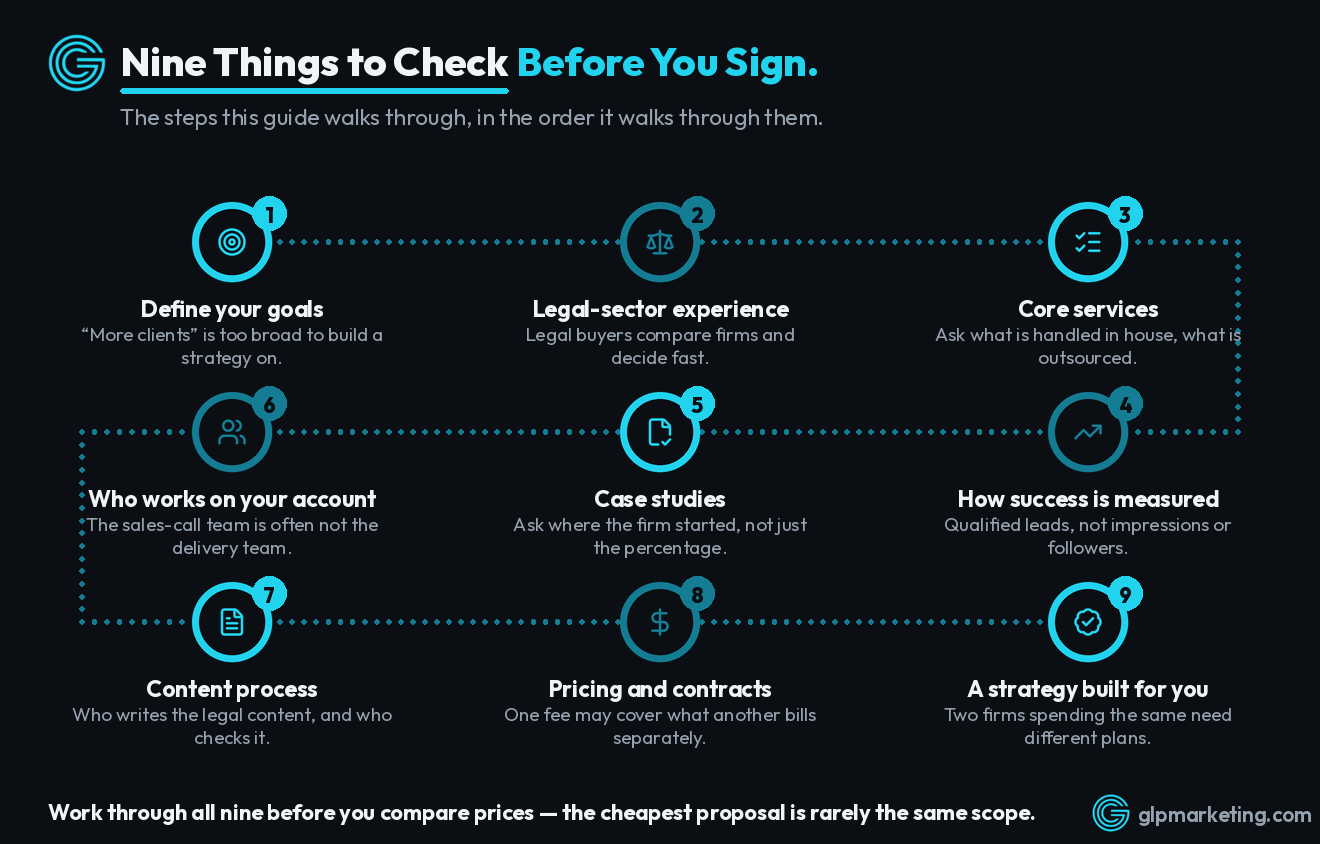
Start by Defining Your Law Firm's Marketing Goals
Before you start comparing proposals or sitting through agency sales calls, get clear on what you want marketing to do for your firm. "We want more clients" is understandable, but it is too broad to help an agency build a useful strategy. A personal injury firm looking for more qualified accident cases may have very different priorities from a firm trying to establish itself in family law, employment law, criminal defense, immigration law, or estate planning.
Give the agency something concrete to work toward. Maybe you want to increase consultation requests, improve your visibility on search engines, bring in more qualified leads from a particular practice area, expand into a new city, or get more value from the traffic already reaching your website. You might also be focused on strengthening brand awareness or staying connected with existing clients who could later refer someone to your firm.
It helps to know where you are starting, too. Look at your current website traffic, lead volume, consultation requests, conversion rates, and the sources currently sending people to your site. Without a baseline, it becomes difficult to tell whether the agency has actually improved anything six months later.
There is also a balance to strike between what you need now and where you want the firm to be a year or two from now. Paid advertising can put your firm in front of potential clients quickly, while law firm SEO, content marketing, and brand building usually take longer to gain traction. Your marketing budget does not have to treat those goals as an either-or decision. A good strategy can address immediate lead generation while continuing to invest in assets that may bring in business over the long term.
Look for Experience in Legal Marketing
A talented general digital marketing agency can bring useful skills to the table, but legal marketing comes with challenges that do not exist in every industry. People looking for a lawyer are often dealing with a problem they want solved quickly. They may compare several firms, search using very specific terms, and make decisions based on trust before they ever fill out a contact form.
That changes how marketing needs to work. Someone searching for a "car accident lawyer near me" is at a different stage from someone reading about whether they have grounds for a criminal defense or employment law claim. A good legal marketing agency should understand that search behavior, recognize which competitive keywords are worth pursuing, and know how to connect different practice areas with the right content and marketing strategy.
Experience across the legal industry matters as well, but ask for details rather than accepting a simple yes. The approach used for personal injury firms will not necessarily translate to estate planning, family law, immigration law, or employment law. Find out what the agency has done for firms facing challenges similar to yours and how it adjusted its strategy to fit the market.
You should also ask about its understanding of attorney advertising rules, client confidentiality, and other ethical considerations that can affect legal marketing. A general agency is not automatically the wrong choice. If it has strong technical, creative, or advertising expertise, it may be capable of producing excellent work. But if your firm becomes its first real introduction to the legal industry, you need to decide whether you are comfortable paying for that learning curve.
Evaluate the Agency's Core Services
A strong law firm marketing agency does not necessarily need to provide every marketing service available. However, it should have the capabilities required to support your marketing goals and explain how its services work together. Before signing a contract, ask what the agency actually handles internally, what may be outsourced, and how each service contributes to attracting potential clients and improving your law firm's visibility.
SEO for Law Firms
Search engine optimization is often a core part of effective legal marketing because it helps law firms improve their visibility when prospective clients search for relevant legal services. However, good law firm SEO involves much more than adding keywords to pages.
"Effective SEO for law firms requires a complete strategy. Technical performance, local visibility, content quality, and authority all need to work together if you want to compete for valuable legal searches." (Juan Reyes, Head of SEO, GLP Marketing)
When evaluating an SEO agency, ask about its approach to technical SEO, local SEO, legal content strategy, link building, and the development of practice area and location pages. You should also ask how the agency approaches highly competitive keywords and what timeframe it expects for meaningful progress. An agency that promises guaranteed first-page Google rankings should be approached cautiously, as no legitimate SEO agency can control Google's algorithm or guarantee a specific ranking.
Content Marketing
Content marketing helps law firms demonstrate legal expertise, answer questions potential clients are already asking, and build authority over time. The quality of that content matters, especially when legal information can influence important decisions.
"Legal content should do more than fill a website with keywords. It should answer real questions, reflect genuine expertise, and give potential clients a reason to trust the firm behind it." (Chidinma Enemanna, Head of Content, GLP Marketing)
Ask who researches and writes the content and whether the agency has experience producing attorney-focused thought leadership, high-quality legal blogs, and practice-area website content. A strong content strategy should also consider credibility signals associated with experience, expertise, authoritativeness, and trustworthiness, while incorporating attorney insights where appropriate.
Generic or duplicate content can weaken your firm's online presence rather than strengthen it. We recommend asking how the agency develops original content and how it incorporates your firm's unique experience, perspective, and legal expertise into its content marketing strategies.
Paid Advertising
Paid advertising can provide immediate visibility for law firms, making it useful when your firm wants to generate leads while longer-term strategies such as SEO develop. Depending on your location and practice area, services may include Google Ads, Local Services Ads where applicable, and other forms of digital advertising.
The agency should be able to explain its approach to targeted marketing campaigns, landing page strategy, audience targeting, and cost-per-lead monitoring. High website traffic or a large number of clicks does not necessarily mean a campaign is successful. The more important question is whether your paid advertising budget is generating qualified leads and consultation requests at a sustainable cost.
We recommend asking how the agency monitors cost per qualified lead, how often campaigns are optimized, and whether management fees and ad spend are clearly separated in your marketing investment.
Website Design and Conversion Optimization
Driving potential clients to a poorly performing law firm's website can waste even the strongest marketing budget. Your website should make it easy for visitors to understand your legal services, trust your firm, and take the next step.
"Traffic only creates value when the website gives visitors a clear and seamless path to take action. Speed, mobile experience, usability, and lead capture all play a role in conversion." (Jovan, Head of Development, GLP Marketing)
Ask whether the agency evaluates mobile experience, page speed, user experience, clear calls to action, and lead capture opportunities. For instance, a personal injury lawyer running paid campaigns may need dedicated landing pages that directly address the needs of someone seeking immediate legal help rather than sending every visitor to the firm's homepage. A good agency should also explain how it plans to measure and improve website conversions over time instead of treating website design as a one-time project.
Reputation and Brand Management
Your firm's reputation can influence whether prospective clients choose to contact you after finding your website or online listing. Reputation and brand management may include support with online reviews, attorney and firm positioning, and consistent messaging across different marketing channels.
The goal is not simply to collect as many reviews as possible. Your marketing partner should help you build a credible online presence that accurately represents your firm and provides potential clients with consistent reasons to trust your legal services.
Ask How the Agency Measures Success
A reputable agency should be comfortable explaining exactly how it measures marketing performance. We recommend looking beyond vanity metrics such as total impressions, social media followers, or raw website traffic.
Instead, ask how the agency tracks qualified leads, organic traffic quality, keyword visibility, conversion rates, cost per qualified lead, consultation requests, and signed cases where that tracking is available. You should also understand how the agency calculates return on marketing investment and what limitations exist when connecting a marketing campaign to actual revenue.
Clear, transparent reporting is essential. Ask how frequently you will receive reports, what data you will have access to, and whether you can view your Google Analytics, Google Ads, Search Console, or other relevant accounts directly.
Review Case Studies and Past Results
Case studies can tell you a lot about an agency, but impressive screenshots and big percentage increases only tell part of the story. Look for examples involving law firms with similar practice areas, markets, or growth challenges, then dig into what happened behind the headline.
Ask where the firm started, what problems it was trying to solve, and what the agency actually did. If a case study says organic traffic increased by 200%, for example, find out whether the starting traffic was 100 visitors a month or 10,000. You should also ask how long the results took. SEO, particularly in competitive legal markets, rarely produces meaningful results overnight, and an agency should be comfortable discussing the work and timeframe behind its success.
It is worth asking whether the results can be independently verified, too. Past performance can demonstrate an agency's expertise, but it does not mean every law firm will get the same outcome. Your website, budget, competition, practice areas, and local market all matter. A credible agency will show you what it has achieved without turning those results into a guarantee.
See the Cali Lemon Lawyers case study →
Understand Who Will Actually Work on Your Account
A strong sales call does not necessarily mean the same people will be working on your campaigns after you sign the contract. Ask who will manage your account day to day and who will be responsible for the actual work.
Depending on the services you need, that could include SEO specialists, content strategists, legal writers, paid media specialists, developers, and senior team members. You should know who your main point of contact is, how often you will receive updates, and what happens when you need a quick answer or want to discuss a change in strategy.
This matters more than many firms realize. Marketing works best when the agency has enough information to understand what is happening inside the business. If your firm opens a new office, adds a practice area, changes its intake process, or notices that a particular type of case is becoming more valuable, the marketing team needs to know. Without regular communication, even a well-planned strategy can start working from outdated assumptions.
Ask About the Agency's Content Process
For many law firms, content becomes one of the largest ongoing marketing investments. That is why you should know how it is produced before agreeing to a monthly content package.
Ask who researches and writes the legal content and how the agency checks it for accuracy. Find out what sources the writers use and whether there is a process for involving attorneys when a topic requires specific legal insight. The goal should be content that reflects your firm's knowledge and answers questions your potential clients are genuinely asking, not a collection of interchangeable articles with your firm's name added at the top.
You should also ask how the agency avoids duplicate or overly generic content. A useful test is simple: remove the firm's name from a draft. If the same article could sit comfortably on the website of any other law firm in the country, it probably is not doing much to distinguish your business.
Do not overlook ownership either. Clarify who owns the content after publication and what rights your firm has to continue using it if you change agencies. The same conversation should cover other assets created during the relationship.
Check for Transparency in Pricing and Contracts
Before you compare prices, make sure you are comparing the same thing. One agency's monthly fee may include strategy, content, reporting, and account management, while another may charge separately for each service. A proposal can look inexpensive until you discover that ad management, content creation, website updates, or reporting come with additional costs.
Ask exactly what the monthly fee covers and whether your advertising budget is separate. You should also understand any setup fees, minimum contract periods, renewal terms, and cancellation requirements. There is nothing inherently wrong with a longer contract, especially for services like SEO that need time, but the work you are paying for should be clearly defined.
Ownership deserves the same level of attention. Confirm what happens to your website, content, analytics data, advertising accounts, and other marketing assets if the relationship ends. If an agency cannot answer these questions clearly before you sign, that lack of transparency is worth taking seriously.
Look for a Customized Strategy, Not a One-Size-Fits-All Package
Two law firms can spend the same amount on marketing and need completely different strategies. Practice area, location, competition, growth targets, existing brand awareness, and the firm's capacity to handle new leads all influence where the budget should go.
An estate planning firm serving a specific local market, for instance, may get more value from local SEO, helpful website content, and a strong Google Business Profile. A personal injury firm competing in a major city may need a much more aggressive mix of SEO, paid advertising, content, and conversion optimization. Neither approach is automatically better. It depends on what the firm is trying to achieve and what the market demands.
The strategy should not stay frozen either. As your firm adds attorneys, expands into new locations, enters different practice areas, or reaches a new stage of growth, your marketing priorities may change. The right law firm marketing agency should be able to adjust with you rather than continuing to sell the same package simply because that is what you signed up for on day one.
Red Flags To Watch Out For When Choosing a Legal Marketing Agency
The National Center for State Courts reports that lawyers represent both sides in less than 25% of cases in state courts, while in some high-volume dockets, including family law, 80% to 90% of cases have at least one party without a lawyer. The figures highlight the significant gap between people with legal needs and those who ultimately obtain representation, creating an important opportunity for law firms that can effectively reach and engage the right prospective clients. However, this also makes choosing the right marketing partner critical because simply generating more website traffic is not enough; your agency should help you connect your legal services with qualified people actively looking for the help your firm provides.
One major red flag is an agency offering guaranteed No. 1 rankings. Search engine rankings depend on many factors, including your current website, competition, Google's algorithm, and the quality and authority of competing websites. No SEO agency can control all of those variables, so we recommend being cautious when an agency promises specific rankings for highly competitive keywords. A reputable law firm SEO agency should explain its strategy, expected milestones, and how it plans to measure progress rather than guaranteeing results it cannot fully control.
You should also be wary of promises of instant results. Some digital marketing strategies, particularly Google Ads and other forms of paid advertising, can generate visibility quickly. However, SEO, content marketing, and brand-building strategies typically require more time to produce meaningful results. For example, an agency that promises to make a personal injury lawyer rank immediately for a competitive search term like "car accident lawyer" should be able to explain exactly how it plans to achieve that result. If the promise sounds too good to be true, it is worth asking more questions.
Unclear pricing is another warning sign. Before making a marketing investment, your firm should understand exactly what the monthly fee covers and whether advertising spend, content creation, website development, or other services cost extra. Ask about setup fees, contract terms, and additional charges that may arise later. A lower proposal is not necessarily the better option if important services are excluded or the agency cannot clearly explain where your money is going.
A lack of access to your marketing data should also raise concerns. Your firm should have appropriate access to the accounts and information used to track marketing performance, including website analytics, advertising accounts, and relevant SEO data. An agency that controls your data without giving you visibility makes it difficult to verify results, understand what you are paying for, or continue your marketing efforts if the relationship ends. We recommend confirming account ownership and access before signing any contract.
Be cautious of agencies producing generic content with little legal expertise. Legal content should reflect your specific practice areas, target audience, and actual legal knowledge rather than using interchangeable articles that could appear on any law firm's website. Ask who researches and writes the content, how accuracy is reviewed, and how the agency incorporates attorney insights. This is particularly important for firms in specialized areas such as family law, criminal defense, employment law, or immigration law, where clients may have very different concerns and search behavior.
Long contracts with unclear deliverables can also become a problem. A longer partnership is not automatically a bad sign because strategies such as SEO may require sustained investment. However, the agency should clearly explain what it will do each month, what deliverables you can expect, how marketing performance will be reported, and what happens if you decide to end the relationship. You should also understand who owns your website, content, data, and other marketing assets.
Poor communication is another red flag we recommend taking seriously. If an agency is difficult to reach during the sales process, gives vague answers to important questions, or cannot clearly identify who will work on your account, those problems may continue after you become a client. A successful partnership requires regular communication, particularly when your firm needs to provide feedback, share attorney insights, or respond to changes in your practice areas and business goals.
Finally, be cautious if an agency shows an unwillingness to explain its strategy. You do not need to understand every technical aspect of search engine optimization or digital advertising, but your agency should be able to explain what it is doing, why it is doing it, and how it will measure success. A transparent legal marketing partner should be comfortable discussing qualified leads, website traffic quality, keyword visibility, conversion rates, cost per lead, and return on marketing investment.
Questions to Ask Before Hiring a Legal Marketing Agency

Before signing with a legal marketing agency, we recommend asking detailed questions about its experience, strategy, reporting, and working process. The answers can tell you whether the agency has the specialized knowledge to support your law firm or is simply offering a generic digital marketing package. A good marketing partner should be transparent, set realistic expectations, and clearly explain how it plans to help your firm attract potential clients.
Have You Worked With Law Firms in Our Practice Area? Not every law firm needs the same marketing strategy. A personal injury lawyer competing for high-value accident cases faces a different search landscape from a family law, estate planning, employment law, criminal defense, or immigration firm. Ask for examples of work involving firms similar to yours and find out what challenges the agency faced, not just the results it achieved. Experience in legal marketing is useful, but relevant experience in your practice area can give the agency a much better starting point.
How Will You Develop Our Marketing Strategy? You should be able to understand why the agency is recommending each part of the strategy. It should take into account where your firm is today, who you want to reach, the markets you serve, your competition, and what you can realistically invest. If your immediate priority is generating leads, paid advertising may play a larger role. If you are building for the long term, SEO and content marketing may deserve more attention. The point is not to find an agency offering every service, but one that can explain why its approach makes sense for your firm.
What KPIs Will You Report On? Ask what the agency will actually measure. A report full of impressions and page views can look encouraging without telling you whether the marketing is bringing in the right people. Depending on your goals, more useful metrics may include qualified leads, consultation requests, conversion rates, organic traffic quality, keyword visibility, cost per lead, and return on marketing investment. Just as important, ask how often you will receive reports and whether someone will walk you through what the numbers mean.
How Long Should We Expect Before Seeing Meaningful Results? This is one of the questions that can quickly separate realistic agencies from those making promises to win a contract. PPC campaigns can generate traffic and leads relatively quickly, but SEO is a different investment and may take six to 12 months to show meaningful progress, particularly in competitive legal markets. Be wary of anyone promising immediate success across every channel. A good agency should give you a timeline based on your starting point and explain what progress may look like along the way.
Who Will Manage Our Account? The person who sells you the agency's services may not be the person doing the work. Ask who your day-to-day contact will be, who is responsible for execution, and whether specialists in SEO, paid media, content, and web development will be involved when needed. You should also know how often you will hear from the team. Clear communication can make a major difference, particularly when the agency needs feedback from your attorneys or your firm's priorities change.
How Do You Handle Legal Content Accuracy? This question matters because legal content is not the same as writing a product description or a general business blog. Find out who researches and writes the content, what sources they rely on, and how they deal with complex legal topics. Ask whether attorneys have an opportunity to review content and how the agency incorporates your firm's actual legal expertise. You do not want pages filled with generic advice that could belong to any law firm.
What Tools and Platforms Will We Retain Access To? Make sure you know who owns the accounts before work begins. Your firm should have access to important platforms such as Google Analytics, Google Search Console, Google Ads, your website CMS, CRM, and any call-tracking software being used. Losing access to data and accounts when changing agencies can create unnecessary disruption, so it is better to settle ownership and permissions at the start rather than argue about them later.
What Happens If We End the Relationship? No one enters a new partnership expecting it to fail, but this is still a question worth asking. Find out what happens to your website, content, SEO work, advertising accounts, data, and other assets if you decide to leave, and check the contract for cancellation terms and notice requirements. A clear exit process protects both sides and gives your firm the freedom to make a change without losing the marketing assets it has spent time and money building.
How to Compare Legal Marketing Agencies
When comparing legal marketing agencies, we recommend looking beyond the lowest price or the longest list of services. The right legal marketing partner should offer a strategy that aligns with your firm's goals, provide specialized knowledge of the legal industry, and communicate clearly about how your marketing investment will be used.
| Comparison Factor | What to Look For | Questions to Ask |
|---|---|---|
| Strategy, Not Just Price | A customized strategy based on your practice areas, target audience, competitive landscape, and marketing goals rather than a generic package. | How will your strategy be tailored to our firm, and why are you recommending these specific services? |
| Expertise and Specialization | Experience in legal marketing, familiarity with law firm SEO, attorney advertising considerations, and the challenges of marketing different practice areas. | Have you worked with law firms like ours, and what relevant results have you achieved? |
| Transparency | Clear pricing, defined deliverables, realistic expectations, and straightforward information about what is included in the monthly fee. | What are we paying for, are ad costs separate, and are there any additional fees? |
| Reporting Methods | Regular reporting with actionable metrics rather than vanity metrics alone, including qualified leads, website traffic quality, conversions, cost per lead, and marketing ROI. | What KPIs will you report on, how often will we receive reports, and will we have access to our data? |
| Communication and Responsiveness | A clear point of contact, consistent communication, and a team that responds to questions and provides updates without excessive delays. | Who will manage our account, how often will we meet, and who should we contact when we need support? |
| Understanding of Business Goals | An agency that takes time to understand your revenue goals, growth plans, ideal clients, practice areas, and the difference between short-term and long-term objectives. | How will you connect our marketing strategy to our firm's specific business and growth goals? |
Are You Looking For a Legal Marketing Agency?
Choosing the right legal marketing agency can have a lasting impact on your law firm's visibility, lead generation, and long-term growth. The best partner will take the time to understand your practice areas, business goals, target audience, competitive market, and realistic marketing budget before recommending a strategy. Rather than chasing guaranteed rankings or quick wins, look for an agency with specialized legal marketing expertise, a proven track record, transparent reporting, and a clear approach to measuring results.
At GLP Marketing, we understand that effective law firm marketing is not one-size-fits-all. We work with law firms to develop customized strategies that combine law firm SEO, content marketing, website optimization, paid advertising, and other digital marketing services based on what the firm actually needs to grow.
Ready to find the right marketing partner for your law firm? Start with a free audit of how your firm shows up on ChatGPT and Google. You get it within 48 hours.
Frequently Asked Questions
Here are answers to some of the questions law firms ask most often.
What Does a Legal Marketing Agency Do?
A legal marketing agency helps law firms attract and engage potential clients through services such as SEO, content marketing, paid advertising, website optimization, social media, and reputation management. The stronger agencies go further by tailoring those efforts to the firm's practice areas, audience, market, and growth plans.
How Much Does a Legal Marketing Agency Cost?
There is no single price because costs depend on what the agency is doing, how competitive your market is, and how much support your firm needs. Before signing, find out exactly what the fee covers and whether ad spend, content creation, website work, or other services will be billed separately.
Should a Small Law Firm Hire a Marketing Agency?
It can make sense for a small law firm, especially if the attorneys do not have the time or in-house expertise to manage marketing themselves. The agency should not simply sell the firm its largest package, though; it should help prioritize the channels that make sense for the firm's goals and budget.
How Long Does Legal SEO Take To Work?
SEO is usually a longer-term investment, and meaningful progress can take six to 12 months, depending on your website, practice area, competition, and market. Paid advertising can deliver visibility sooner, but consistent SEO can continue building your firm's presence long after an individual campaign ends.
Can a Marketing Agency Guarantee Law Firm Leads?
No agency can honestly guarantee a specific number of leads because demand, competition, budget, and your firm's ability to convert inquiries all affect the outcome. What an agency should be able to do is explain its approach, set reasonable expectations, and show you how it is tracking lead quality and marketing performance.
What Should I Ask Before Hiring a Legal Marketing Agency?
Start with the basics: Who have they worked with, how will they build your strategy, what results will they measure, and who will actually manage your account? You should also ask about pricing, reporting, content accuracy, access to your marketing data, and what happens to your assets if you decide to end the relationship.
Should I Hire a Legal Marketing Specialist or a General Agency?
A specialist may have an advantage if your firm needs someone who already understands law firm SEO, legal content, attorney advertising considerations, and the way legal clients search online. A general agency can still be a good choice, but ask how it plans to handle the legal industry's specific requirements before assuming broad marketing experience will be enough.