
The best marketing for family lawyers combines local SEO, helpful content, a credible reputation, and targeted paid advertising, so the right clients find you when they need help.
In short
So, what's the best marketing for family lawyers? For most family law firms, the strongest approach combines local SEO, helpful content, a credible online reputation, and targeted paid advertising, rather than relying on one channel alone. The goal is to show up when someone needs a family lawyer and give them enough confidence to make the call.
At GLP Marketing, we help law firms build stronger online visibility and turn marketing into a real growth channel. Our case studies include a family law and estate litigation firm that grew from 3,299 to 15,835 monthly organic visitors in 12 months, and a lemon law firm whose monthly organic visitors went from 240 to 54,700, as reported from Search Console screenshots captured at the time. If your firm wants to show up in traditional search and AI-powered results, get a free audit of how your firm shows up on ChatGPT and Google, sent within 48 hours.
In this guide, we'll look at the family law marketing strategies that can make the biggest difference, including SEO, Google Business Profile optimization, content, reviews, social media, paid advertising, and lead response. We'll also look at how these pieces fit together so your firm can attract the right clients without simply spending more money on marketing.
What Makes Family Law Marketing Different?
Family law clients are not always approaching a lawyer with the same mindset as someone looking for another type of legal service. A person searching for a divorce lawyer, child custody attorney, or help with a domestic violence matter may be dealing with a situation that feels personal, urgent, and difficult to talk about. That changes what they need to see from a law firm before they are comfortable making contact.
Matthew Khorsandi, CEO of GLP Marketing, puts it this way: “Family law marketing has to account for the person behind the search. These are often people making decisions during some of the most stressful periods of their lives, so trust and clarity have to come before the sales pitch.”
That is one of the biggest differences we see when comparing family law clients with clients in other practice areas we market. With something like personal injury, for example, there is often a specific incident that prompts the search. On the other hand, family law can involve an ongoing relationship, children, finances, and deeply personal circumstances. A prospective client may spend more time looking through a firm's website, reading reviews, checking an attorney's background, and trying to get a sense of how that lawyer will treat them before ever picking up the phone.
Local visibility matters, too. Someone looking for a family law attorney is usually not searching for the "best family lawyer in the country." They are looking for someone who can represent them in their city, county, or state. That makes local SEO, Google Business Profile optimization, location-specific website content, and reviews particularly important parts of a family law firm's marketing strategy.
Competition can make that visibility difficult. Family law is a common practice area, and firms may be competing for the same searches around divorce, child custody, support, and related services. Simply publishing more pages or increasing your advertising budget does not guarantee better results. The strategy has to account for what other firms are doing, what potential clients are searching for, and where your firm has a credible opportunity to stand out.
There is also a different level of sensitivity involved in the messaging. A family law firm should not approach someone dealing with a custody dispute or domestic violence matter as though they are selling a consumer product. The language on the firm's website, social media posts, advertisements, and landing pages needs to be professional and reassuring without becoming overly promotional or intrusive. Privacy matters at every stage of the client journey.
And then there are the rules. Attorney advertising requirements and state bar rules need to be considered when creating family law advertising, testimonials, claims about results, and other marketing materials. That is another reason legal marketing requires more than general digital marketing knowledge. The best family law marketing strategy is one that attracts attention while still respecting the professional and ethical responsibilities that come with marketing legal services.
What Is the Best Marketing Strategy for Family Lawyers?
There is no single channel that wins for every family law firm. In most markets, the strongest approach is a combination of local SEO, high-intent legal content, a well-maintained Google Business Profile, reputation management, and strategic paid advertising, with each channel doing a different job. That combination matters because family law clients often need information before they are ready to call, but once they are ready, they may move quickly.
The National Center for State Courts reports that lawyers represent both sides in fewer than 25% of state-court cases, while 80% to 90% of cases in some high-volume dockets, including family law, have at least one party without a lawyer. That does not mean every unrepresented person is a potential client, but it does show the size of the audience looking for information and legal assistance. Your firm's best marketing mix will ultimately depend on its location, competition, budget, practice areas, existing reputation, and growth goals.
1. Invest in Local SEO
For a family lawyer, being visible in the right local search can matter more than having thousands of people visit the firm's website. Someone searching for “family lawyer near me,” “divorce lawyer in Atlanta,” “child custody attorney in California,” or “spousal support lawyer in Ohio” has already told you something important: they are looking for legal help in a particular place.
That makes local SEO one of the first areas worth investing in. Your website should have useful, genuinely distinct pages for the services you want to grow, such as divorce, child custody, child support, spousal support, property division, and prenuptial or postnuptial agreements. These pages give search engines more context about your practice while giving prospective clients a place to find specific answers.
Local signals matter beyond the website, too. Make sure your firm's name, address, and phone number are consistent across relevant business listings and directories. Location-specific content, legitimate local links, and visibility within the community can also strengthen the connection between your firm and the geographic areas you serve.
2. Optimize Your Google Business Profile

Your Google Business Profile can be one of the first things a potential client sees when searching for a family lawyer. That makes it more than an online directory entry.
Complete the important business information, choose categories that accurately represent your practice, keep your hours and contact details current, and add professional photographs. Reviews deserve particular attention. A profile with recent, genuine reviews can give someone who has never heard of your firm a reason to investigate further.
This is especially useful in family law because local searches often happen when someone wants an attorney they can actually meet and work with in their area. A strong local presence can put your firm in front of people searching for family law services before they ever reach the traditional organic search results.
3. Build Trust With Helpful Family Law Content
Family law content works best when it answers a question someone is already asking. Let's use an illustration with a person who searches, “How is child custody decided?” They may not be ready to hire an attorney. They may not even know whether they need one. But if your firm's article explains the issue clearly, answers the obvious follow-up questions, and makes it easy to understand what circumstances may require legal guidance, your firm has already made an impression.
The same approach can work with questions such as:
- How long does a divorce take?
- Can I modify a child support order?
- What happens to the house during a divorce?
- What should I know before filing for divorce?
These topics also give you an opportunity to demonstrate how your attorneys think. A good family law article should not read like a keyword exercise. It should sound like someone who understands that the person reading it may be frightened, angry, confused, or simply overwhelmed.
We usually advise that you think about the client journey. Someone researching divorce may need basic educational content today and an attorney comparison page several weeks later. Someone already preparing for a custody hearing may skip the introductory material entirely and go straight to your attorney bio and consultation page. That is why we prefer building content around different stages of the decision rather than publishing dozens of disconnected blog posts.
4. Use Paid Search for High-Intent Leads
SEO is a long-term investment. Paid search gives family law firms another way to get in front of people who are actively searching right now.
Suppose your firm wants more divorce consultations in one particular city. Instead of running a broad campaign for every family law term imaginable, you could create a tightly targeted campaign around divorce-related searches in that geographic area. Those visitors could then be sent to a dedicated divorce landing page rather than a generic homepage.
That distinction matters because every click costs money.
A campaign targeting “family law information” may attract someone doing early research who has no intention of hiring an attorney. But a campaign built around a high-intent search for a divorce lawyer may attract someone who is ready to schedule a consultation.
That does not mean broad keywords never have value. However, your firm should know what it is paying for and what each campaign is supposed to accomplish.
Track calls, consultation requests, qualified leads, and eventually signed cases where your systems allow it. If one campaign produces 30 inquiries but only one qualified consultation, while another produces 10 inquiries and four consultations, the second campaign may be doing much more for the business.
5. Make Your Law Firm Website Convert
Getting someone to your website is only half the job. If a potential client arrives on a page and cannot figure out what your firm handles, who to contact, or what happens next, the marketing investment that brought them there can go to waste.
Keep practice area navigation straightforward and make contact information easy to find. Your website should work well on mobile devices, load quickly, and give visitors clear next steps. Attorney bios should communicate experience and personality without becoming pages of credentials that are difficult to scan.
The consultation form should be simple, too. You do not need to ask a prospective client to complete an interrogation before they can contact the firm. Give them an easy path to call, submit an inquiry, or request a consultation, then make sure someone responds promptly.
6. Prioritize Online Reviews and Reputation
Reviews carry particular weight when someone is choosing a lawyer they have never met. One of the statistics often cited in legal marketing research is that 39% of legal consumers read seven or more reviews before choosing a law firm. That makes reputation management more than a matter of collecting stars; it is part of the decision-making process.
Ask satisfied clients for feedback in an appropriate way and follow the rules that apply to attorney advertising and client communications. Do not pressure clients to leave positive reviews or try to manufacture them.
How you handle criticism matters, too. A negative review may be frustrating, but responding with details about the client's matter can create a much bigger problem. The ABA notes that lawyers generally cannot disclose information relating to a client's representation when responding to an online review, even when the review is inaccurate. A professional, restrained response can say more about your firm than an argument ever could.
7. Build a Strong Referral Network
Google is not the only place family law clients come from. A financial professional may know someone going through a divorce, another attorney may have a client who needs family law assistance outside their own practice area, and a therapist or counselor may encounter someone dealing with a family dispute and looking for legal guidance.
That does not mean these professionals should become a pipeline for questionable referrals. Instead, the relationship has to be genuine and handled in accordance with applicable rules.
For instance, a family lawyer who regularly attends local professional events and builds relationships with financial advisors may become the attorney those advisors think of when a client needs help with the legal side of a divorce. That relationship did not come from an advertisement. It came from being visible, useful, and trusted within the local community.
8. Use Social Media to Build Familiarity and Trust
Social media is unlikely to replace search when someone urgently needs a child custody attorney. But it can help answer a different question: “Do I feel comfortable with this lawyer?”
Use your platforms to share useful legal insights, introduce attorneys, answer general questions, highlight community involvement, and repurpose strong content from your website. Short videos can be particularly useful because potential clients get to hear an attorney explain something in their own voice rather than judging the firm entirely from a website.
That familiarity has value in family law. Someone dealing with a divorce or custody dispute may want to know what an attorney is like before sharing deeply personal information. Social media marketing gives your firm another opportunity to demonstrate professionalism and personality.
Targeted social media advertising can also help reach particular demographics or geographic audiences. Still, treat it primarily as a way to build awareness and familiarity unless your campaign data shows that it is consistently producing qualified leads.
9. Email Marketing for Long-Term Lead Nurturing
Not everyone who contacts your firm will be ready to hire immediately. Some people are still gathering information, speaking with a spouse, sorting out finances, or simply trying to understand whether they need an attorney.
With appropriate consent and privacy practices, email marketing can help your firm stay useful during that period. Educational updates, new articles, and other relevant information can keep your firm familiar without repeatedly asking someone to hire you.
Email can also support relationships with referral sources and, where appropriate, former clients. The goal is not to fill inboxes with promotional messages. It is to remain useful enough that someone remembers your firm when they or someone they know eventually needs family law services.
10. Track Which Marketing Channels Actually Produce Cases
This is where the conversation should move away from clicks and toward business results. A family law firm might celebrate a 50% increase in website traffic, but what if those additional visitors never contact the firm? Another firm might have fewer visitors but a much higher percentage of qualified inquiries.
Track what happens after someone finds you. Look at qualified leads, consultation requests, consultation-to-client conversion rates, cost per qualified lead, cost per signed case, and revenue by marketing channel when your CRM or case management systems can provide that information.
For example, suppose your SEO campaign generates 40 inquiries in a month and paid search generates 25. At first glance, SEO looks like the clear winner. But if paid search produces 10 consultations and four signed cases while SEO produces three consultations and one signed case, the numbers tell a very different story.
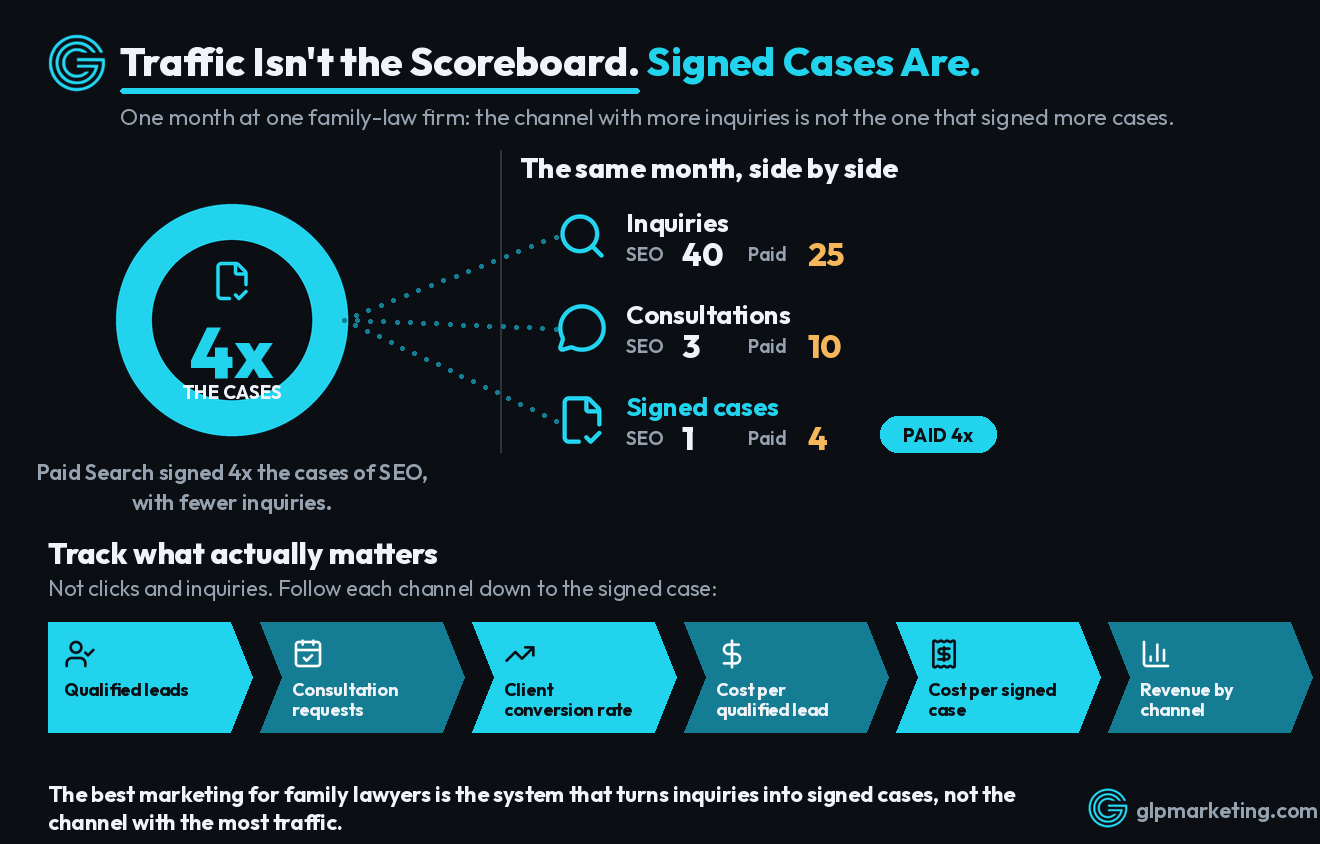
That is why the best marketing for family lawyers is not necessarily the channel that generates the most traffic or inquiries. It is the system that consistently puts your firm in front of the right people, builds enough trust for them to contact you, and gives your team a good chance of turning that inquiry into a client.
How Should Family Lawyers Allocate Their Marketing Budget?

There is no single formula for deciding how much a family law firm should spend on marketing or where every dollar should go. The American Bar Association suggests that firms may consider allocating 5% to 10% of annual revenue to marketing, while noting that the right figure depends on factors such as firm size, goals, and circumstances.
For a family law firm, budget allocation should reflect local competition, practice areas, growth goals, existing website authority, and available budget. A firm already ranking well for divorce-related searches may get more value from conversion optimization and paid campaigns, while a newer firm may need to invest first in local SEO, its Google Business Profile, reviews, and a strong website.
For new or small family law firms, we would focus on getting the foundation right before spreading money across every marketing channel. Build local SEO visibility, optimize your Google Business Profile, develop a review strategy, and use targeted paid campaigns to generate inquiries while organic rankings develop.
Established firms have more room to build on what is already working. That could mean expanding SEO across additional practice areas, creating more in-depth content, improving website conversions, strengthening reputation management, and using lead tracking to determine which campaigns are actually producing clients.
For firms entering a new market, combining local SEO with paid advertising can make sense. Paid campaigns can provide immediate visibility while the firm builds location-specific content, local authority, and organic search presence.
The important thing is not to spend more simply because you can. A good marketing budget puts money behind the strategies most likely to support the firm's current goals, then adjusts as the results and business priorities change.
Common Family Law Marketing Mistakes
Family law firms do not necessarily need to be on every platform or run every type of campaign. In many cases, the bigger problem is spreading the budget too thin or investing in tactics without a clear connection to client acquisition.
Check out these common mistakes:
| Common Mistake | Why It Can Hurt Your Family Law Practice | A Better Approach |
|---|---|---|
| Trying Every Channel at Once | Splitting a limited budget across SEO, paid ads, social media, email, and other channels can make it difficult to do any of them well. | Start with the channels that match your goals and target audience, then expand when you have enough data to justify it. |
| Targeting Overly Broad Keywords | Broad searches can attract people who are only looking for general information and have little intention of hiring a lawyer. | Prioritize relevant, high-intent searches tied to services, locations, and specific family law needs. |
| Ignoring Local SEO | Someone searching for a divorce lawyer usually wants an attorney who serves their area, making local visibility particularly important. | Optimize your Google Business Profile, location pages, local listings, and website content for the communities you serve. |
| Publishing Generic Legal Content | Content that could appear on any family law firm's website does little to demonstrate your attorneys' knowledge or distinguish your practice. | Answer real client questions with accurate, useful content that reflects your firm's experience and perspective. |
| Failing to Track Leads to Signed Cases | Knowing how many inquiries you receive does not tell you which marketing efforts are actually generating clients. | Track the journey from lead to consultation to signed case whenever your CRM or case management system allows it. |
| Sending Paid Traffic to Weak Landing Pages | Paying for a click only to send someone to a confusing or generic page creates unnecessary friction and can waste advertising spend. | Build focused landing pages with clear information, strong calls to action, and an easy path to contact the firm. |
| Neglecting Reviews and Reputation | Prospective clients may compare reviews before deciding which family lawyer to contact, particularly when several firms appear in local search. | Encourage appropriate feedback from satisfied clients and monitor and respond to reviews professionally without compromising confidentiality. |
| Making Unrealistic Promises in Advertising | Claims about guaranteed outcomes, rankings, or results can create unrealistic expectations and may create ethical or compliance concerns. | Set accurate expectations and make sure advertising claims comply with applicable professional rules. |
| Ignoring Attorney Advertising Rules | Marketing legal services comes with professional and ethical requirements that vary by jurisdiction. | Review campaigns, testimonials, claims, and other advertising materials against the rules applicable to your jurisdiction before publishing them. |
How Long Does Family Law Marketing Take to Work?
There is no fixed timeline for family law marketing because different channels produce results at different speeds. Paid advertising can generate visibility and inquiries relatively quickly, especially when campaigns target people actively searching for services such as a divorce lawyer or child custody attorney. However, that does not mean every click will become a qualified lead or signed case.
SEO and content marketing usually require more patience. Building rankings, earning authority, and attracting consistent organic traffic takes sustained work, particularly when a family law firm is competing for valuable local keywords. Reputation building works similarly; a firm's reviews, online presence, and familiarity within the local community tend to strengthen gradually rather than overnight.
In our experience, the strongest approach is usually to combine short-term and long-term strategies rather than choosing between them. Paid advertising can help generate opportunities while SEO, content, local SEO, and reputation management build a stronger foundation for future growth.
Be wary of any agency that promises that your family law firm will rank on Google or generate a specific number of clients within a guaranteed timeframe. Marketing performance depends on factors such as your market, competition, budget, website authority, practice areas, and how effectively your firm handles incoming inquiries. A good marketing partner should give you realistic expectations and use actual performance data to determine whether the strategy is moving in the right direction.
How to Choose the Right Marketing Strategy for Your Family Law Firm

Choosing a marketing strategy becomes much easier when you stop asking, “Which marketing channel should we use?” and start with a more practical question: “What does our firm need marketing to accomplish?” From there, you can build a strategy around your actual clients, practice areas, market, and budget.
Step 1: Identify your highest-value practice areas. Start by deciding which family law services you want to grow. Divorce, child custody, child support, property division, and other services can attract different types of clients and face different levels of competition. If divorce cases are your priority, for example, your SEO, content, paid advertising, and website messaging should reflect that rather than trying to promote every service equally.
Step 2: Understand your ideal client. Think about who you actually want to reach. What problem are they dealing with? Are they searching for a divorce lawyer, child custody attorney, or help with another family law matter? Understanding their concerns and search behavior helps you create marketing that speaks to prospective clients instead of generic legal consumers.
Step 3: Review your local competition. Search for the family lawyers and law firms competing for the same clients in your area. Look at their Google search visibility, reviews, websites, content, Google Business Profiles, and paid advertising. This gives you a clearer idea of what your firm needs to compete and where there may be opportunities that other firms are overlooking.
Step 4: Assess your current online presence. Before spending more money, find out what is already working. Review your website traffic, search rankings, Google Business Profile, client reviews, conversion rates, and existing marketing campaigns. You may discover that your firm does not need a completely new strategy; it may simply need to fix weaknesses in an existing one.
Step 5: Set measurable business goals. “Get more clients” is a useful ambition, but it is not specific enough to guide your marketing. Decide whether you want more qualified leads, more consultations, greater visibility for a particular practice area, or expansion into a new geographic market. Then establish measurable targets so you can tell whether your marketing efforts are actually contributing to growth.
Step 6: Choose channels that support those goals. Once you know what you want to accomplish, choose the channels that make sense. Local SEO and Google Business Profile optimization can support local visibility, SEO and content marketing can build long-term organic traffic, while Google Ads can help generate visibility for high-intent searches more quickly. Social media may be useful for building familiarity and brand awareness, but it does not necessarily need to receive the same investment as channels closer to the point of client intent.
Step 7: Measure results and adjust over time. Your first marketing plan does not have to be your final one. Track qualified leads, consultation requests, conversion rates, cost per qualified lead, signed cases, and revenue where possible, then use that information to adjust your budget and strategy. The goal is not simply to do more marketing; it is to understand what is producing results for your family law practice and invest more intelligently over time.
Do You Need Marketing Support for Your Family Law Firm?
Growing a family law practice takes more than being good at what you do. You also need to make sure potential clients can find your firm, understand what you offer, and feel confident enough to reach out. A strong family law marketing strategy can bring together SEO, local search, content, paid advertising, reputation management, and website optimization to create a more consistent path from search to consultation.
At GLP Marketing, we understand that family law marketing requires a different approach from marketing other legal services. Ready to make your firm's marketing work harder? Reach out to GLP Marketing to see how we can help your family law practice grow.
Frequently Asked Questions
Marketing a family law practice is not about finding one tactic and putting your entire budget behind it. The right approach depends on your practice areas, location, competition, growth goals, and the way potential clients search for legal help.
What Is the Best Way To Market a Family Law Practice?
A combination of local SEO, helpful content, Google Business Profile optimization, reputation management, and targeted paid advertising can give family law firms a strong foundation. The best mix depends on where your firm is located, which services you want to grow, and how quickly you need to generate new client inquiries.
Is SEO Worth It For Family Lawyers?
Yes, SEO can be valuable because many prospective clients begin researching family law services through search engines. It takes time to build organic visibility, but consistent SEO can help a firm attract relevant website traffic without paying for every individual click.
Should Family Lawyers Use Google Ads?
Google Ads can make sense when a firm wants to reach people actively searching for family law services and generate inquiries more quickly. The campaign should be tightly targeted, however, because broad keywords and poorly optimized landing pages can quickly consume a marketing budget without producing qualified leads.
How Can Family Lawyers Get More Local Clients?
Start by improving local SEO, optimizing your Google Business Profile, building relevant location and practice area pages, and developing a consistent review strategy. Your firm should also make its contact information easy to find and ensure that potential clients can quickly understand where you practice and which family law services you provide.
What Keywords Should Family Lawyers Target?
Focus on keywords that reflect your actual services, locations, and the needs of your target audience, such as “divorce lawyer in Texas,” “child custody attorney in Michigan,” or “family lawyer near me.” We recommend combining high-intent service keywords with informational searches that potential clients use while researching their legal options.
How Much Should a Family Law Firm Spend On Marketing?
There is no universal marketing budget for every family law firm, since spending should account for revenue, competition, practice areas, growth goals, and available resources. A firm should set a realistic budget that covers both the cost of marketing services and expenses such as paid advertising, then adjust the allocation based on measurable performance.
How Long Does Family Law SEO Take?
SEO generally requires several months of consistent work before a firm can expect meaningful results, especially in competitive markets. Your starting website authority, competition, location, content quality, and SEO strategy can all affect the timeline, so agencies should avoid promising a specific ranking or guaranteed result.
Should Family Lawyers Use Social Media?
Social media can help family lawyers build familiarity, demonstrate personality, share useful legal information, and strengthen brand awareness. It works best as part of a broader marketing strategy rather than a replacement for channels such as local SEO and search advertising, where potential clients may already be actively looking for legal assistance.