
Discover the latest law firm marketing trends that help attorneys attract more clients
In short
The marketing trends moving law firms forward in 2026 are AI-driven search visibility, local SEO, video, review generation, and sharper paid advertising. With more than 1.3 million active U.S. lawyers, standing out means owning organic and AI search rather than outspending rivals on ads. Firms that pair genuinely useful content with measurable lead tracking pull ahead.
The law firm marketing trends shaping today's legal industry are increasingly driven by digital transformation, data-driven decision-making, and client-focused experiences. In our experience working with law firms across multiple practice areas, the firms seeing the most growth are investing in search engine optimization, video marketing, local SEO, social media marketing, and smarter paid advertising strategies.
At GLP Marketing, our team brings years of experience helping law firms implement effective law firm marketing strategies that generate measurable lead generation and client inquiries. If you're looking to strengthen your law firm's brand, increase client inquiries, and stay ahead of competitors, reach out to us!
In this guide, we'll break down seven major marketing trends shaping modern law firm marketing. We'll also share actionable insights on helping your law practice attract more clients through the most effective marketing channels.
Why Law Firm Marketing Is Changing
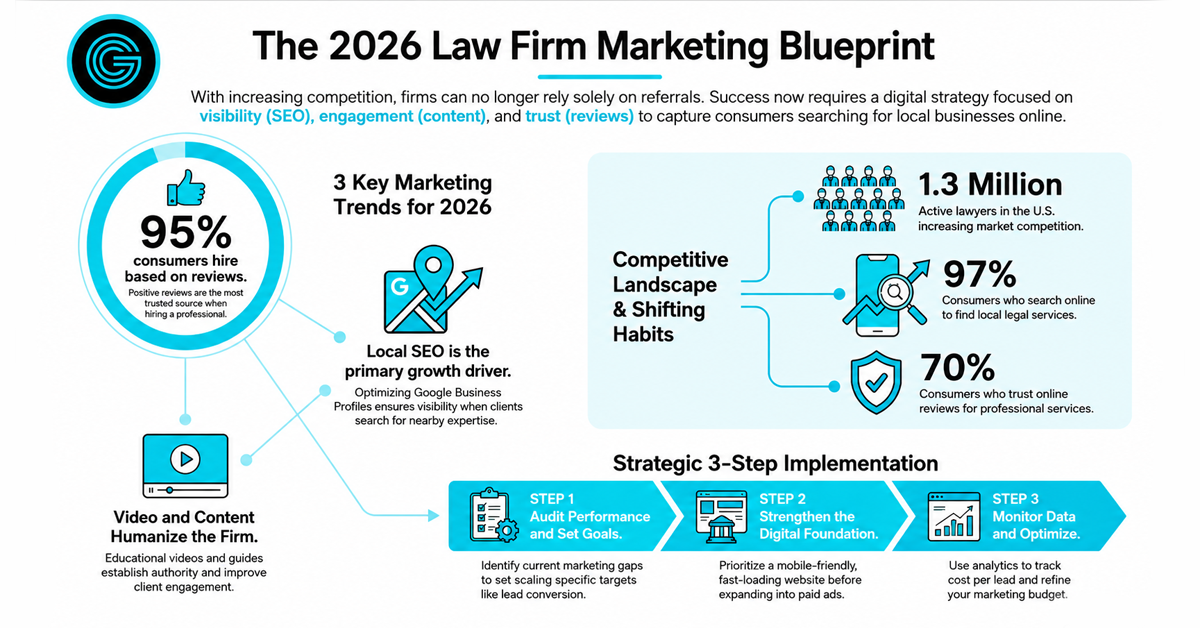
The way law firms approach law firm marketing has shifted dramatically over the past decade, largely because the legal industry, technology, and client behavior have all evolved. According to the U.S. Bureau of Labor Statistics, employment for lawyers is projected to grow by 4% from 2024 to 2034, with about 31,500 job openings each year, meaning more attorneys entering the market and increased competition for potential clients.
As the number of legal professionals grows, many firms are investing more heavily in digital marketing, search engine optimization, and online advertising to maintain a competitive edge and attract prospective clients searching for legal services online. In our experience, this growing competition has pushed many law firms to rethink their marketing strategies and adopt more sophisticated marketing approaches across multiple channels.
One of the biggest drivers behind current trends in law firm marketing is the sheer level of competition in the legal industry. With thousands of attorneys competing within the same practice area, firms must now build a strong law firm online presence through local SEO, legal directories, and optimized law firm websites to appear in local search results.
According to the American Bar Association, there are more than 1.3 million active lawyers in the United States, which significantly increases competition for visibility and lead generation online. In practical terms, this means most firms must invest more in content creation, paid advertising, and PPC advertising to stand out in search engines and attract client inquiries.
Another key factor shaping marketing trends is the shift in how people find lawyers. Research on legal advertising shows that most people now begin their search for an attorney online, using search engines and digital platforms rather than traditional referrals. This change has transformed lawyer marketing strategies, pushing firms to prioritize search engine optimization, voice search optimization, and generative engine optimization to increase organic traffic and website traffic. From what we've seen, a law firm website that is well-optimized for relevant legal keywords and answers common questions about legal processes can greatly improve the number of leads that turn into clients.
Online reputation has also become a major factor in legal marketing. Studies cited by the American Bar Association Journal indicate that 95% of consumers say reviews help determine which attorney to hire. This highlights the importance of positive client reviews and client testimonials in building trust. At the same time, broader consumer research shows that about 70% of consumers trust online reviews, reinforcing how positive reviews affect purchasing choices for services, including legal services.
Finally, rapid innovation in digital marketing tools is reshaping firm marketing across the legal industry. Emerging technologies such as artificial intelligence, predictive analytics, and client intake software now enable marketing teams to analyze client behavior, track conversion rates, and generate valuable insights that improve marketing efforts and ad spend decisions.
According to the American Bar Association's Legal Technology Survey, more than half of attorneys now rely on online tools and technology platforms to support their work and research. As a result, many law firms are expanding their marketing budget toward social media marketing, targeted social media ads, google ads, and video marketing to reach more clients.
What Are Law Firm Marketing Trends?

Law firm marketing trends refer to the strategies, technologies, and approaches that law firms use to attract potential clients, strengthen their law firm's brand, and stay competitive in the modern legal industry. In our experience working with legal professionals, these trends reflect how client behavior, technology, and the broader digital marketing landscape influence how firms promote their legal services. For instance, as more people search for attorneys through search engines, law firm marketing has shifted heavily toward digital marketing, including search engine optimization, online advertising, and strategic content creation that drives organic traffic and website traffic.
Typically, modern legal marketing focuses on three key elements: visibility, engagement, and trust. Visibility comes from improving a firm's law firm online presence through local SEO, legal directories, and optimized law firm websites that target high-value legal keywords and appear in local search results. Engagement happens through social media marketing, video marketing, social media posts, and educational content marketing that helps prospective clients better understand complex legal processes. Trust is built through positive client reviews, client testimonials, and effective reputation management, all of which influence whether someone chooses a firm after their initial search.
Branding is another important piece of marketing strategies for law firms, especially for multi-practice firms that need to differentiate themselves in crowded markets. A strong law firm's brand communicates authority, credibility, and a clear practice area focus while helping firms build strong client relationships with both existing clients and new prospects.
How Do Marketing Trends Impact Law Firms?
According to the U.S. Small Business Administration, roughly 97% of consumers search online to find local businesses, which includes people looking for attorneys and other legal services. This shift explains why most law firms now prioritize digital marketing, search engine optimization, and online advertising to strengthen their law firm online presence and appear in local search results when prospective clients search for legal help.
One of the most significant ways marketing trends for law firms impact them is through client acquisition. Today, the journey from prospective clients to satisfied clients often begins with a search query. According to the U.S. Small Business Administration, consumers overwhelmingly rely on search engines to research businesses before making decisions. This means marketing strategies for law firms must prioritize search engine optimization, local SEO, and optimized websites that target high-value legal keywords. If a firm appears low in search results, it may never reach the potential clients who need its legal services.
Adapting to evolving marketing trends also provides a powerful competitive edge for law firms trying to stand out in a crowded ecosystem. According to the U.S. Small Business Administration, businesses that actively invest in digital marketing and online advertising are significantly more likely to reach new audiences and grow their customer base. In the legal industry, this means firms that consistently refine their lawyer marketing strategies are more likely to dominate local search results and capture a larger share of potential clients.
What Are Key Marketing Trends for Law Firms in 2026?

In our experience working with law firms, successful firms are no longer relying solely on traditional marketing methods. They are combining search engine optimization, content creation, video marketing, online advertising, and data-driven insights to strengthen their law firm online presence and attract potential clients.
Trend #1: Local SEO
One of the most important trends in law firm marketing today is local SEO, because most people searching for legal services want a lawyer in their geographic area. When prospective clients search terms related to a specific practice area, such as personal injury or employment law, search engines prioritize results from nearby law firms. This means firms must optimize their law firm website, listings, and local signals to appear in local search results and generate consistent lead generation.
"For most law firms, local search visibility is the difference between getting consistent consultations and being invisible online," says Juan Reyes, Head of SEO at GLP Marketing. "Optimizing your Google Business Profile, location pages, and client reviews can dramatically improve how your firm ranks for high-intent legal keywords."
Key marketing strategies for law firms within local SEO include:
Optimizing your Google Business Profile for visibility in local search results.
Building location-specific practice area pages on your law firm website.
Encouraging positive client reviews and managing reputation management.
Maintaining consistent listings across legal directories.
Trend #2: Content Marketing
Another major driver of law firm marketing success is content marketing. Informative and educational content creation helps law firms demonstrate expertise while attracting organic traffic from search engines. When done well, this type of legal marketing positions a firm as a trusted authority in its practice area, helping build stronger client engagement with prospective clients who are researching legal issues.
"Educational content is one of the most effective ways to build authority and trust online," explains Chidinma Enemanna, Head of Marketing at GLP. "When a firm consistently answers real questions potential clients have about legal processes, it naturally improves website traffic, visibility, and ultimately lead generation."
Examples of effective content marketing strategies include:
Detailed practice area guides explaining legal rights and options
FAQ blog posts answering common legal questions
Legal explainer articles simplifying complex legal processes
Publishing case result insights or case studies
Trend #3: Video Marketing
Video marketing is rapidly becoming a powerful tool for marketing law firms because it allows legal professionals to communicate expertise and personality in a way that written content alone cannot. In our experience, video marketing improves client engagement, strengthens a law firm's brand, and increases trust among prospective clients evaluating different firms. Since video content performs well on social media channels, law firm websites, and online advertising campaigns, it often improves conversion rates and encourages potential clients to reach out.
Common forms of video content used by many law firms include:
Attorney introduction videos that humanize the firm
Short legal FAQ videos addressing common client concerns
Educational videos explaining complicated legal processes
Client testimonial videos sharing success stories
Trend #4: Online Reviews
Online reviews have become one of the most influential factors in legal marketing and client decision-making. Today, positive client reviews, client testimonials, and proactive reputation management help law firms build credibility and attract more clients. For most law firms, strong client reviews serve as social proof that builds strong client relationships even before the first consultation.
For example, one personal injury firm we worked with significantly improved its law firm online presence by implementing a structured review strategy. After encouraging satisfied clients to leave feedback on their Google Business Profile, the firm increased its positive reviews by more than 60% within a year. This resulted in higher local search rankings, increased website traffic, and a noticeable rise in client inquiries.
Key elements of successful reputation management include:
Collecting Google reviews from satisfied clients
Responding professionally to both positive and negative feedback
Highlighting client testimonials on the law firm website
Monitoring reputation across legal directories
Trend #5: Mobile Optimization
Another important law firm marketing trend is mobile optimization, as many potential clients now search for legal services directly from their smartphones. If a law firm website loads slowly or is difficult to navigate on mobile devices, prospective clients may leave before submitting a consultation request.
We recently worked with a mid-sized firm whose website traffic was strong but whose conversion rates were low. After redesigning the law firm's website to improve its mobile-friendly design, faster load speeds, and simple contact forms, the firm saw a significant increase in client inquiries within just a few months.
Important elements of mobile optimization include:
Mobile-friendly website design
Fast page load speeds
Click-to-call functionality
Simple contact forms for quick consultations
Trend #6: Data-Driven Marketing Decisions
Modern law firm marketing strategies increasingly rely on analytics and data-driven insights to measure performance. According to the U.S. Small Business Administration, businesses that track marketing data are significantly more likely to make informed decisions that improve growth and efficiency. Data helps marketing teams evaluate which marketing channels produce the best results and where to allocate their marketing budget and ad spend.
Key performance metrics used in law firm marketing include:
Website traffic from search engines and organic traffic
Conversion rates from landing pages and campaigns
Cost per lead from paid advertising or PPC advertising
Overall case acquisition cost
Many firms now also use predictive analytics, artificial intelligence, and other emerging tools to analyze client behavior, identify trends, and generate valuable insights that refine marketing strategies. By tracking these metrics, most firms can continuously optimize their marketing efforts, improve lead generation, and set achievable marketing goals.
Trend #7: Personalized Client Communication
Finally, one of the fastest-growing marketing trends is personalized client communication. Today's clients expect fast responses and tailored communication throughout their experience with a law practice.
"Speed and personalization are becoming critical to the client experience," explains Ignacio Gonzalez Guerineau, Customer Success Manager at GLP Marketing. "When firms respond quickly and communicate clearly, they increase their chances of converting prospective clients into actual clients."
Many law firms are adopting tools and systems that improve client engagement and communication, including:
Live chat tools on the law firm website
Automated follow-up emails for consultations
Online consultation scheduling
Faster response times using client intake software
How Do Law Firms Implement These Trends?

Below is the step-by-step framework we typically recommend for law firms looking to modernize their marketing strategies:
Step 1: Audit Your Current Marketing Efforts: The first step is evaluating your current law firm marketing performance. Many firms attempt to adopt new marketing trends without first understanding which marketing efforts are already working and which areas need improvement. Conducting a comprehensive audit of your firm's marketing allows legal professionals to assess how their law firm website performs in search engines, how visible they are in local search results, and how effectively their current marketing channels attract potential clients.
Step 2: Define Achievable Marketing Goals: After evaluating your current performance, the next step is setting achievable marketing goals that align with your law practice objectives. Some law firms focus on increasing website traffic, while others prioritize improving lead conversion or generating more consultations within a specific practice area, such as personal injury.
Step 3: Strengthen Your Digital Foundation: Before expanding into new marketing trends, law firms must ensure their digital foundation is strong. This begins with optimizing the law firm website, improving local SEO, and building a strong law firm online presence across relevant platforms. When prospective clients search for attorneys through search engines, the firms that appear prominently in results are typically those with well-optimized websites and consistent digital signals.
Step 4: Expand Marketing Channels Strategically: Once the foundation is established, law firms can begin expanding their marketing channels to reach potential clients across multiple platforms. Effective lawyer marketing strategies typically combine several approaches, including content marketing, video marketing, social media marketing, and strategic online advertising.
Step 5: Leverage Technology and Emerging Tools: Technology is now a key component of modern law firm marketing strategies. Tools powered by artificial intelligence, predictive analytics, and other emerging tools enable marketing teams to analyze client behavior, automate certain marketing tasks, and get helpful information about which strategies produce the best results.
Step 6: Monitor Performance and Optimize Continuously: The final step involves continuously monitoring marketing performance and refining strategies based on data. The legal industry is highly competitive, and law firms that consistently evaluate their results are more likely to maintain a competitive edge. Tracking metrics such as website traffic, organic traffic, conversion rates, and the number of new client inquiries helps firms determine which marketing strategies are producing results.
Challenges and Solutions
Adopting modern marketing trends can significantly improve a law firm's visibility, client acquisition, and long-term growth. However, implementing these strategies is not always straightforward. Many firms encounter operational, financial, and cultural barriers that slow down adoption or limit the effectiveness of their marketing efforts. Understanding these challenges and addressing them with practical solutions allows law firms to integrate new marketing trends more successfully and remain competitive in an evolving legal marketplace.
Challenge | Solution |
|---|---|
Budget constraints for marketing initiatives | Many law firms hesitate to adopt new marketing strategies because of limited budgets. A practical solution is to prioritize high-impact channels such as SEO, content marketing, and targeted digital advertising. Firms can also better allocate resources by understanding expected expenses and ROI through resources like law firm website design cost, which helps firms plan website and digital marketing investments effectively. |
Resistance to change within the firm | Attorneys and staff may be comfortable with traditional marketing methods and skeptical of new approaches. Leadership should address this by demonstrating measurable results from modern marketing strategies and gradually introducing new tools, providing training and clear explanations of how these changes improve client acquisition and efficiency. |
Lack of in-house marketing expertise | Many law firms do not have internal teams experienced in digital marketing trends such as SEO, analytics, or social media strategy. Firms can solve this by partnering with legal marketing agencies or consultants who specialize in law firm growth while also training internal staff to understand and manage ongoing campaigns. |
Difficulty measuring marketing ROI | Without proper tracking tools, firms may struggle to determine whether their marketing investments are producing results. Implementing analytics platforms, call tracking, and client intake tracking systems allows firms to monitor lead sources, conversion rates, and revenue generated from each marketing channel. |
Keeping up with rapidly evolving marketing technologies | Marketing tools and platforms change frequently, making it difficult for firms to stay current. Law firms should establish a periodic marketing review process, evaluate emerging tools annually, and focus on adopting technologies that align with their long-term growth strategy rather than chasing every new trend. |
Common Law Firm Marketing Mistakes to Avoid
One common mistake is relying solely on referrals. Referrals from former clients, colleagues, and professional networks can be valuable, but depending exclusively on them can limit a firm's growth. For example, a small personal injury firm that receives most of its cases through word-of-mouth may experience unpredictable case volumes during slower referral periods. By adding digital channels such as search engine optimization (SEO) and online content marketing, the firm can create additional pathways for potential clients to find their services.
Another frequent issue is ignoring search engine optimization (SEO). Many potential clients now begin their search for legal services online, meaning firms without a strong search presence may lose opportunities to competitors. For instance, a family law firm that does not optimize its website for relevant keywords may struggle to appear in search results when people look for divorce or custody attorneys in their area. Investing in SEO strategies helps ensure that a firm's services are visible to individuals actively seeking legal assistance.
A third mistake involves maintaining outdated or poorly designed websites. A website often serves as the first impression potential clients have of a law firm. If the design is outdated, difficult to navigate, or not optimized for mobile devices, visitors may leave the site before contacting the firm. For example, a client researching estate planning services may choose another firm if one website appears modern, informative, and easy to use while another looks outdated or loads slowly.
Finally, inconsistent marketing strategies can weaken long-term marketing results. Some law firms launch marketing campaigns for a short period and then stop when immediate results are not visible. For example, a criminal defense firm might publish blog posts or run ads for a few months but discontinue the effort before the strategy has time to build momentum. Marketing efforts typically require consistent implementation over time to generate measurable results and build brand recognition.
Embrace the Future of Law Firm Marketing
Law firm marketing continues to evolve as digital tools, client expectations, and competition reshape how legal services are discovered and evaluated. Firms that stay ahead of trends such as digital marketing, personalized client experiences, and data-driven strategies are better positioned to attract new clients and maintain a strong competitive edge.
If your firm is ready to strengthen its online presence and implement modern marketing strategies that deliver real results, working with experienced legal marketing professionals can make a meaningful difference. GLP Marketing helps law firms develop strategic, data-driven marketing solutions designed to improve visibility, generate qualified leads, and support long-term growth.
Ready to grow your law firm? Contact GLP Marketing today!
FAQs
Below are answers to some common questions about current marketing trends and how law firms can implement and measure successful marketing efforts:
What Are The Latest Law Firm Marketing Trends?
Recent law firm marketing trends include search engine optimization (SEO), content marketing, personalized client experiences, and data-driven decision-making. Many firms are also investing in stronger website experiences and targeted digital advertising to improve visibility and attract qualified leads.
How Can Law Firms Leverage Social Media For Marketing?
Law firms can use social media platforms to share educational content, legal insights, firm updates, and community involvement to build credibility and brand awareness. Consistent posting and engagement with followers can help establish trust while directing potential clients to the firm's website or consultation services.
What Are The Key Challenges in Implementing Marketing Strategies for Law Firms?
Common challenges include limited marketing budgets, resistance to adopting new technologies, and a lack of in-house marketing expertise. Strategic planning, training, and partnering with experienced legal marketing professionals can address these obstacles.
How Do Law Firms Measure The Success of Their Marketing Campaigns?
Law firms typically measure marketing success through metrics such as website traffic, search rankings, lead generation, conversion rates, and client acquisition costs. Using analytics tools and call tracking systems can help firms identify which marketing channels generate the most valuable results.
What Are The Best Digital Marketing Tools for Law Firms?
Effective digital marketing tools for law firms often include website analytics platforms, SEO tools, customer relationship management (CRM) systems, and call tracking software. These tools help firms monitor performance, manage client interactions, and optimize marketing strategies over time.
Law firm marketing trends: common questions
Which marketing trend should a firm act on first?
Start with the one closest to signed cases, not the shiniest one. For most firms right now that's making sure your site shows up in search and in AI answers when someone looks for help, because that's where intent is highest. Chasing a trend on social while your search presence is weak is building the roof before the walls.
Is traditional advertising like TV and billboards dead for law firms?
No, but it's changed. Billboards and TV still build name recognition in a local market, and for some high-volume practice areas they pull. What they don't do well is give you clean numbers on cost per case. If you run them, pair them with tracking so you know whether they earn their spot instead of assuming they do.
How does AI search change how firms need to market?
People increasingly get answers straight from AI overviews without clicking anywhere. That rewards content structured so an AI can read it and cite it (clear answers, real expertise, proper markup), and it punishes thin, generic pages. The firms that write like a trusted source get quoted. The ones publishing filler quietly disappear from the answer.
Do I need to chase every new trend?
No, and trying to will spread you too thin to do any of it well. Pick the two or three that fit your practice area and your clients, then commit. A firm doing search and reviews properly beats one dabbling in seven channels. Trends are a menu, not a checklist you're graded on.
How often do these trends actually shift?
The fundamentals (show up in search, earn reviews, answer real questions) barely move year to year. What changes is the mechanics on top: how AI surfaces answers, which platforms matter, how Google weights signals. Revisit your approach once or twice a year. Rebuilding everything every quarter because of a headline is a good way to never gain ground.