The best content for law firm SEO includes dedicated practice area pages, location-specific landing pages, educational blog posts, frequently asked questions, attorney biographies, and comprehensive legal guides. Each type does a different job, helping search engines understand your services while giving prospective clients what they need to decide whether to call. The strongest strategies combine this content with good keyword research and local SEO and ensure that the site is easy to navigate so visibility translates into getting high-quality leads.
At GLP Marketing, we work as a consulting CMO for law firms, with a focus on AI SEO and full marketing attribution that ties every channel back to signed cases. Our work helped Onyx Law Group, a family and estate litigation firm, grow its Google clicks from 3,299 to 15,835 for the same 28-day window year over year, a 380% increase. We also took Cali Lemon Lawyers from no organic-search revenue to about half a million dollars a month in roughly a year. If your firm wants more visibility in both traditional search and AI-powered results, request a free audit and growth plan.
This guide covers what works best for SEO of law firms, choosing topics based on what people want to find, and building and optimizing an overall strategy for content. We also go over optimization at the page level, use of internal links, ensuring that legal content is correct, and tracking important results.
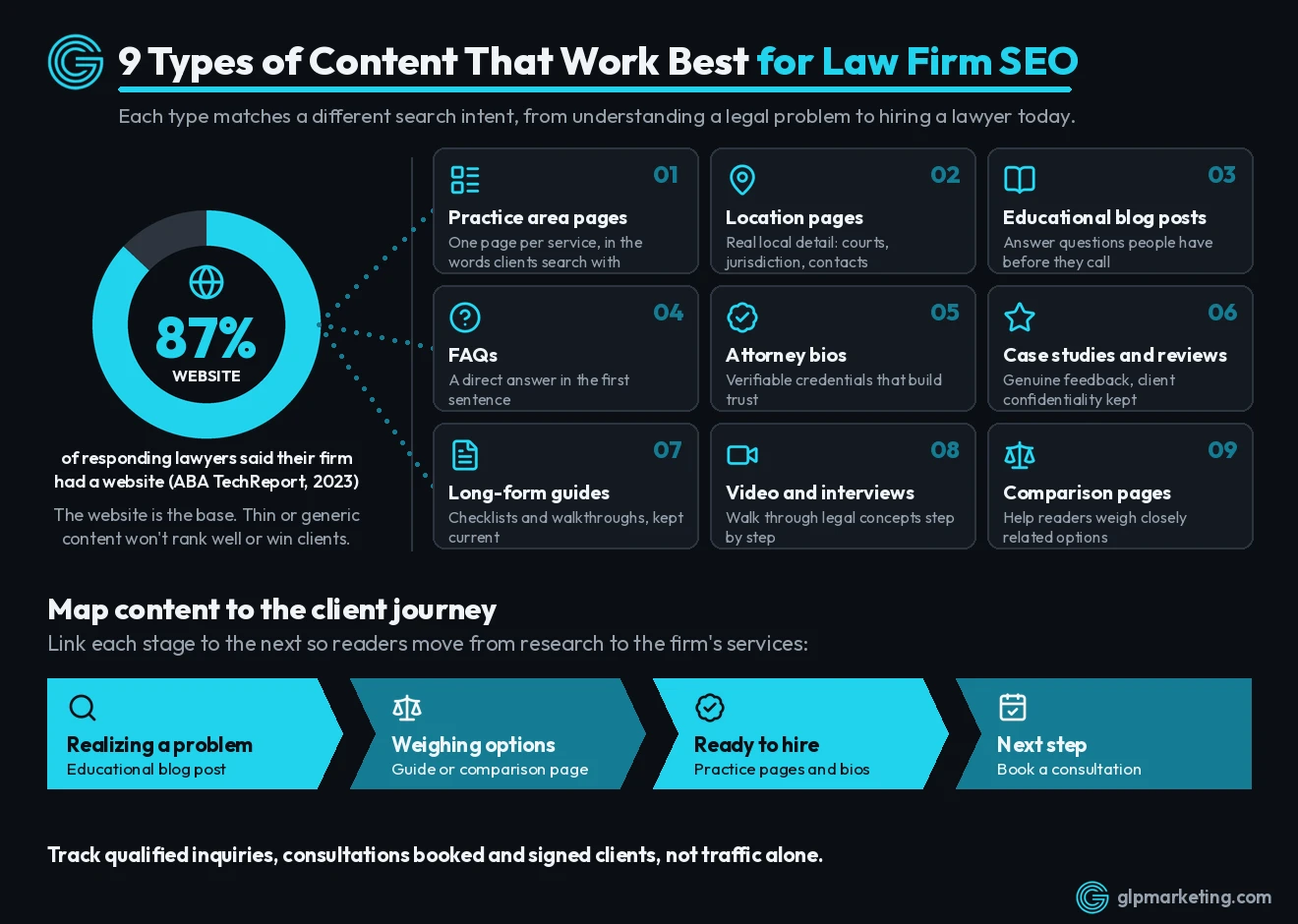
9 Types of Content That Work Best for Law Firm SEO
The content that performs best for law firms spans practice area pages, location pages, educational blog posts, FAQs, attorney bios, case studies, long-form guides, videos, and comparison pages. Each one matches a different search intent, from someone first trying to understand a legal problem to someone ready to hire a lawyer today.
A website is the base of everything. The American Bar Association's 2023 Websites & Marketing TechReport found that 87% of responding lawyers said their firm had a website, with solo practitioners far less likely to have one than larger firms. A site with thin or generic content, though, won't rank well or win clients. Among the nine content types below, we would start focusing on those first for any law firm SEO program.
1. Practice Area Pages

Practice area pages are among the most important pages on a law firm's site because they reach people actively looking for a lawyer. Each practice area should get its own page, carefully using words that potential clients use and addressing issues they are facing.
For example, an injury law firm might have separate pages for car accidents, medical malpractice cases, and wrongful deaths. A real estate firm could build pages for commercial transactions, landlord-tenant disputes, and real estate litigation.
A strong practice area page explains the service and the specific issues the firm handles, using the language clients actually search with. Using words that real clients use when looking for this information, it provides an overview of what generally happens in legal matters and what people can reasonably expect. Credentials of lawyers and their relevant work experience are also showcased. It should also link to related articles on the site and end with a clear invitation to book a consultation.
These pages help search engines understand what the firm does and help visitors decide quickly whether the firm fits their needs. Avoid publishing several pages that say the same thing with small keyword swaps. Instead, each page should provide something new or unique for people reading it.
2. Local SEO and Location Pages
Most legal searches are local. People who ask questions like "personal injury lawyer in Chicago" or "estate planning attorney near me" want help that pertains specifically to their locality. Local content therefore is key for a law firm to be seen locally.
Location pages can help your firm show up for those searches when they carry real, useful information. Each page should explain the services available in that area, name the relevant courts or jurisdiction, and list accurate contact details and local resources.
A firm serving several cities can build a page for each one, as long as each page offers genuine local detail and isn't a copy of the same template. Blog posts talking about local court procedures or state requirements can also help answer questions that potential clients have locally.
Local SEO goes beyond your website. Claim and maintain your Google Business Profile, keep your name, address, and phone number consistent across directories, and ask for genuine client reviews within your state's professional rules. Google's own tips for improving local ranking point to relevance, distance, and prominence, and a complete, active profile supports all three. For hands-on help, see our local SEO services.
3. Educational Legal Blog Posts
Blog posts about education attract organic traffic because they answer questions people have before contacting lawyers directly. They also show a firm's expertise and simplify complex issues using clear language. They also develop topical authority in different practice areas as well.
Google recommends focusing on helpful, reliable, people-first content and favors original content written to help readers rather than content aimed at boosting rankings. For a law firm this typically involves how-to guides for common legal processes such as preparing for a consultation when divorcing or documenting details of an accident along with answers to commonly asked questions about deadlines, court procedures, and what comes next. It also means timely explanations of new laws, regulations, and court decisions that affect your clients, posts that correct common misconceptions about legal rights, and, for firms with business clients, coverage of regulatory changes in the industries they serve.
Keyword research shows which phrases potential clients use and where competitors have left questions unanswered. Write for the searcher's intent rather than forcing keywords into every paragraph.
Every substantive post should be reviewed by a qualified attorney for accuracy and jurisdiction. Also keep updating articles as laws or procedures change so that people can always have access to fresh information.
4. Frequently Asked Questions (FAQs)
FAQs answer specific legal questions very succinctly and are quick to scan through. They fit naturally inside practice area pages, blog posts, and long-form guides, so visitors can find a direct answer without reading a full article.
Start with the questions attorneys hear most often in consultations, intake calls, and emails. Google Search Console also highlights questions that people already ask about your website. Often these questions point out other related ones worth addressing too.
A personal injury firm, for instance, might explain how long a claim usually takes, what evidence tends to matter, and what happens when an insurer disputes fault. A business law firm could cover how contract review works, common commercial disputes, or general compliance questions.
Answer each question directly in the first sentence, then add context where it helps. Use descriptive headings and link to the relevant practice page or detailed article for readers who want more.
FAQs can improve the experience for visitors and make a page easier for search engines to interpret, but they don't guarantee a featured snippet or special search result. The first priority is accuracy and usefulness.
5. Attorney Bios and Expert-Led Content

Attorney bios and expert-led content help prospective clients judge a firm's qualifications and credibility. They also make clear who stands behind the information on the site.
A strong bio covers qualifications, bar admissions, practice areas, professional experience, publications, speaking engagements, and other verifiable achievements. Where it makes sense, link the bio to articles the attorney wrote or reviewed.
Google talks about E-E-A-T: experience, expertise, authority and trustworthiness. It isn't a single ranking factor, but Google's guidance says its systems give extra weight to trust on topics that can significantly affect people's lives, finances, or well-being. Legal content falls squarely in that group, because readers may act on it.
Companies can bolster trust signals by publishing articles that have been reviewed by attorneys, referencing authoritative legal sources, naming authors and keeping credentials up to date as well. An article on a major legal development, for example, can show the reviewing attorney's name and qualifications, the publication date, and links to the underlying statute or court decision. Readers find this clearer and therefore easier to evaluate, and the content consistent and believable too.
6. Case Studies, Client Testimonials, and Reviews
Case studies, testimonials and reviews show potential clients how good it is to work with the firm. Unlike educational articles, they offer a look at client experiences, service, and, where appropriate, past results.
A case study can describe the legal challenge, the firm's approach, and the outcome, where disclosure is permitted. For instance, a law firm that deals with business law might explain how they helped a company solve a dispute over a contract as long as those details are correct and don't break confidentiality rules.
Testimonials and reviews add social proof, especially when they speak to communication, responsiveness, and the overall experience. Use only genuine feedback. The FTC's rule banning fake reviews and testimonials prohibits fake or AI-generated reviews, bought reviews, and undisclosed insider reviews.
Maintain confidentiality of clients at all times. Get written consent when required, leave out confidential details, and remember that removing a client's name may not be enough to keep them from being identified.
Present past results accurately and in context, and never imply that an outcome is guaranteed or that another client should expect the same result. In California, SB 37 went further as of January 1, 2026: it bans outcome predictions in attorney advertising and limits past-result claims to those that are objectively verifiable. When handled carefully like this, such content earns trust without overpromising.
7. Long-Form Legal Guides and Downloadable Resources
Longer guides along with downloadable materials allow a company to explore deeper into complicated legal issues that aren't covered by blog posts or FAQs. They draw in people researching unfamiliar legal problems and position the firm as a go-to resource in its practice area.
Here are some examples: checklists for estate planning, guides for preparing for a consultation related to personal injury, resources on compliance for small businesses, and walkthroughs explaining each phase of commercial litigation.
A good guide should have a well-defined audience and purpose. Break it into logical sections, define legal terms, link to authoritative sources, and include practical steps readers can take. Downloadable resources can also generate leads when offered through a landing page, but don't lock away content you want to rank, since gated pages are harder for search engines to see.
Longer isn't automatically better. Google's guidance asks whether content is complete, original, and helpful, and it doesn't reward hitting a word count.
Review these resources regularly so they reflect current law and procedure. If a guide talks about requirements that can differ based on different states, you should let people know which state this applies to and also mention any key limitations.
8. Video Content and Attorney Interviews
Video gives firms another way to explain legal concepts, answer common questions, and introduce attorneys to prospective clients. It works especially well for issues where it's easier for someone to walk through something step by step.
Pair shorter videos that address specific questions with longer interviews or explanations about complicated processes. A personal injury attorney might explain what evidence matters after an accident, while a corporate lawyer could walk through common contract risks for small businesses.
Embed videos on important pages of your site and also reuse them for use with YouTube and other social media platforms. Descriptive titles, accurate captions or transcripts, clear descriptions, and links to related content all help people find them.
One estate planning interview, for example, could support the firm's estate planning page, a related blog post, and several short clips answering individual questions. In this way a single recording yields multiple valuable results.
Videos should supplement the written content, not replace it. The accompanying written explanation allows visitors to select formats and gives more context to search engines about what is on that page as well.
9. Legal Comparison Pages
Comparison pages detail distinctions among closely related legal procedures, options, or types of representation. They attract people in the middle of a decision who want clear information before contacting an attorney. Common examples include:
- Mediation vs. litigation in a divorce
- Chapter 7 vs. Chapter 13 bankruptcy
- Settling vs. taking a personal injury case to trial
- In-house counsel vs. outside counsel
- Buying vs. leasing commercial property
A strong comparison page lays out the differences between the options, their advantages and limits, and the factors that change the answer for a particular person. Where the law varies by state, say so plainly and support key claims with authoritative sources.
Don't present one option as always better when the answer depends on the facts. Help people understand what's important for their own particular circumstances and when talking to a lawyer makes sense.
Comparison pages link smoothly to pages about related legal areas and detailed articles so that readers can move from broad research into the firm's services. As with all law firm content, their value comes from answering a real question, not from targeting one more keyword.
How to Choose the Best Content for Your Law Firm
Focus on what matters most for your firm and the clients you want to serve. A personal injury firm will build around accident-related guides and practice pages, while a corporate firm might focus on business disputes, contracts, and regulatory compliance.
Prioritize first and foremost. Put your first effort into content tied to your highest-value practice areas, questions prospective clients ask most often, and topics with a realistic chance of bringing in qualified traffic. Before creating anything new, audit what you already have: outdated information, practice areas with no dedicated page, and pages that would perform better with stronger internal links are often faster wins than a new article.
Content for education and services should work together closely. Blog posts and guides reach people researching a legal problem, while practice and location pages serve people ready to choose a lawyer. Linking the two moves readers from one stage to the next.
When evaluating content, look at results it produces for your business rather than just traffic numbers alone. Track organic traffic and search queries alongside qualified inquiries, consultations booked, and signed clients, and put more into the content that drives them.
How to Create an Effective Law Firm SEO Content Strategy

Do some keyword research to find out what terms your potential clients use when looking for legal information or a lawyer. Search Console and keyword research tools can unearth relevant queries, show how competitive they are and also disclose long-tail phrases that reflect very specific legal issues. Someone searching "how does probate work" needs an explanation, while someone searching "probate lawyer in Chicago" is probably ready to hire. Prioritize keywords that fit your practice areas, service locations, and the intent behind the search, rather than chasing volume.
Next, map content to the client journey. Someone just realizing they have a legal problem may need an educational blog post. Someone weighing options may need a long-form guide or a comparison page. Someone ready to hire needs clear practice area pages, attorney bios, and an easy way to book a consultation. Having content mapped out for each phase lets you address different search intentions and help customers take the right next step at each point.
Organize content into topic clusters built around your core practice areas. Give each service a main page and support it with related blog posts, FAQs, location pages, and guides. A personal injury firm, for example, could build a car accident cluster with a main service page, an article on gathering evidence after a crash, and a guide to the claims process. Link these pages together so readers can move between them easily and search engines can see how they relate.
Make sure that all pages show expertise and credibility. Name authors and reviewers, include credentials, cite authoritative legal sources, and explain where rules differ by jurisdiction. Because legal content can shape major decisions, a qualified attorney should review substantive information before it goes live.
Optimize each important page with a descriptive title tag, a useful meta description, a clear heading structure, and keywords worked naturally into the text. Use readable URLs, compress and label images, and make sure the site works well on mobile. Structured data can help search engines understand information about your firm, attorneys, and pages, though it doesn't guarantee enhanced results.
To make internal linking stronger, connect related posts, practice pages for lawyers, biographies of attorneys, and location pages whenever this connection helps readers. For example, you could link an article about the different phases of divorce to firm pages with information on divorce and family law. Use descriptive anchor text, fix broken links, and look for important pages that receive few internal links. Google's link best practices explains that anchor text is important both for readers and for crawlers who browse through web pages.
Keep legal content accurate and current. Make sure you review published pages regularly for any changes in laws, procedures followed by courts, deadlines for filing documents and other important details, especially for fast-developing areas of law or issues that could impact someone's decision. Check updates against current statutes, court publications, and other authoritative sources. Accurate content protects your firm's credibility and gives every search visitor information they can rely on.
Finally, track both SEO performance and lead generation. Google Analytics tracks organic traffic, engagement, landing-page performance, and conversions, while Search Console reports queries, impressions, clicks, and rankings. Track qualified inquiries, consultations booked, signed matters, and attributable acquisition costs alongside them. Regular reviews show which pages underperform, where new opportunities lie, and how to adjust the strategy based on results rather than traffic alone. SEO takes time, so it's important to set realistic expectations from the start.
Common Law Firm SEO Content Mistakes to Avoid
Even a well-planned SEO strategy can fall short when content misses what readers need, fails to show real expertise, or doesn't support the firm's business goals. The table below covers the most common mistakes, why they hurt, and how to fix them.
| Common mistake | Why it hurts your SEO efforts | How to avoid it |
|---|---|---|
| Publishing generic or unoriginal articles | Content that repeats information already available online struggles to stand out in search results or meet reader needs. | Publish original legal insights, attorney-reviewed explanations, practical examples, and answers specific to your audience. |
| Creating thin or repetitive location pages | Near-identical pages with little local value frustrate readers and can be treated as doorway pages under Google's spam policies. | Build location pages only for areas you actually serve, with real local information, relevant services, and jurisdiction-specific details. |
| Neglecting search intent and internal links | Pages attract the wrong visitors or leave readers with no path to related services and information. | Match each page to the searcher's need and link naturally to relevant practice pages, guides, and articles. |
| Publishing old or incorrect legal info | Wrong explanations of laws, procedures, or deadlines damage trust and can mislead prospective clients. | Have qualified attorneys review substantive content and update pages when laws, court decisions, or procedures change. |
| Relying on unreviewed AI-generated content | AI drafts can contain inaccurate claims, outdated information, or generic explanations that show no real expertise. | Use AI for research and drafting only, verify every factual claim against authoritative sources, and require attorney review before publishing. |
| Measuring traffic without tracking qualified leads | High traffic does not mean the content attracts the right clients or brings in business. | Track qualified inquiries, consultations booked, signed matters, and acquisition costs along with traffic and engagement. |
The law firm content that performs best is accurate, original, matched to search intent, and useful to clients. Regular review and gauging how much of this content converts into high-quality leads also improve their search visibility and make for better marketing decisions. If you need help producing it, our legal web content team writes attorney-reviewed pages built to rank.
Do You Need Help Building a Law Firm SEO Strategy Around Useful Content?
Practice area pages, location pages, educational posts, FAQs, attorney bios, and long-form guides each play a part in attracting prospective clients and growing organic visibility. The results come from content that matches search intent, shows real legal expertise, reflects current law, and helps the reader. Steady optimization, strong internal linking, and honest tracking keep that content working for both rankings and revenue.
Want to plan, create and gauge that content better? We have GLP Marketing. And what we do with content marketing for law firms is about signed cases rather than just traffic. Are you ready to convert organic traffic into high-quality inquiries for clients? With a content strategy that matches your practice areas and goals, a free audit from GLP Marketing can help you do that.
Frequently Asked Questions
SEO content for law firms can improve visibility in searches, showcase expertise and attract potential new clients. These answers cover publishing frequency, rankings, and using AI in legal marketing.
How Often Should a Law Firm Publish SEO Content?
Publish content at a pace that is sustainable for you and prioritize quality and relevance over any fixed number of pieces to publish. Don't forget to update existing posts as well, and regular, useful additions help keep your site accurate and relevant to your audience.
Do Blog Posts Help Law Firms Rank on Google?
Sure! Well-researched blog posts can bring in organic traffic by answering legal questions, matching relevant searches, and building topical authority. How well they work depends on quality, search intent, competition, and how they connect to the rest of your SEO strategy.
Are Practice Area Pages More Important Than Blog Posts?
Pages in specific practice areas tend to attract people who are already actively seeking out a lawyer, but blog posts can also reach people who are doing research about something they need help with or trying to weigh their options. Both matter, so use them together and link educational content to the relevant service pages.
How Long Does Law Firm SEO Content Take to Rank?
Most new content takes several weeks to several months to gain real visibility, depending on competition, site authority, content quality, and technical health. Watch Search Console and Google Analytics to track progress and spot pages that need improvement.
Should Law Firms Use AI to Create SEO Content?
Law firms can use AI to help with keyword research, topic ideas, outlines, and first drafts, but every piece must be fact-checked and reviewed by a qualified legal professional. AI should support original, accurate, people-first content, not replace legal expertise or churn out generic articles at scale.