
Indianapolis, its freight suburbs and law practices statewide
Lawyer SEO in Indianapolis, IN
Search for Indianapolis law firms, planned around the people who make and move the goods.
Many of the people who call an Indianapolis law firm pick, pack, drive, load or run a machine for a living. GLP builds search, paid ads and AI answers around the matters that start on their shifts, and checks every page against Indiana Rules of Professional Conduct 7.1 to 7.5.
This page is the Indianapolis part of our work: who the city's clients are, the Indiana Code sections their cases turn on, how paid search and audits work for a Marion County office, and the advertising rules the Indiana Supreme Court applies to every lawyer it licenses. For the national side of the work, see law firm SEO.
Free, done by a real person, and in your inbox within 48 hours.
Lawyer SEO services in Indianapolis
Hiring GLP in Indianapolis: the work we take on and the work we pass along
We are a legal and digital marketing company for law firms, and a city plan begins with who walks into its law offices. In Indianapolis, the clients our firms want are unusually likely to work in a warehouse, a plant, a cab or a delivery van, and their legal problems start with a shift that went wrong: an injury on the dock, a paycheck that came up short, a machine that failed. Below is what a Marion County or Central Indiana firm can hire us for, how each piece is shaped by that client base, and where the work belongs to somebody else.
| What firms ask for | How it is shaped in Marion County | Where it stops |
|---|---|---|
| Lawyer SEO and practice pages | Practice pages written from the Indiana Code section that decides the matter, with the statute linked, so a reader and a search engine both see a page about Indiana law rather than a national template with the city name swapped in. | Nothing stating Indiana law is published until one of the firm's attorneys has signed off on it. |
| Local SEO and the map results | Business Profile categories, services and service areas set from the office you actually have, and review requests built into intake. | No invented offices in Plainfield or Greenwood; Rule 7.2(c) wants a real office address. |
| Pay-per-click campaigns | Search and Local Services campaigns aimed at the counties where the firm's clients live, with every call recorded against a source. | Ad spend goes to Google, not to us; the auction decides placement. |
| AI search (AEO and GEO) | Pages that answer an Indiana question in their opening lines and state facts the same way on the site, the profile and the directories, so AI tools have something exact to quote. | What an answer engine finally writes is outside any agency's control. |
| Law firm website design | Sites built with the search plan inside them and Indiana's name-and-address requirement in the template. | Hosting and IT support stay with your provider. |
| Audit and SEO analysis | A no-cost, human-made diagnosis of your search presence, explained in the section on analysis below. | The audit is a starting point, not a forecast of rankings. |
Start with the audit. We search for your practice the way an injured forklift operator in Decatur Township or a plant manager in Speedway would, compare your pages with the firms above you, and record what we would fix first.
Get My Free AuditRead across the rows
Marion County beside the warehouse counties that ring it
One table, five places. Read along a row and you see a county's working life; read down a column and you see where the logistics jobs, the factory jobs and the lawyers actually are. Below the table, one line per column turns the count into a decision about pages.
| Place | Private jobs in transportation and warehousing | Private jobs in temporary help agencies | Private jobs in manufacturing | Private law offices |
|---|---|---|---|---|
| Marion County (Indianapolis) | 37,840 6.9% | 23,297 4.3% | 55,746 10.2% | 551 |
| Hendricks County (Plainfield, Avon) | 16,810 23.7% | 2,114 3.0% | 4,179 5.9% | 36 |
| Johnson County (Greenwood, Whiteland) | 9,054 15.8% | 1,634 2.8% | 5,819 10.1% | 47 |
| Hamilton County (Carmel, Fishers, Noblesville) | 1,474 1.0% | 3,269 2.2% | 7,704 5.2% | 216 |
| United States | 6.56 million 5.0% | 2.59 million 2.0% | 12.73 million 9.6% | 188,520 |
Source: BLS QCEW, private ownership, annual averages for 2024, county files for Marion, Hendricks, Johnson, Hamilton, United States. Percentages are shares of each area's private-sector jobs. Temporary help is NAICS 561320; law offices are NAICS 54111.
- Down the first column: nearly one private job in four in Hendricks County moves freight, so a firm's injury and wage pages have readers living west of the city line.
- Down the second: Marion County's share of jobs held through temp agencies is more than twice the national one, which puts two employers on many of its injury files.
- Down the third: factory work is spread across all four counties, and so are equipment-injury claims with their own Indiana deadline.
- Down the last: 36 law offices serve Hendricks County's 70,842 private jobs, so most of its workers will be found by firms in other counties, through search.
The people behind the searches
A picker, a driver, a press operator: who an Indianapolis firm's next client is
Census survey data classify working residents twice, once by occupation and once by industry. In Indianapolis, 17.5% of employed residents hold production, transportation or material-moving jobs, against 12.9% nationally; 8.7% work in transportation, warehousing and utilities, against 5.9% across the country and 6.2% across Indiana (ACS 2020-2024, table DP03). That second figure is the unusual one. Indiana as a whole is a factory state, but the capital is where its freight gets sorted, stored and shipped.
Warehouse, driving and factory work in Indianapolis, against Indiana and the nation
Percent of working residents, five-year survey ending 2024
- Production, transportation and material moving jobsShare of employed residents, by occupation 17.5% 19.1% 12.9%
- Transportation, warehousing and utilitiesShare of employed residents, by industry 8.7% 6.2% 5.9%
- ManufacturingShare of employed residents, by industry 10.9% 18.0% 9.9%
Use the arrow keys to read each value.
| Measure | Indianapolis (%) | Indiana (%) | United States (%) |
|---|---|---|---|
| Production, transportation and material moving jobs / Share of employed residents, by occupation | 17.5 | 19.1 | 12.9 |
| Transportation, warehousing and utilities / Share of employed residents, by industry | 8.7 | 6.2 | 5.9 |
| Manufacturing / Share of employed residents, by industry | 10.9 | 18 | 9.9 |
Source: U.S. Census Bureau, American Community Survey 2020-2024 five-year estimates, table DP03, Indianapolis city (balance), Indiana and the United States, data.census.gov.
What these jobs produce for a law firm
Work that involves lifting, driving, loading and running equipment produces a recognizable set of legal problems. Each of the matters below has its own Indiana statute, and each later section of this page takes one of them apart:
- an injury on the job, which almost always runs through the Worker's Compensation Board rather than a courtroom;
- an injury caused by somebody other than the employer: a defective machine, another company's driver, a property owner at a delivery stop;
- a final paycheck that arrives short, late or not at all;
- a job held through a staffing agency, which puts two companies between the worker and an answer;
- a crash with a government vehicle or on public property, which starts a notice deadline measured in days.
Why the client's job title shapes the page
A shift worker who has just been hurt does not search for "premises liability" or "third-party claim". The phrases we see in Indianapolis searches are about the job and the object: forklift, warehouse, temp agency, final paycheck, choose my own doctor. A firm whose pages are organized by legal theory makes this reader translate; a firm whose pages are organized by the situation (hurt while working through an agency, hurt by a machine, paid late after quitting) meets them where the search starts. We build the page list from those situations and then attach the legal theory inside each page.
The city and the state are different markets
Manufacturing employs 18.0% of working Hoosiers but 10.9% of Indianapolis residents. A statewide firm that writes its product and plant-injury pages for Elkhart or Kokomo may find those pages a poor fit for a Marion County reader, who is more likely to be hurt by a pallet jack in a distribution center than by a stamping press. When a firm has offices in both settings, we plan the two sets of pages separately.
Where the jobs sit
Plainfield, Greenwood and the airport: warehouse counties without many lawyers
Federal wage records put the region's freight work outside the city limits as much as inside them. In Hendricks County, home to Plainfield and Avon, 23.7% of private-sector jobs are in transportation and warehousing, and warehousing alone (NAICS 493) accounts for 11,702 jobs, 16.5% of the county's private employment. Johnson County, south of the city, has 15.8% of its private jobs in the same sector. Marion County sits at 6.9%, not far over Indiana's 6.0% (wage files for Hendricks, Johnson and the state).
Freight jobs and agency jobs as a share of private work, 2024
Hendricks, Johnson, Marion and Hamilton set beside the state and national shares
- Hendricks 23.7% 3.0%
- Johnson 15.8% 2.8%
- Marion 6.9% 4.3%
- Indiana 6.0% 2.4%
- U.S. 5.0% 2.0%
- Hamilton 1.0% 2.2%
Use the arrow keys to read each value.
| Area | Transportation and warehousing (%) | Temporary help (%) | Transportation and warehousing jobs | Private law offices |
|---|---|---|---|---|
| Hendricks | 23.7 | 3 | 16,810 | 36 |
| Johnson | 15.8 | 2.8 | 9,054 | 47 |
| Marion | 6.9 | 4.3 | 37,840 | 551 |
| Indiana | 6 | 2.4 | 166,920 | 2,572 |
| U.S. | 5 | 2 | 6,562,468 | 188,520 |
| Hamilton | 1 | 2.2 | 1,474 | 216 |
Source: U.S. Bureau of Labor Statistics, Quarterly Census of Employment and Wages, 2024 annual averages, private ownership; NAICS 48-49 and 561320 as shares of all private employment.
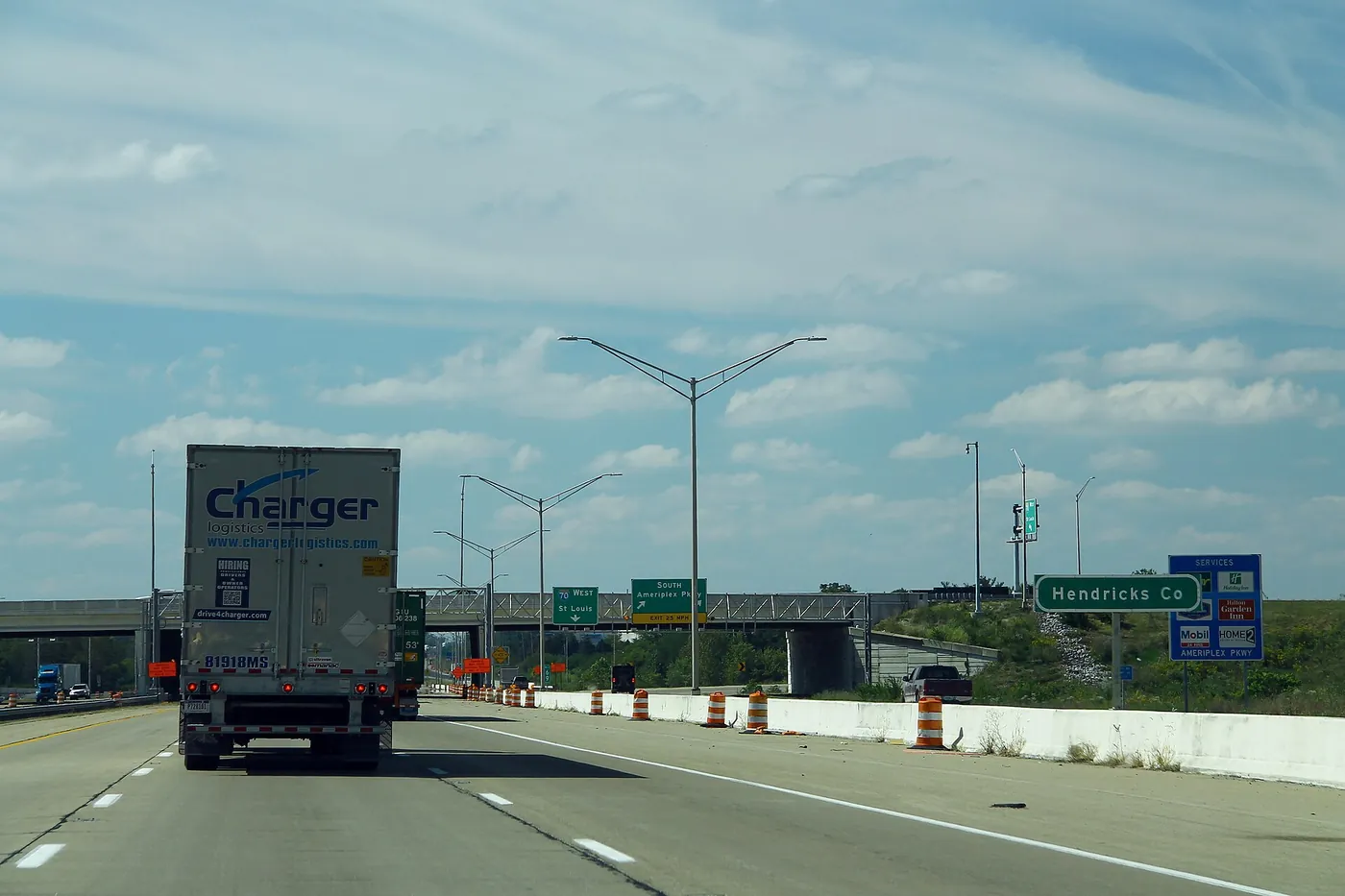

Counting workers per law office
The same federal file counts law offices. Hendricks County has 36 private offices of lawyers, Johnson County 47, Marion County 551 (BLS QCEW, Marion). An injured Plainfield picker therefore has a short list of nearby firms and a long list of Marion County ones. Which of those firms they call is mostly decided by a search on a phone during a break.
Service-area pages without a pretend office
The Indiana rule that every advertisement carry a responsible lawyer's office address (Rule 7.2(c), covered below) rules out the cheap trick of a Plainfield page that hints at a Plainfield office. What works is a page that says plainly where the firm is, how far the drive is, how the first meeting can happen, and which court a Hendricks County case would be filed in. We write county pages that way, and set the Business Profile's service areas to match.
The airport as an employer
Couriers and express delivery services (NAICS 492) employ 10,548 people in Marion County, with an average weekly wage of $1,120, against the county's all-industry private average of $1,476. Much of that work is overnight sorting at the airport, where a strain injury or a vehicle accident on the ramp raises the same workers' compensation questions as a warehouse floor, plus the possibility of a claim against a contractor who is not the employer.


For firms whose clients live west or south of the city: the audit includes the Plainfield, Avon and Greenwood searches, not only the ones that say Indianapolis.
Ask for the auditStaffing agencies
Hurt at a client company's warehouse while employed by a temp agency
Temporary help services employed 23,297 people in Marion County in 2024, 4.3% of all private jobs, against 2.4% for Indiana and 2.0% nationally; the average weekly wage in the sector was $771 (BLS QCEW, Marion; United States). Many of those workers spend their shifts inside a client company's warehouse or plant. When one of them is hurt, the first question is not "how much is my case worth" but "who do I even tell".
Indiana's rule for a worker in joint service
The statute anticipates this arrangement. When an injured employee is "in the joint service of two (2) or more employers" covered by the Act, those employers contribute to the compensation in proportion to their wage liability, unless they have agreed on a different split between themselves (IC 22-3-3-31). For the worker, the practical answer is that benefits are owed regardless of which company's name is on the paycheck; the companies sort out the shares.
Why a temp worker's page cannot stop at compensation
The Act's exclusive-remedy rule bars a suit against the employer, but a separate section preserves claims against "some other person than the employer and not in the same employ" (IC 22-3-2-6 and 22-3-2-13). Whether the client company counts as an employer for that purpose depends on facts a lawyer has to examine, which is exactly why a temp worker's page should explain that the question exists rather than answer it in a sentence.
The lien that follows a third-party recovery
Section 13 also says what happens to the money. When a worker recovers from the outside party, the employer or its insurer is repaid the compensation and medical costs it paid, less its share of the cost of bringing the claim, and its liability for future compensation ends. A page that mentions third-party claims without this repayment step leaves a reader expecting more than the claim will deliver, which is the sort of omission Rule 7.1 treats as misleading.
Pages we build for staffing-agency readers
- A page titled for the situation ("hurt while working through a temp agency in Indianapolis") rather than for "joint employment".
- A short list of what to write down: the agency, the client company, the supervisor on the floor and the badge or site name.
- The joint-service section and the third-party section, each quoted and linked.
- An intake form that asks for both company names, so the firm hears the full picture on the first call.
Indiana Code title 22, article 3
Hurt on a shift in Indiana: the Worker's Compensation Act, section by section, for a firm's pages
Most workplace injuries in Indianapolis never reach a courtroom. They are decided by the Worker's Compensation Board of Indiana, whose offices are downtown on West Washington Street (WCB contact page). A firm that wants these clients needs pages that explain the Board's process in Indiana's own terms, because several of its rules surprise people who have read about workers' compensation in other states.


The employer chooses the doctor
Until permanent impairment is decided, Indiana law requires the employer to furnish, free of charge, an attending physician and the services the physician or the Board considers necessary (IC 22-3-3-4). The Board's own answer to "Do I have to go to the doctor my employer selects?" is that employers and insurers "have the right to direct the medical care" and that refusing an examination they request may suspend benefits (WCB FAQ). It is the most searched question in our survey with a clear Indiana answer, and only 8 of the 79 firm pages we read stated it.
Notice to the employer within 30 days
Section 1 asks the injured worker to give written notice "as soon as practicable", and says compensation isn't paid until notice is given if neither notice nor the employer's own knowledge arrives within 30 days of the injury (IC 22-3-3-1). A late notice defeats the claim only to the extent the employer shows it was prejudiced. That distinction (late is costly, not necessarily fatal) is worth a paragraph on any Indianapolis comp page, because readers who missed 30 days often assume they have lost everything.
The Board's filing limit, and when its clock restarts
The right to compensation is "forever barred" unless a claim is filed with the Board within two years after the accident, or two years after a resulting death. Since a 2022 amendment, when temporary total or temporary partial disability benefits have been paid, the two years for an application for adjustment of claim run from the last date for which those benefits were paid (IC 22-3-3-3). A worker who has been receiving checks may have more time than a generic "two-year deadline" sentence suggests, so a page should name the trigger, not just the number.
Fired while on comp
The Board's published answer starts from Indiana being an employment-at-will state, where employers may fire at their discretion short of discrimination on listed grounds (WCB FAQ). It is a hard answer to read when you are off work with an injury, and it is why "fired after workers comp claim indiana" brings up firm pages: readers want someone to tell them what, beyond the agency's sentence, may still be done. A firm that publishes that page should be precise about what Indiana law offers and what it doesn't, and send the reader to a lawyer for the facts.
What the comp pages of an Indianapolis firm should contain
- The Board's name and address, and a link to its forms, so the page is plainly about Indiana.
- Employer-directed medical care, stated in the first screen, with the Board's own FAQ linked.
- The written notice to the employer, then the prejudice test that softens it.
- The two-year filing limit and its restart after temporary disability payments.
- A separate page for third-party claims, linked from every comp page.
Product liability
When the conveyor or the press was the cause: Indiana's 10-year statute of repose
In a plant or a distribution center, the outside party behind a third-party claim is often the company that made or sold the equipment. Indiana gives those cases their own limitations section, and it is stricter than the general two-year rule for injury suits (IC 34-11-2-4).
The accrual limit and the repose limit
A product liability action based on negligence or strict liability must be started within two years after the cause of action accrues, or within ten years after the product was delivered to its initial user or consumer (IC 34-20-3-1). There is one carve-out inside the rule: if the claim accrues at least eight but less than ten years after delivery, the action may still be brought within two years after it accrues. The section applies "regardless of minority or legal disability".
Old machines, short windows
Conveyors, balers, lifts and presses in Central Indiana buildings are often older than ten years. For a worker hurt by one, the repose period may have run before the injury happened, which changes what a firm can offer and what its page should promise. We write equipment-injury pages that ask the reader, in plain words, how old the machine was and who installed it, because that answer decides whether the product claim exists at all.
Fault shared with the injured worker
Outside the workers' compensation system, Indiana's comparative fault chapter bars recovery when the claimant's contributory fault is greater than the fault of all the persons whose fault caused the harm (IC 34-51-2-6). Equipment cases often involve an argument about how the machine was being used, so a page that explains this threshold prepares a reader for the conversation the firm will have with them.
A page plan for equipment injuries
- One page per type of equipment the firm actually sees (forklifts and pallet jacks, conveyors, presses and balers), not a single "workplace accidents" page.
- The two-year and ten-year limits in the opening section, with the eight-to-ten-year carve-out explained.
- A clear line between the comp claim against the employer and the product claim against the maker.
- No talk of recoveries in earlier cases; Indiana's comments to Rule 7.1 treat them as likely to mislead.
Indiana Code title 22, article 2
Final paychecks, short checks and the limits of the Department of Labor
Pay disputes are the other daily legal problem of hourly work. Indiana has two statutes for them, and which one applies depends on how the job ended. A firm's wage pages are clearer, and better at answering the questions people type, when they keep the two apart.
The Wage Payment Statute: when and how pay is due
Employers doing business in Indiana must pay at least semimonthly or biweekly if requested, for wages earned up to no more than ten business days before payday (IC 22-2-5-1). When they don't, section 2 makes them liable for the unpaid wages and requires the court to order a reasonable fee for the employee's attorney plus court costs. Bad faith costs more: the court then adds liquidated damages of twice the wages owed. Of all this, the fee sentence matters most to a reader. It is why a lawyer will look at a claim worth only a few weeks of pay.
The Wage Claims chapter: when the employer ended the job
A separate chapter covers employees the employer "separates" from the payroll: their unpaid wages become due at the regular payday for the pay period in which the separation occurred (IC 22-2-9-2). The Commissioner of Labor enforces it, may hold hearings and may refer claims to the Attorney General, who can sue for the worker or hand the claim to a private Indiana lawyer (IC 22-2-9-4). Which chapter a worker's claim falls under is a question for a lawyer; the page's job is to show the reader that there are two.
What the state says it cannot do
The Department of Labor's own help page is unusually frank. It tells workers to file a complaint with its Wage and Hour Division, and then says the complaint starts an investigation but that the Department "does not have the authority to make the employer pay you the wages"; if the employer doesn't act, resolution comes through legal action (IN.gov FAQ). That sentence is where a wage firm's page begins. It names the gap between a complaint and a check, and explains what a lawyer adds.
Small amounts, small claims
Marion County runs its small claims courts by township, and a small claims court's civil jurisdiction covers claims founded on contract or tort up to $10,000, not counting interest or attorney's fees (IC 33-34-3-2). Most single-worker wage disputes fall well under that ceiling. A wage page that tells a reader which court is likely to hear a claim of their size, and why the fee statute matters even there, answers the question behind "unpaid wages lawyer indianapolis" better than a list of the firm's awards ever could.
For wage and hour practices: we check which of the final-paycheck searches end on a state FAQ, a directory or a competitor, and where your page could stand instead.
Get the auditIndiana Tort Claims Act
A city truck, a county road, a state building: notice before anything else
Drivers and delivery workers spend their days on public roads and at public loading docks. When the other vehicle belongs to a city or the hazard sits on public property, Indiana's Tort Claims Act changes the order of everything, and an injury page that skips it can cost a reader the claim.
180 days for a political subdivision, 270 for the state
A claim against a political subdivision (a city, a county, a township, a school corporation) is barred unless notice is filed with its governing body, and with the Indiana political subdivision risk management commission where that applies, within 180 days after the loss (IC 34-13-3-8). Against the state, notice goes to the Attorney General or the state agency involved within 270 days (IC 34-13-3-6). Indianapolis and Marion County share one consolidated government, but the agency involved still matters: a Department of Public Works truck and a state highway crew lead to different notices.
What the notice must say
Section 10 asks for a short and plain statement of the facts: the circumstances, the extent of the loss, the time and place, the names of everyone involved if known, the amount of damages sought, and the claimant's residence at the time of the loss and at filing. A page can turn that list into a checklist the reader fills in before the first call.
Caps and no punitive damages
For causes of action accruing on or after January 1, 2008, the combined liability of all governmental entities and public employees is capped at $700,000 for one person's injury or death in one occurrence and $5,000,000 for everyone hurt in that occurrence, and punitive damages are not available (IC 34-13-3-4). A crash involving a city bus with several injured riders reaches the per-occurrence cap sooner than people expect.
Fault rules that change with the defendant
Indiana's comparative fault chapter states that it "does not apply in any manner" to tort claims against governmental entities or public employees under the Tort Claims Act (IC 34-51-2-2). So the 51% bar described in the equipment section above is not the rule that measures a worker's own fault in a claim against a city. That difference is subtle enough that we keep government-defendant pages separate from ordinary crash pages, and have the firm's lawyers write the paragraph that explains it.
Our search survey
Do the pages ranking for Indianapolis worker searches state Indiana law?
On November 4, 2026 we put 14 worker searches to Google through the Serper API with the searcher placed in Indianapolis: "workers comp lawyer indianapolis", "forklift accident lawyer indianapolis", "temp agency worker injured on the job indiana", "final paycheck law indiana", "can i choose my own doctor workers comp indiana", "how long do i have to file a workers comp claim in indiana" and eight more. We recorded the first ten organic results for each, 140 in all, and then read every page we could fetch to see whether it stated the Indiana rules described above.
Who holds the first page of results
Law firm pages took 100 of the 140 results, spread over 63 different firm sites, and 34 of the 42 top-three positions. Directories, answer sites and forums took 25, government pages 9, and payroll and insurance-reference sites the remaining 6. The government results clustered on two questions, the final paycheck and the choice of doctor, where the state's own FAQ pages rank. For worker searches in Indianapolis, the competition is other firms.
Few firm pages state the rule that answers the question
Of the 79 firm pages we could read, 17 named the Worker's Compensation Board, 9 cited a section of the Indiana Code, 8 said that the employer directs medical care and 5 mentioned the Indiana Department of Labor. Taking the first, second and fourth together, 23 of 79 pages named at least one Indiana statute or agency. The rest answered Indiana searches with text that would read the same in Ohio or Kentucky.
Out-of-state pages win Indiana searches
Thirteen of the firm pages never used the word "Indiana" at all. Several came from firms in other states: a North Carolina firm's temp-agency post, an Albuquerque firm's Amazon-warehouse page, pages about federal workers' compensation. They rank because the search is broad and they answer it in general terms. A Marion County firm that answers the same question with the Indiana section, the Indiana agency and an Indianapolis courthouse has a better page than any of them, and a better chance of being quoted by an AI tool.
How to read these numbers
Results vary by day, device and searcher, and we read only pages that allowed automated access, so the counts guide a plan rather than measure a market. A page counted as "stating" a rule if its text contained it anywhere, even in a footnote, which makes the figures generous to the pages rather than harsh.
Business clients
The other side of the loading dock: carriers, shippers and manufacturers as clients
The same freight economy produces business disputes: a carrier and a shipper arguing over damaged goods, a warehouse operator and its tenant over a lease, a manufacturer and a former manager over a noncompete. Indiana's commercial court rules happen to sort these disputes neatly, which gives a business firm's pages a ready outline.
What the commercial court docket takes
Under Commercial Court Rule 2, a civil case is eligible when its principal claims relate to the internal affairs of a business entity, trade-secret, non-disclosure, non-compete or employment agreements between a business and its people, business torts such as unfair competition or interference with contracts, commercial insurance coverage, and disputes between businesses over their contracts and transactions, including those governed by the Uniform Commercial Code (Commercial Court Rule 2). Commercial courts are permanently established in ten counties, Marion and Hamilton among them (Commercial Courts Committee).
What it turns away
Rule 3 excludes cases whose core is personal injury, consumer claims against a business, consumer debts, wages and hours, occupational safety, workers' compensation and most other employment matters (Commercial Court Rule 3). So a single forklift accident can produce a worker's comp claim that never comes near the commercial docket and an indemnity dispute between the warehouse operator and the forklift lessor that may belong there. Two firms, two sets of pages, one event.
Pages for business readers
- Short pages per dispute type a logistics or manufacturing client brings: freight claims, warehouse leases, supply contracts, noncompetes.
- An explanation of the commercial docket for owners, not lawyers: what qualifies, what doesn't.
- A plain line between the firm's business practice and any worker-side practice, so neither audience lands on the wrong page.
Pay-per-click in Marion County
PPC agency work for Indianapolis law firms: campaigns, budgets and Indiana's ad rules
A good share of this page's search traffic asks about buying clicks: management of a law firm's ad account, attorney advertising in Indianapolis, Google Ads consultants for Indiana attorneys, LSA for Indiana lawyers. The general method sits on law firm PPC. Here is what changes when the office is in Marion County.
Targeting where the workers live, not where the firm sits
The county table above is the main input. A worker-side firm downtown that limits its campaigns to Marion County misses the Hendricks and Johnson County residents who make up so much of the freight workforce. We set campaign locations to the counties the firm can serve and build ad groups around the situations those workers search, then watch which locations produce signed cases rather than clicks.
The address rule inside a search ad
Indiana's Rule 7.2(c) applies to "any communication subject to this rule", and search ads, display ads and Local Services Ads are advertising. That puts a lawyer's or the firm's name, plus a real office location, inside every campaign. A 90-character ad can't hold much, so the firm name goes in the ad text and the office address in the ad's location assets and on the landing page, with a record of where each appeared.
An archive of every ad that ran
Paragraph (c) also starts a six-year retention clock for every ad version from the day it ran. A busy campaign rotates dozens of ad versions a year, and an ad platform's change history is not a record the firm controls. A regular export of the ads that ran, stored by the firm, keeps the record intact even if the account changes hands.
Google Screened listings for a downtown office
With Local Services Ads the firm pays for each lead, and Google decides placement from the practice category, the service area and the listing itself; the Google Screened badge follows a license and background check. Google matches them to the service area, so the county question applies here too: a downtown firm that lists Hendricks County in its service area can appear to a Plainfield searcher, provided the office address shown is the real one.
Audit
An Indiana legal SEO analysis: what we look at for a Marion County office
Queries such as "indiana lawyer seo analysis" come from partners who want to see the problem before hearing a pitch. Our free audit is that diagnosis: a person looks at how the firm shows up on Google and in ChatGPT, AI Overviews and featured results, which searches other firms hold, and how the site performs technically, and sends a short video within 48 hours (what the audit covers). For an Indiana firm, it adds checks that only matter here.
Indiana checks we add
- Footer and template checks for the Rule 7.2(c) identification line on all pages, including landing pages built for ads.
- Results pages, testimonials and win rates read against the Rule 7.1 comments.
- Any use of "specialist" without a named, accredited certifying organization (Rule 7.4(d)).
- Indiana Code citations on worker pages, and whether each section is still current.
- County and suburb pages that imply an office the firm doesn't have.
North of 96th Street
North-side firms: the Carmel, Fishers and Noblesville market
Searches naming Noblesville reach this page, and Hamilton County is a different market from the one described above. Production, driving and material-handling occupations account for 6.9% of the county's working residents, well under half the city's share, and freight and warehousing make up 1.0% of its private jobs (ACS DP03, Hamilton County; BLS QCEW). It has 216 private law offices, more than Hendricks and Johnson counties combined, and its own commercial court.
Who Hamilton County firms serve
A north-side firm's local clients are more likely to be business owners, professionals and families planning estates or going through divorces than injured warehouse workers. Local pages for a Carmel office speak to that reader. If the firm also wants worker-side cases, those pages are written for readers in other counties and say so, which brings back the office-address point from the county section.
Ranking near the office and still reaching the west side
A Carmel firm can rank near home for searches made near the office and still need paid search or strong county pages to reach the west and south sides. We plan the two halves separately: Hamilton County pages for the people around the office, and situation pages for workers elsewhere, each measured on its own.
AI search and answer engines
Getting quoted when someone asks an AI tool an Indiana worker question
More of the questions in our survey are now asked of ChatGPT, Google's AI Overviews and similar tools. For Google's version, the documentation sets no special markup: a page qualifies as a supporting link if it is indexed and can already appear with a snippet (Google Search Central). For Indianapolis firms that makes the survey's finding a direct opportunity.
Exact answers get quoted
An AI tool answering "can I choose my own doctor for workers comp in Indiana" needs a source that says, in one sentence, that the employer directs medical care under IC 22-3-3-4. Only 8 of the 79 firm pages we read gave it that sentence. We write the answer at the top of the page, link the section, and keep the wording identical wherever the firm repeats it, so a tool comparing sources finds the same fact in the same form.
What we report
The monthly report pairs Search Console data with a fixed list of Indiana worker questions for the firm's practices, the sources ChatGPT and Google's AI features named for each, and any visits those tools sent. Because an AI tool can answer the same question differently for two people in the same week, these figures describe a sample of questions, never a market share.
Indiana Rules of Professional Conduct
Indiana kept the older structure: advertising Rules 7.1 to 7.5 as they stand today
Several states have condensed their lawyer-advertising rules into three in recent years. Indiana has not. The Indiana Supreme Court's official rules site lists Rule 7.1 (communications), Rule 7.2 (advertising), Rule 7.3 (direct contact with prospective clients), Rule 7.4 (fields of practice and specialization) and Rule 7.5 (firm names and letterheads), with no Rule 7.6 (rules.incourts.gov, read November 4, 2026). Rules 7.1 to 7.4 show an effective date of January 1, 2011; Rule 7.5 shows January 1, 2021, the date of its trade-name change. Checklists built on another state's three-rule structure, or on the ABA Model Rules, miss Indiana requirements that still exist here.


Who enforces them
The Indiana Supreme Court Disciplinary Commission investigates and prosecutes misconduct, with staff support from the Office of Judicial and Attorney Regulation. In fiscal 2024-2025 the Court's annual report counts 1,639 complaints from the public, most of them dismissed after review, and 19,213 active attorneys on the Roll of Attorneys (Indiana Supreme Court Annual Report 2024-2025). Every one of them is subject to the same five rules, whatever their county.
Rule 7.1's single sentence
The text of Rule 7.1 fits in two sentences. It forbids false or misleading statements about a lawyer or the lawyer's services, and it treats a statement as misleading when it misstates a material fact or the law, or leaves out what a reader needs to avoid a wrong overall impression (Rule 7.1). Indiana's commentary is where it gets strict.
Rule 7.1, Comment [2]
Case results, win rates and testimonials on an Indiana firm's site
Comment [2] lists ten kinds of communication that violate Rule 7.1 "in the absence of special circumstances that serve to protect the probable targets of a communication from being misled or deceived". Several of them go straight at common law firm marketing:
- (2)
- Statistical data or other information based on past performance, or an express or implied prediction of future success. Win rates, "millions recovered" counters and success percentages sit here.
- (5)
- Comparisons with other lawyers' services, unless the comparison can be factually substantiated. "Indianapolis's most aggressive" is a comparison.
- (6)
- Any reference to results obtained that may reasonably create an expectation of similar results in future matters. A verdict list on a practice page is the obvious example.
- (7)
- Dramatizations or re-creations, unless the ad clearly and conspicuously discloses that one is being presented.
- (8)
- A testimonial or endorsement likely to create an unjustified expectation about a lawyer or about a person's legal rights.
- (3) and (4)
- Claims by third parties that the lawyer couldn't personally make, and appeals primarily to a lay person's fear, greed or desire for revenge.
What this means for a results page
A national template's "Recent Results" block, imported unchanged onto an Indiana firm's site, sits close to items (2) and (6). Whether "special circumstances" protect a given presentation is a judgment for the firm's lawyers, and result figures shouldn't go up before they have made it. Practice pages can earn trust another way: through the law they explain and the process they describe.
Reviews and third-party claims
Item (3) matters for review widgets. A star rating or a quoted review that says what the lawyer could not say about themselves ("the best lawyer in Indiana") is still a communication the firm chose to publish. Review displays on an Indiana site are safer when they feature clients describing their experience and leave out reviews that make claims about outcomes or rankings.
Rule 7.2
Rule 7.2 in Indiana: an office address on every ad, and copies kept for 6 years
Rule 7.2(a) allows lawyers and firms to advertise and defines "advertise" broadly: any public communication partly or entirely intended or expected to promote the purchase or use of the professional services of a lawyer, a law firm or an employee of either (Rule 7.2). Websites, search ads, social posts and directory profiles all qualify.
Paragraph (c): name, office address, and the record
Paragraph (c) asks two things of every advertising communication. It has to identify, by name and office address, a lawyer or firm that answers for it, and that lawyer or firm keeps a copy or recording for six years after it went out. Six years is long for web content; a practice page edited every quarter produces many versions in that time. The practical answer is a dated copy of every page version, kept by the firm and not only by whoever hosts the site.
Payments the Indiana rule allows
Under paragraph (b), handing over something of value so that someone will recommend or promote a lawyer is prohibited. Ad spend is the first exception. A legal service plan's or approved referral service's normal charges are the second, a practice purchase under Rule 1.17 the third, and the last is a referral swap with another professional, allowed only if it is non-exclusive and the client hears about it. The commentary's own examples of payable costs run from print and online directories, domain names and banner ads to sponsorships and group advertising, and it lets a firm pay publicists, business-development staff and website designers. An SEO and PPC retainer belongs on that list.
Rule 7.3
Rule 7.3: the 30-day wait after an accident, "Advertising Material" and the $50 filing
Indiana's Rule 7.3 is titled "Direct Contact with Prospective Clients", and it keeps several requirements other states have dropped (Rule 7.3). For firms whose clients are hurt at work, three of them matter every week.
No live contact for gain
Under paragraph (a), seeking a paying client face to face, on a live phone call or over a real-time electronic channel is off limits when money is a significant reason for the contact. Fellow lawyers are exempt, and so are relatives, close friends and former clients of the lawyer. The ban reaches the lawyer's employees and agents, which includes an intake vendor making outbound calls.
The 30-day wait after an accident
Paragraph (b)(3) bars any solicitation, in person or in writing, recorded, audio, video or electronic form "including the Internet", that concerns a personal injury or wrongful death action or relates to an accident or disaster involving the person or a relative, unless the event happened more than 30 days before. Comment [6] explains it by the "sensitized state" of people who are injured or grieving. A workplace accident is an accident, so a firm that learns of a warehouse injury waits 30 days before any targeted contact.
"Advertising Material", the filing and the fee
A targeted solicitation (one aimed at somebody who may need a lawyer for a particular matter) gets a label under paragraph (c): the words "Advertising Material", placed conspicuously on any envelope and at the top of a letter, and spoken or shown at both the start and the finish of a recording or electronic message. A copy goes to the Indiana Supreme Court Disciplinary Commission at or before dissemination, with a $50 fee payable to the Supreme Court Disciplinary Commission Fund. A mass mailing may be filed once without recipient details, every changed version is filed again, the recipient list is kept for at least a year after the last mailing, and the filings are open to public inspection.
Referral services, lead buyers and the stop request
Paragraph (d) lists the referral services a lawyer may work with (bar-sponsored, court-operated, law school, nonprofit and military programs, among others), and paragraph (e) bars paying anyone to recommend or secure the lawyer's employment, apart from permitted advertising and those services' usual fees. Paragraph (b)(1) and Comment [5] add that once a person has said they don't want to be contacted, or simply hasn't answered a letter, further efforts may violate the rule. Automated email and text follow-up for web inquiries should stop at the first request and should not keep chasing a person who never replied.
Rules 7.4 and 7.5
"Specialist", patent attorneys and trade names under Indiana Rules 7.4 and 7.5
Saying what you do, without saying "specialist"
Rule 7.4(a) lets a lawyer say that they do or don't practice in particular fields. Paragraph (d) forbids stating or implying specialization unless the lawyer has been certified by an Independent Certifying Organization accredited by the Indiana Commission for Continuing Legal Education under Admission and Discipline Rule 30, and the communication names the certifying organization (Rule 7.4). "Practicing workers' compensation law since 2012" is fine; "workers' comp specialist" needs the certification and the name.
Patent Attorney and Proctor in Admiralty
Indiana's Rule 7.4 reserves two titles for lawyers who qualify: registration to practice before the U.S. Patent and Trademark Office earns the patent title, and an admiralty practice earns the maritime one. For a manufacturing client base, the first matters: an Indianapolis firm's IP pages can use the patent designation for those lawyers who hold it.
Trade names since 2021
Rule 7.5(a), in its form effective January 1, 2021, opened brand names to private practitioners in Indiana. Two limits remain: the name may not hint at an agency of government or at a public or charitable legal services program, and it must survive Rule 7.1 (Rule 7.5). Comment [1] adds that a firm may be known by a distinctive website address. A name such as "Indiana Workers Help Center" invites the very confusion with a public program the rule forbids; a brand name tied to the firm does not.
Lawyers in public office, and "partners" who aren't
Paragraph (c) keeps the name of a lawyer holding public office out of the firm name during any substantial period the lawyer isn't actively practicing with it, with an exception for part-time legislative bodies such as the General Assembly, a county or city council or a school board. Paragraph (d) allows lawyers to say they practice in a partnership or other organization only when they do; Comment [2] gives the example of office-sharers calling themselves "Smith and Jones". An "our partners" heading on a team page, or Person markup that lists office-sharers as one firm, has the same problem.
Up and down the interstates
Fort Wayne, Chicago, Columbus, Cleveland, Nashville: GLP city pages at the end of Indianapolis's interstates
Indianapolis sits where four interstates meet, and the nearest cities we write for are at the far end of them, each under its own state's rules (Indiana's for Fort Wayne). Every market with a GLP page appears in our service-area index.
Short answers on Indiana rules, retainers and reach
In short
GLP plans lawyer SEO and paid search in Indianapolis around a workforce that makes and moves goods, writes worker and business pages from the Indiana Code sections that decide them, and reviews ads and pages against the Indiana Supreme Court's advertising rules, which still run from Rule 7.1 to Rule 7.5.
Does GLP have an office in Indianapolis?
No. GLP works out of West Hollywood, California, so our working day starts three hours after an Indianapolis morning, and Marion County firms deal with us by phone, video call and shared documents. What we don't rely on is local guesswork: the courts, statutes and county figures on this page all come from Indiana's own sources, linked where they appear. Retainer terms, the single point of contact and the cadence of calls are set out under how we work.
Does GLP fix computers and networks for Indianapolis firms?
No, and we would rather say so than stretch. Servers, laptops, email security and help-desk tickets belong with a managed IT provider. The nearest thing we offer is law firm operational intelligence: connecting the case management, intake, phone and accounting systems a firm already runs into one dashboard that flags stalled cases, missed calls and intake gaps. Firms often hire both, and the two don't overlap.
Can GLP make video for an Indiana firm?
Filming and editing aren't part of what we sell, so an Indiana firm looking for attorney video marketing should talk to a production company first. Two Indiana points are worth taking to that company: a re-enacted crash or warehouse scene needs a clear on-screen notice that it is a dramatization, under Comment [2](7) to Rule 7.1, and the finished video is an advertising communication the firm keeps for six years under Rule 7.2(c).
Our office is in Fort Wayne. Does this page apply to us?
The Indiana parts do, word for word: Rules 7.1 to 7.5 and the Indiana Code sections in this page apply in Allen County exactly as in Marion County. The market doesn't. Allen County has its own Superior Court, its own employers and its own competitors in search, so a Fort Wayne plan starts from that county's data. Allen County's own market is described on the Fort Wayne page.
Do we have to file our website or Google Ads with the Disciplinary Commission?
No. The filing duty in Rule 7.3(c) covers targeted solicitations: letters, emails, texts and recordings aimed at a person known to need help in a particular matter. A website, a search ad or a billboard addressed to the public isn't filed. What those do carry is Rule 7.2's burden: the name and office address of a responsible lawyer or firm, and a copy kept for six years after it ran.
Is buying leads from a lead-generation company allowed for an Indianapolis firm?
Carefully. Under Rule 7.2(b) advertising itself can be bought, and the commentary's examples include directory listings, banner ads and site design. Rule 7.3(e) forbids paying a person or organization to recommend or secure the lawyer's employment, apart from advertising and qualifying referral services listed in 7.3(d). A vendor that sells advertising space sits on the safe side; one that screens callers and "matches" them to the firm that pays it starts to look like a recommendation. The vendor's own consumer-facing pages usually show which kind it is, so they are worth reading before a firm signs.
Can we email workers named in a public accident or injury report?
Not for the first 30 days. Indiana's waiting period, Rule 7.3(b)(3), covers injury and death claims and anything else tied to an accident or disaster that touched the person or a relative: no targeted contact until day 31. After that, each message needs "Advertising Material" at the start (and on any envelope), a copy filed with the Disciplinary Commission with a $50 fee before it goes out, and a recipient list kept for at least a year.
Can GLP get us to the top of Google Ads for "workers comp lawyer indianapolis"?
Ads can appear above the organic results the day a campaign starts, but no agency can promise the top slot, because Google runs an auction on every search and weighs bid, ad quality and the landing page together. What we commit to on law firm PPC is the method: tracked calls, negative keywords, intake review and cost judged per signed case. Unpaid results carry no promise either: by Google's account, following every one of its guidelines still leaves the decision to show a page with Google (Google Search Central).
Our site is old. What changes if GLP redesigns it for an Indiana firm?
Construction, templates and launch are explained under law firm website design; Indiana then adds a pair of requirements. Every page carries a responsible lawyer's or the firm's name and office address, usually in a footer that never gets dropped from a template, because Rule 7.2(c) asks it of any advertising communication. And the old site is archived before launch, because the six-year retention period runs from each version's dissemination, not from the day the firm replaces it.
Can GLP show results it has achieved for an Indiana law firm?
No. GLP has not published a study about an Indiana client. Every study we have released is listed under case studies. Indiana's Rule 7.1 comments treat references to past results that may create an expectation of similar results as misleading, so we would rather walk you through how we would plan your site than point to a number from another state.
Do Indiana lawyers need "Advertising Material" on retargeting or social ads?
The label belongs to solicitations "potentially in need of legal services in a particular matter", so an ad shown to everyone in Marion County who fits an age band doesn't carry it. The closer an ad gets to a known person with a known matter (an uploaded list of people from an incident, for example), the closer it gets to Rule 7.3(c). Paid social is safest at the general-audience end, and a campaign that starts to narrow toward identifiable people is a question for the firm's lawyers before it runs.
Several of our attorneys hold Kentucky or Ohio licenses as well. Does Indiana care how bios show it?
Rule 7.5(b) allows a firm with offices in more than one jurisdiction to use the same name in Indiana, provided each office's lawyer listings show the limits on those not licensed in Indiana. In practice, a bio for someone licensed only across the Ohio River states that limit in the bio, while the Indianapolis office page lists who is licensed in Indiana. Each state's own rules then apply to its office pages.
Our firm sits in Hamilton County. Is a Carmel or Fishers office an advantage for Indianapolis searches?
For searches made near the office, yes; Google weighs proximity in its local results. For searches made from the west and south sides, where Hendricks and Johnson County warehouse workers live and drive, a Carmel office is far away, and Rule 7.2(c) keeps a firm from inventing an office closer to them. The honest fix is pages and Business Profile service areas that describe the real office and the counties it serves.
Which Indiana searches end at another firm?
Send us the office address and the case types your intake is short of. Someone on our team runs those searches in Google and ChatGPT from an Indianapolis vantage point and records a brief video of what turns up, usually within two days.
Or call Call (661) 388-5526