
Yes. Well-planned content helps a law firm show expertise, earn trust, and get found in search, so the right clients choose your firm when they are ready to act.
In short
Yes, content helps marketing for a law firm but posting content alone isn't enough for marketing purposes. Content works if it meets real search demand for a specific practice area, targets the right audience clearly and effectively, and results in measurable business goals.
Law firms often ask us at the start if having content helps marketing. And yes, content does help marketing for law firms but posting content alone is not enough to market them. Content succeeds only if there is a direct connection with actual search demand, a very specific practice focus, right target customers, clear pathways to converting leads into clients and you can measure results that matter.
At GLP Marketing, we provide consulting CMO services with an emphasis on AI SEO and complete marketing attribution. Our case studies include a family law and estate litigation firm that grew from 3,299 to 15,835 monthly organic visitors in 12 months, and a lemon law firm whose monthly organic visitors went from 240 to 54,700, as reported from Search Console screenshots captured at the time. If your firm wants to show up in traditional search and AI-powered results, get a free audit of how your firm shows up on ChatGPT and Google, sent within 48 hours.
This guide will show how marketing content for law firms can increase visibility on search engines, attract new clients, build credibility and drive conversions. We will also explain what kind of content firms need to produce and discuss how SEO works into that strategy as well as why tracking results is important.
How Does Content Actually Help a Law Firm Market Itself?
Content does four important practical things for a law firm. First, content helps them show up for people looking for information they need. Second, it builds familiarity with people who might want to meet them later. Third, content supports a person's decision to reach out to the firm directly. And last but not least, content also creates marketing materials that work well on other platforms as well.

First, content helps potential clients discover the firm. When a law firm publishes useful, SEO-optimized content around questions its target audience actually searches, those pages can appear in search engine results pages and bring relevant website traffic. The American Bar Association recommends publishing high-quality blog posts, articles, and case studies with relevant practice-area keywords to improve search visibility and attract organic traffic.
Content is important for building familiarity with clients before they schedule an appointment. Prospective clients might not know what legal jargon to use or if they really need to consult an attorney. So things like helpful articles, FAQs, videos and practice areas pages can answer their current questions. The ABA also suggests using actual language that people use and focusing on questions that come up most frequently during conversations, calls and emails.
Third, useful content builds conversions through trust building. Someone who reads many helpful pages on legal issues gets multiple chances to understand the firm's expertise, approach, and specialty before contacting them. Guidance from the ABA says that content marketing is a way to show your expertise and credibility and attract potential new clients and leads; however, they also caution that content should not just be produced without purpose.
Finally, one piece of content has the potential to transform into many different marketing pieces. For instance, a detailed blog post can then serve as social media updates, emails, videos, FAQs, or materials used in selling or taking on new clients. ABA advises spreading educational content out among different sites, social media channels, newsletters and blogs and reusing content where you can.
The numbers also show why measurement matters. In the ABA’s 2023 Websites & Marketing TechReport, 29% of firms with blogs reported that clients had retained them directly or through referrals from their blogs, while only about 20% of respondents said they received regular reports on marketing performance. That gap matters, because content should not simply exist on a law firm’s website; it should have a purpose, reach the right audience, and be measured against outcomes that matter to the practice.
What Kind of Content Actually Helps a Law Firm?
The question isn’t whether a law firm should publish blogs, videos, or social media posts. The better question is whether each piece of content helps a potential client move closer to making a decision. A strong law firm content marketing strategy matches content to what someone needs at each stage of the decision-making process.
The table below breaks that down:
| Client stage | Content that helps |
|---|---|
| Has a problem | “What should I do if…” articles that provide clear, practical answers to an immediate legal problem. |
| Trying to understand their options | Explainers, comparisons, and guides that make complex legal matters easier to understand. |
| Evaluating whether they have a case | Content covering eligibility, deadlines, evidence, legal requirements, and what the process typically involves. |
| Choosing an attorney | Attorney-authored insights, case experience, FAQs, and testimonials where permitted by applicable bar advertising rules. |
| Ready to contact the firm | Detailed practice area and service pages with clear information about the firm’s services and strong conversion paths. |
This approach also prevents a big problem with marketing content for law firms: producing lots of material that gets visitors but doesn't lead to any action that clients actually take next. People looking for information on what happens after an accident need to get different information than those searching for 'near me a lawyer for car accidents'. Both content and the way people get converted therefore need to show that difference.
A law firm doesn't need lots of content; they just need high quality stuff that can answer questions that keep potential clients from moving forward to the next step.
Why More Law Firm Content Does Not Always Mean Better Marketing
Publishing lots of content won't necessarily result in great marketing for law firms. Just because a firm publishes 25 generic articles each month doesn't mean they will get much meaningful business; if those articles aren't closely related to what potential clients actually look for or the specific legal services offered by that firm.
One of the main problems is using keywords with very low intent. Sometimes a topic might draw lots of searches but no one actually looking for legal help which means the firm gets web traffic but not meaningful requests. This also happens when you rank highly for something that doesn't really relate to what your law firm does. Even if people visit these pages they won't necessarily be interested in becoming new clients.
Another problem is redundancy. Putting out multiple articles that all answer essentially the same core question ends up making content strategies repetitive rather than focusing on different areas in a constructive way. Usually, it's better to improve an existing article or create one comprehensive resource rather than producing lots of short articles which compete with each other for similar search terms.
Content that focuses on search engines rather than potential clients can still fail. It's important to do keyword research and optimize for search too, but if you just stuff relevant keywords into text that is hard to understand or not helpful, people seeking help for a complicated legal issue won't build trust. Legal content should be reliable and clear. It should be relevant to your audience and actually useful.
Finally, traffic and marketing success are not the same thing. Just because you get lots of people visiting your site does not mean they will take any meaningful action such as booking a consultation or taking some other step important for business. A better approach would be to focus on a smaller set of high quality pages that directly address actual customer questions and support the services provided by your firm and clearly lead visitors to connect with your firm in some way.
Can Content Help Law Firms Get Better Leads, Not Just More Traffic?
Sure, having a good strategy for marketing legal firm content can also help in identifying potential clients before they actually reach out. Content really matters beyond just getting traffic to the site.
Consider someone searching for information about the evidence needed for a California slip-and-fall claim. If they read a detailed page explaining the types of evidence that may matter, relevant deadlines, and what to prepare for a consultation, they have already demonstrated more specific intent than someone who simply lands on a generic “personal injury” page.
Right content can also help prospects decide if your firm handles cases like theirs. Well developed pages that focus on specific areas of law can describe what legal services you offer. Articles that supplement this information can also help people figure out whether they need legal advice and what information they should be prepared with before getting in touch with your firm.
This makes future inquiries more useful for the company as well. People who have already read up on how consultations work, collected important papers and know what kind of info the lawyer needs come into the discussion with more background.
That is why we shouldn't measure success of marketing content for law firms just by page views or ranking on searches. A better way to judge if the content works is if it really draws in people who genuinely have a need for legal services and which pushes them closer towards being solid leads. We don't want just any traffic; we want high quality traffic that has a clear path leading to conversion into clients.
How Content Works With Other Law Firm Marketing Channels
We often see that content is much more effective if you don't think about it separately. Good quality content can help with Search Engine Optimization (SEO), Pay Per Click (PPC) campaigns, social media, emails, and also at the intake stage for new clients. By putting effort into content creation, this means that firm gains more value overall.
Content + SEO
Content gives your law firm’s website more opportunities to appear for relevant searches. A well-researched practice area page or article can target questions that prospective clients are already asking, while internally linking related pages can help create a stronger SEO strategy around the firm’s services. The American Bar Association’s 2024 survey found that 90% of responding firms had a website, while 33% reported that a new client had retained their firm in response to a blog post.
Content + PPC
And content can also guide PPC campaigns as well. If we notice certain articles are getting traffic for related search terms or if people repeatedly ask about a particular topic, then this insight helps us decide on keywords to use, ad copy, and landing pages as well as testing with paid search. Rather than keeping SEO and PPC separate, data from one channel can really help improve decision making in the other.
Content + Social Media
A strong article doesn’t have to live on your law firm website and stop there. We can take one useful piece of content and turn it into several social media posts, short-form videos, graphics, or email topics, giving the firm multiple ways to reach its audience without constantly starting from scratch. The ABA’s 2024 survey found that 80% of respondents used social media as a marketing tool, with LinkedIn used by 76% and Facebook by 53%.
Content + Intake
This is where you can really get creative with content. If your intake staff keeps hearing questions over and over like about deadlines, eligibility requirements, proof needed, fees, or what happens during consultations, these repeated queries become great topics for content which resolve concerns before people call the firm. Your intake staff also helps potential clients find relevant resources too; this makes the interaction more informed and enhances the firm's expertise level.
We don't just churn out content because there's a monthly plan that says so. Instead we look into what prospects are searching for, what questions they have, where they come from and what we want them to do next. Content becomes a piece of an integrated marketing system instead of being treated as just another isolated task.
How Do You Know if Your Law Firm Content Is Actually Working?

One of the biggest mistakes is judging content based solely on traffic numbers. Content from a law firm succeeds if it helps the right people find that firm, interacts with their site and ultimately leads them to take actions that help grow new business.
Focus on getting lots of impressions and clicks, but also dig deeper. A page that gets thousands of impressions might not be valuable if it doesn't rank at all for keywords related to the firm's services. On the other hand, a page that attracts just 200 visitors who really are interested in what you do can actually generate much more business.
Now look at rankings for important commercial searches. Ranking for "What is personal injury law" might improve visibility, but ranking for searches that directly relate to the firm's specific practice areas is much more valuable. People searching on such terms usually have a higher level of intent.
Connect content with booking consultations, submission forms, and qualified leads. If someone reads pages about a specific legal practice, looks at bios of lawyers and then finally schedules a consultation, this clearly indicates that the content is performing well compared just to page views.
At the next level, we focus on understanding conversions better. Someone might read an article about a company, leave the site, and then search for the company a few days later before contacting them. If you just give credit for when they do a branded search at the end, you might overlook how important original content was in first attracting this potential customer to that company."
When Is Content Marketing a Poor Investment for a Law Firm?
Publishing consistently doesn't guarantee that content marketing is a good investment for a law firm. Marketing content performs poorly if there's no connection to the firm's practice focus, target audience and business goals.
One common issue that arises is creating content without a clear strategy related to specific practice areas. Just publishing general legal articles can get some traffic, but if those topics are not closely tied to the services offered by the firm, they won't lead to much meaningful business opportunity either.
Accuracy is also important. Legal content published by law firms needs to be checked for accuracy and kept up to date especially if they discuss things like laws, deadlines, regulations or legal procedures. Publishing incorrect or old information damages trust that this content aims to earn.
Content can also suffer when it's not researched properly regarding keywords and audience. If people don't know exactly what prospective customers are looking for, the company spends time writing things that get very little traffic that actually relates to their target audience. Similarly this happens if there is no clear pathway to convert like having a relevant service page, a call to action for consultation, or a clear next step.
Content marketing just doesn't work well if a company expects quick results or won't track performance. Generally speaking, SEO and content marketing take time to develop; therefore, companies need to have realistic goals and a way of gauging whether that content leads to good prospects over time.
To put it another way, the problem is not with the content itself. Content is not a good investment if a company focuses on publishing as its strategy rather than integrating content into a system that measures marketing effectively.
How Should a Law Firm Build a Content Strategy?

A good content strategy isn't about just asking 'How frequently should we post?' Instead, it begins by understanding what potential clients need and how those needs align with the firm's services.
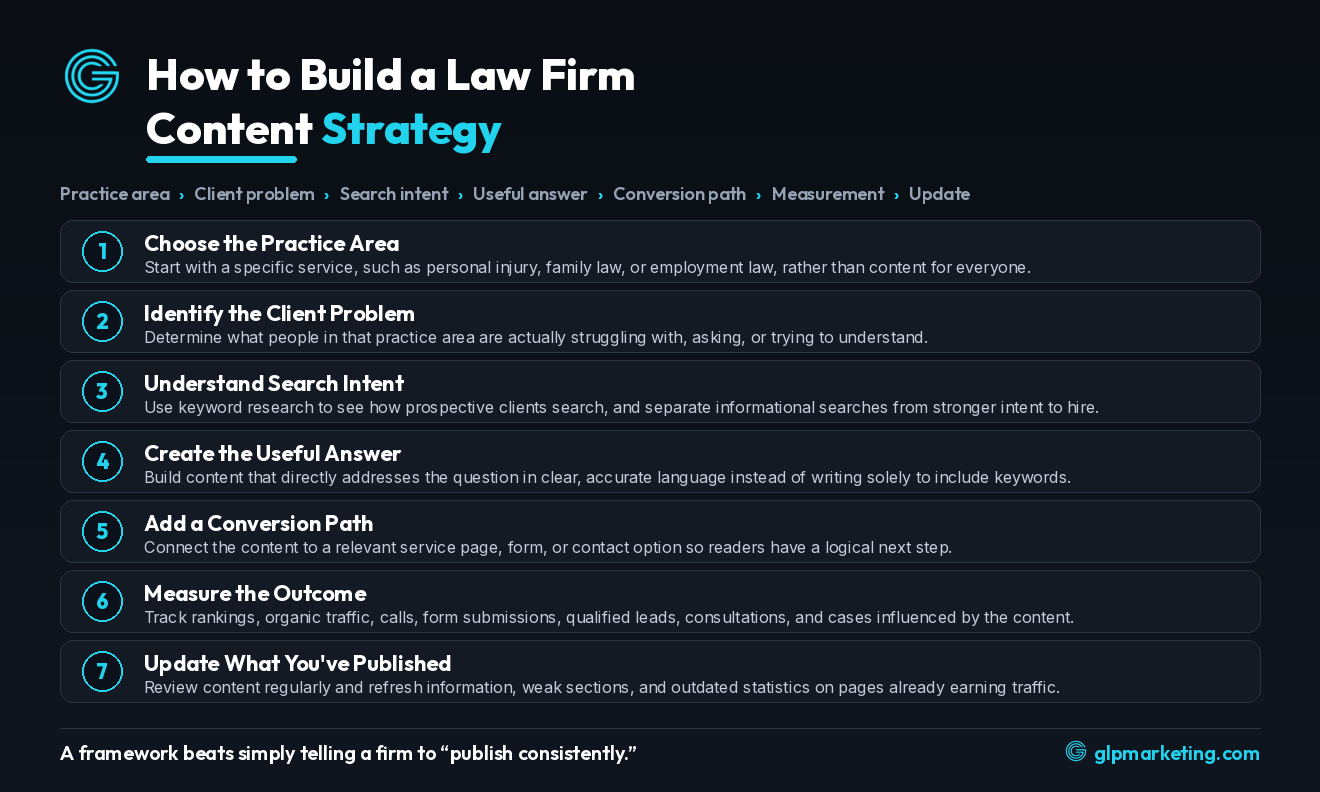
Step 1: Choose the Practice Area
Start with a specific service, such as personal injury, family law, or employment law, rather than trying to create content for everyone.
Step 2: Identify the Client Problem
Determine what people in that practice area are actually struggling with, asking, or trying to understand.
Step 3: Understand Search Intent
Use keyword research to identify how prospective clients search for answers and distinguish informational searches from searches indicating stronger intent to hire.
Step 4: Create the Useful Answer
Build content that directly addresses the question in clear, accurate language instead of writing solely to include keywords.
Step 5: Add a Conversion Path
Connect the content to a relevant service page, landing page, consultation form, or contact option so readers have a logical next step.
Step 6: Measure the Outcome
Track rankings, organic traffic, calls, form submissions, qualified leads, consultations, and cases influenced by the content.
Step 7: Update What You’ve Published
Review existing content regularly and update information, improve weak sections, refresh outdated statistics, and strengthen pages that are already attracting relevant traffic.
The framework is simple: practice area → client problem → search intent → useful answer → conversion path → measurement → update. That is far more useful than simply telling a law firm to “publish consistently.”
Want to Turn Content Into a Law Firm Marketing Asset?
Content isn't just about getting people to visit your firm's website. It really pays off when content targets specific questions clients ask and matches closely with search intent. High quality pages that clearly direct people towards conversions also contribute to making your firm visible and trustworthy. Ultimately this results in a better flow of high quality leads.
The aim isn't just to publish things in order to publish them. Rather, we want to produce useful content that attracts the right kind of people, aligns with our search engine optimization plan and impacts our actual business results measurably.
At GLP Marketing, we help businesses turn content into a strategic marketing asset. If you’re ready to build a content strategy that does more than generate traffic, start with a free audit of how your firm shows up on ChatGPT and Google.
FAQs
Here are some answers to common questions people have regarding blogging, SEO, lead generation and also about how long it takes before marketing through content works.
Does Blogging Help Law Firm Marketing?
Sure, blogs really do attract organic traffic to a law firm and they also answer questions of prospective clients. Posts that closely match what people are looking for in search results and which relate to related services and steps toward conversion work best.
How Often Should a Law Firm Publish Content?
Frequency of publishing doesn't have any strict rules; rather, it's more important to focus on quality and relevance. Quality articles that are carefully researched and directly targeting specific audiences are better than just posting generic content regularly.
Does Law Firm Content Help SEO?
Sure thing, optimizing content does really help to boost ranking for related search queries and also raises the credibility in specific practice areas on a firm's website. Good SEO content should mix key information with appropriate keywords. It also means using strong internal links and understanding very well what people who are actually doing searches want.
Can Content Marketing Generate Clients for a Law Firm?
Yes, great content is very effective at attracting people with specific legal problems and helping them find related services and consulting options. Really great results happen when you connect effectively with high quality leads and gather important information versus relying just on metrics of traffic alone.
What Should a Law Firm Write About?
A law firm should concentrate on creating content that responds to questions and concerns that their prospective clients face related to specific areas of practice. Through keyword research, intake questions, data on search terms and also client inquiries, content topics can be suggested using different kinds of information sources.
How Long Does Law Firm Content Take to Produce Results?
SEO and content creation generally take some time to work. So don't expect that immediately after publishing each piece of content traffic or leads start pouring in. Results usually take several months to develop. Over time pages will be seen more, rankings will go up and your content library will grow stronger.