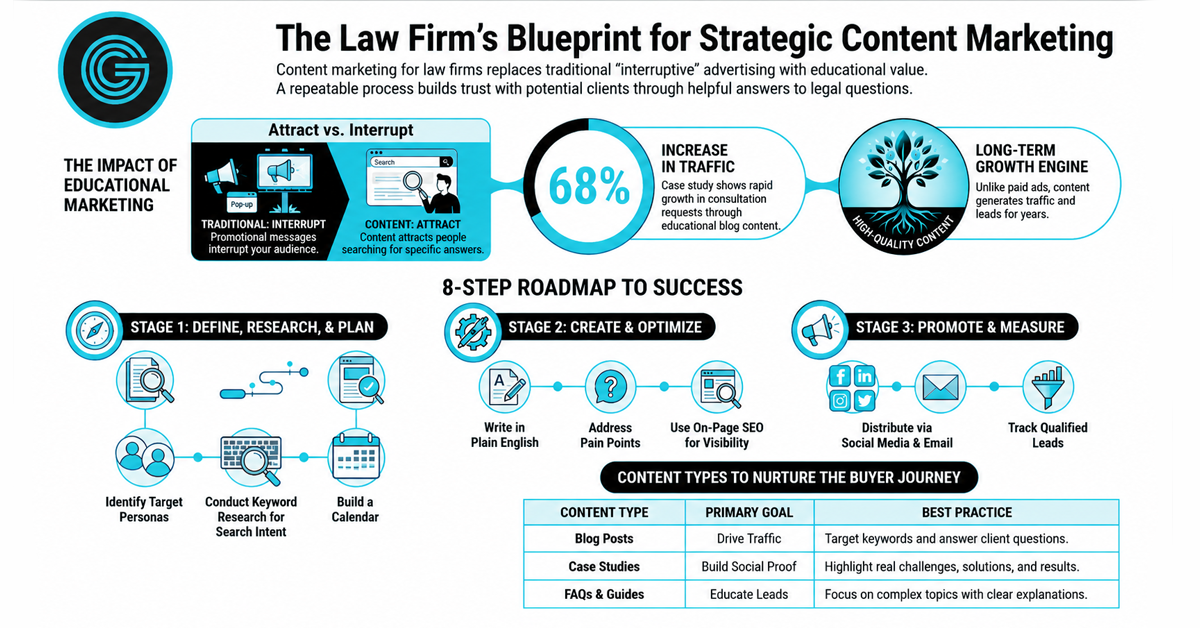
A strong marketing plan for law firm growth should clearly define your target audience, outline your legal marketing strategies, establish your marketing goals, allocate a realistic budget, and set measurable key metrics to track performance
It also accounts for advertising regulations for law firms, builds a clear law firm’s brand, and focuses on attracting prospective clients through consistent content marketing and online visibility. Without a structured marketing plan, most law firms rely on random marketing efforts that fail to generate sustainable website traffic or new clients.
GLP Marketing, we have spent years helping law firms develop customized marketing strategies that actually drive results. We understand how competitive the legal industry is, and we know what it takes to help a law firm effectively stand out in local search results, build authority, and convert potential clients. If you are ready to strengthen your online marketing and grow your practice,
now!
In this guide, we will break down the essential components of a successful marketing plan and share proven tactics you can implement whether you run a small law firm or a multi-practice operation.
What Is A Marketing Plan For A Law Firm?
A marketing plan for a law firm is a structured roadmap that outlines how your firm will attract prospective clients, promote its legal services, differentiate itself from other law firms, and measure results. In our experience, the firm that grows consistently are not necessarily the biggest. Instead, they are the ones with a clear marketing strategy for their law firm tied to specific goals, defined audiences, and measurable outcomes.
marketing plan is not just about advertising. It connects branding, client acquisition, competitive analysis, budgeting, and tracking performance into one coordinated system.
- At its core, a marketing plan for a law firm answers three critical questions:
- Who are we trying to reach?
- Why should they choose us?
- How will we reach them?
- Let’s break down the essential elements.
1. Target Audience (Your Ideal Clients)
Every successful marketing plan for a law firm starts with clearly defining your target audience. This means identifying your target market based on your practice area, location, income level, legal needs, and even behavioral patterns.
For instance, if you are a family law attorney , your ideal clients may be individuals searching for divorce representation in your city. In that case, your legal marketing strategies should focus on local SEO tactics, Google Business Profile optimization, and content marketing around divorce-related relevant keywords. On the other hand, if you serve business owners in complex litigation, your marketing channel mix may lean more heavily into legal industry branding, thought leadership, and personal connections through local events.
We recommend building detailed client personas. Ask yourself:
- What problems are they facing?
- How do most clients find a lawyer in your practice area?
- Are they searching on Google, asking other lawyers to refer clients, or browsing legal directories?
- According to the
American Bar Association’s Legal Technology Survey Report , more than one-third of clients begin their search for legal services online. That means your law firm online presence is often your first impression.
2. Unique Selling Proposition (USP) and Branding
Your unique selling proposition defines what makes your law firm different from other law firms in your area. This is where legal industry branding becomes critical.
In our experience, many small law firms struggle because their messaging sounds identical to competitors. “Experienced.” “Aggressive.” “Results-driven.” Those words mean very little without proof.
- Instead, your marketing plan should clearly define:
- Your niche focus within your practice area
- Your approach to client communication
- Your track record (case outcomes, years in practice, recognitions, etc.)
- Your commitment to client experience
For example, we once worked with a small law firm that positioned itself around rapid response times and proactive communication. They built their law firm’s brand around returning calls within one business day and offering transparent fee discussions. Within six months, positive client reviews increased by 42 percent and website traffic grew by 69 percent because their messaging resonated with potential clients who felt ignored by larger firms.
Branding is not just logos and colors. It is how your firm is perceived across digital channels, online reviews, client testimonials, and even traditional marketing efforts like direct mail.
3. Competitive Analysis
A strong marketing plan includes a formal competitive analysis. This means reviewing:
- Other law firms ranking in search engine results
- Their website structure and practice area pages
- Their Google Ads and local service ads
- Their directory listing
- Their online reviews and client testimonials
We recommend searching your primary relevant keywords in Google and analyzing the top three firms appearing in local search results. What are they doing well? Where are the gaps?
It depends on your market. In highly competitive metro areas, paid ads and local SEO are often necessary. In smaller markets, a strong Google Business profile and consistent content marketing may be enough to dominate search results.
Competitive analysis ensures your marketing efforts are strategic, not reactive.
4. Marketing Channels
Once you define your audience and brand positioning, your marketing plan should outline your chosen marketing channels. These may include:
| Search engine optimization | Google Ads and paid ads | Social media platforms | Content marketing |
|---|---|---|---|
| Legal directories | Local SEO tactics | Traditional marketing like direct mail | Networking locally and attending local events |
In our experience, the most effective law firm marketing combines both digital marketing and traditional tactics. For example, a firm might publish content regularly on its law firm’s website to demonstrate expertise while also investing in targeted ads for high-intent search terms.
We also encourage firms to think carefully about marketing budget allocation. Paid advertising can drive fast results, but ad costs in competitive practice areas can be high. SEO, while slower, often delivers stronger long-term ROI.
5. Client Acquisition and Measurement
Finally, a marketing plan must outline how you will measure success. Without tracking performance, even the best marketing ideas fall flat.
Key metrics often include:
- Website traffic
- Search engine rankings
- Conversion rates
- Cost per lead
- Number of new clients
- Positive client reviews
- Local visibility in search engine results
Make sure to assign specific marketing tasks and responsibilities. Whether you work with a marketing agency or manage marketing in-house, someone must own tracking performance and adjusting strategy.
Importance Of A Marketing Plan for Law Firms
A successful law firm marketing plan integrates strategy, budgeting, branding, and measurable goals.
According to the American Bar Association, the majority of clients begin their search for legal services online. This makes having a coordinated digital marketing and search engine optimization strategy critical for visibility in search engine results. Additionally, the
U.S. Small Business Administration emphasizes that businesses with formal marketing plans are more likely to achieve growth objectives because structured planning improves decision-making and resource allocation. This applies directly to law firm marketing. Without a plan, firms often overspend on paid ads or underinvest in high-ROI channels like local SEO and content marketing.
A marketing plan ensures a structured approach instead of reactive tactics
Measurable outcomes are another reason a marketing plan is necessary. A well-designed law firm marketing plan includes specific key metrics such as website traffic growth, conversion rates, cost per lead, online reviews, and new client acquisition numbers. We recommend setting quarterly benchmarks and reviewing tracking performance regularly. It depends on your practice area, but in some cases, firms discover that SEO drives 60 percent or more of qualified leads, while paid ads generate faster short-term inquiries at higher ad costs. Without measurement, you cannot optimize your marketing strategies effectively.
Resource allocation is equally important. Many small law firms operate with limited marketing budgets, so strategic budgeting is essential. A marketing plan outlines how much to allocate toward digital marketing, traditional marketing like direct mail, directory listings, local events, or networking locally. In our experience, firms that clearly assign budget percentages to SEO, online advertising, and branding efforts are far more likely to see steady client acquisition than unpredictable spikes.
Finally, a marketing plan supports long-term business development and client retention.
Marketing is not only about attracting prospective clients; it also strengthens relationships with past clients and encourages satisfied clients to refer clients. Consistent content marketing, client testimonials, and positive client reviews reinforce trust and demonstrate expertise. Over time, this creates compounding growth because referrals and repeat engagements become a natural extension of your marketing efforts.
How Do Law Firms Create A Marketing Plan?
In our experience, the difference between inconsistent marketing efforts and sustainable client acquisition comes down to whether a law firm follows a clear methodology. A solid marketing strategy for a law firm does not begin with running paid ads or posting randomly on social media. It begins with planning, positioning, and measurable objectives.
Below is the step-by-step process we recommend when building a law firm marketing plan that supports long-term business development:
Step 1: Conduct a Full Competitive Analysis
The first step in building a marketing plan for a law firm is conducting a thorough competitive analysis. Before investing in digital marketing or traditional marketing, you need to understand what other law firms in your practice area are doing.
Search your primary relevant keywords in Google and study the firms appearing in local search results and organic search engine results. Pay attention to their law firm’s website structure, messaging, practice area pages, online reviews, directory listings, and whether they are using Google Ads or local service ads.
This process gives you clarity on positioning and opportunity gaps. For instance, if competitors are heavily investing in paid ads but have weak content marketing, you may find an opportunity to dominate through search engine optimization and publishing high-quality content regularly.
It depends on your market. In highly competitive metropolitan areas, you may need a more aggressive online advertising strategy, while smaller markets may reward strong local SEO tactics and Google Business Profile optimization.
Step 2: Define Your Target Audience and Ideal Clients
A marketing plan for law firm growth must clearly define the target audience. Without clarity on your target market, your marketing strategies will lack direction and waste resources. Identify which types of cases are most profitable, which clients align best with your expertise, and where most clients currently come from.
For example, if you are a family law attorney serving a specific region, your target audience likely consists of individuals actively searching online for divorce or custody representation. That means your marketing strategy for the law firm should prioritize local SEO, positive client reviews, and visibility in local search results.
On the other hand, firms serving business clients may rely more heavily on personal connections, networking locally, and thought leadership content to demonstrate expertise. In our experience, small law firms that narrow their focus often see stronger conversion rates because their messaging speaks directly to ideal clients rather than attempting to appeal to everyone.
Step 3: Clarify Your Unique Selling Proposition and Legal Industry Branding
Once your audience is defined, your law firm’s brand must be clearly articulated. Legal industry branding is about more than design elements. It is about defining why potential clients should choose you over other lawyers. Many firms use generic messaging, but differentiation is critical in competitive practice areas.
We recommend reviewing client testimonials and positive client reviews to identify recurring themes. Are satisfied clients praising responsiveness, communication, courtroom skill, or empathy? That feedback often reveals your true unique selling proposition. A clearly defined brand strengthens every marketing channel you use, from social media marketing to directory listings.
Step 4: Set Clear Goals and Key Metrics
No law firm marketing plan is complete without measurable outcomes. Strategic planning requires defining key metrics that align with your business goals. These metrics may include website traffic growth, conversion rates, number of new clients, cost per lead, search engine rankings, and increases in online reviews.
Step 5: Establish Your Marketing Budget and Resource Allocation
A marketing plan must clearly define your marketing budget and how it will be allocated. Many law firms overspend on one marketing channel while neglecting others. A balanced approach may include investment in search engine optimization, Google Ads, local service ads, content marketing, legal directories, social media platforms, and traditional tactics like direct mail or local events.
Ad costs vary widely by practice area, and in competitive markets, paid ads can become expensive quickly. In our experience, firms that allocate a percentage of their marketing budget toward long-term SEO while reserving funds for targeted ads see more stable growth. Resource allocation should also include assigning responsibility for marketing tasks, whether internally or through a marketing agency. Without ownership and accountability, even the best marketing strategy for a law firm can stall.
Step 6: Optimize or Build Your Law Firm’s Website
Your law firm’s website is the foundation of your law firm online presence. It must clearly communicate your practice area expertise, include detailed practice area pages, and be optimized for search engine visibility.
Make sure your site includes strong calls to action, client testimonials, and educational content that demonstrates expertise. In some cases, redesigning and optimizing a website alone can significantly increase website traffic and conversion rates, especially if previous content lacked clear positioning or relevant keywords.
Step 7: Implement Search Engine Optimization and Local SEO Tactics
Search engine optimization is a cornerstone of effective law firm marketing. SEO ensures your firm appears in search engine results when prospective clients actively seek legal services. This includes optimizing practice area pages, conducting keyword research, building directory listings, and enhancing your Google Business profile to improve local visibility.
Local SEO tactics are particularly important for small law firms. Improving rankings in local search results and encouraging positive client reviews can dramatically increase inquiries. In our experience, firms that consistently focus on SEO and publish content regularly often see compounding growth over time as authority builds in search engines.
Step 8: Launch Paid Advertising Strategically
Paid ads, including Google Ads and local service ads, can accelerate client acquisition when implemented strategically. However, they should complement your broader marketing strategies rather than replace them. Targeted ads work best when aligned with clear goals and measurable outcomes.
We recommend starting with controlled budgets and closely monitoring cost per acquisition. It depends on your market and practice area, but paid ads can either deliver high-quality leads or quickly exhaust your marketing budget if not managed carefully. Tracking performance ensures that online advertising remains profitable rather than reactive.
Step 9: Develop a Consistent Content Marketing Strategy
Content marketing plays an important role in building authority and trust. Publishing educational content allows your firm to demonstrate expertise while addressing common questions potential clients may have. This may include blog articles, FAQs, legal updates, or in-depth guides.
In many cases, one well-optimized piece of content can generate leads for years. Content marketing also supports search engine optimization by improving rankings for relevant keywords. We recommend publishing content regularly and aligning topics with your target audience’s most pressing concerns.
Step 10: Integrate Social Media and Relationship-Based Marketing
Social media marketing and traditional relationship-building efforts should also be integrated into your law firm marketing plan. Social media platforms can increase brand awareness, reinforce credibility, and nurture relationships with past clients. Sharing educational posts, community involvement, and firm updates helps maintain visibility.
At the same time, do not underestimate traditional tactics such as networking locally, attending local events, and maintaining personal connections with other lawyers who may refer clients. In some practice areas, referrals remain one of the most significant sources of new clients. A comprehensive marketing plan acknowledges both digital channels and traditional marketing.
Step 11: Monitor, Adjust, and Refine Continuously
A marketing plan is not static. Continuous monitoring and refinement are essential. Regularly review key metrics such as website traffic, search engine rankings, client reviews, and conversion rates. If certain marketing tactics underperform, adjust accordingly.
Strategic planning requires flexibility. It depends on changes in law firm advertising regulations, competitive shifts, and evolving client behavior. The most successful firms treat marketing as an ongoing process rather than a one-time initiative.
Step 12: Consider Professional Support When Necessary
In some cases, partnering with a specialized marketing agency can accelerate growth. An experienced agency understands legal marketing, compliance considerations, and advanced digital marketing techniques. However, even when working with outside experts, internal involvement remains critical. Your firm’s authenticity, expertise, and client relationships are the foundation of any effective marketing plan.
What Are The Benefits Of A Marketing Plan?
A documented marketing plan improves client acquisition, branding, and measurable growth.
A well-structured marketing plan for law firm growth does far more than organize your marketing tasks. In our experience, it creates clarity, improves accountability, strengthens branding, and drives measurable business development results.
Law firms that document their marketing strategy consistently outperform those relying on reactive or scattered marketing efforts. A solid marketing plan for your law firm aligns your target audience, marketing budget, digital channels, and business goals into one cohesive roadmap.
As Juan Reyes, our Head of SEO at GLP Marketing, often says,
“The firms that win in search engine results are not necessarily the biggest. They are the ones with a documented strategy, consistent execution, and a long-term commitment to search engine optimization.”
That philosophy applies across every marketing channel, from SEO to social media marketing to paid ads.
Below are the key benefits of implementing a structured marketing plan:
Increased Client Acquisition
One of the most significant benefits of a marketing plan is increased client acquisition. A structured law firm marketing strategy ensures your marketing efforts are targeted rather than broad and ineffective. Instead of attempting to reach everyone, you focus on your ideal clients within your specific practice area and geographic target market.
By aligning messaging with prospective clients’ active searches, targeted marketing efforts enhance lead generation. For example, if you are a lemon law attorney , optimizing your law firm’s website for relevant keywords related to defective vehicles, manufacturer buybacks, or warranty disputes can significantly improve your visibility in search engine results.
If someone searches “car qualifies for lemon law in Arizona” or “manufacturer refusing to repair vehicle,” and your practice area pages are properly optimized with strong search engine optimization, your firm is far more likely to appear in local search results. When you combine that with local SEO tactics, targeted Google Ads for high-intent terms, and a fully optimized Google Business Profile with positive client reviews, your law firm online presence becomes much easier for potential clients to discover at the exact moment they need legal services.
Improved client engagement also plays a critical role. A marketing plan outlines how you will use content marketing, social media platforms, and online reviews to nurture trust. In our experience, firms that implement SEO and structured content marketing often see website traffic increase by 40 to 60 percent within the first year.
When traffic improves and messaging is clear, conversion rates typically follow. A documented marketing plan ensures that every marketing channel supports client acquisition rather than operating in isolation.
Enhanced Brand Recognition
Another major benefit of a marketing plan for a law firm is enhanced brand recognition. Consistent messaging across your law firm’s website, directory listings, social media platforms, and online advertising strengthens your brand identity and differentiates you from other law firms.
Differentiation is important in competitive markets. When your branding clearly communicates what makes your firm unique, prospective clients can quickly understand why they should choose you over competitors.
Reputation management is also a key component. The
Federal Trade Commission notes that online reviews significantly influence consumer decision-making, which indicates the value of managing client testimonials and maintaining positive client reviews as part of your marketing plan. In our experience, firms that actively encourage satisfied clients to leave online reviews and consistently manage their reputation often experience improved local visibility and stronger engagement within six months.
Improved Resource Allocation
A structured marketing plan helps law firms allocate their marketing budget more effectively. Without a plan, firms may overspend on paid ads with high ad costs while neglecting long-term strategies like search engine optimization or content marketing.
Strategic planning guarantees the distribution of funds across appropriate digital channels and traditional tactics, guided by measurable outcomes. It depends on your practice area, but firms that balance short-term online advertising with long-term SEO investments typically achieve more stable and predictable growth.
Clearer Competitive Positioning
A documented marketing plan requires a competitive analysis that clarifies how your law firm compares to other lawyers in your market. This allows you to identify positioning gaps and refine your messaging.
In some cases, the competitive advantage is not spending more but communicating more effectively. For example, if other law firms focus heavily on aggressive advertising, you may stand out by emphasizing personalized service, community involvement, or educational content that demonstrates expertise. Clear positioning strengthens both lead generation and conversion rates.
Higher Conversion Rates
A marketing plan for your law firm ensures your website structure, practice area pages, and calls to action are designed to convert visitors into potential clients. Improved messaging, clearer value propositions, and strategically placed client testimonials all increase conversion rates. In our experience, firms that refine their law firm online presence and align it with targeted marketing strategies often see measurable improvements in inquiries within three to six months.
Stronger Client Retention and Referrals
Marketing does not stop at client acquisition. A comprehensive marketing plan also supports client retention and referral growth. Structured communication, educational content, and ongoing engagement through social media platforms help maintain relationships with past clients.
Satisfied clients are more likely to refer clients who feel connected to your firm’s brand. In some practice areas, referrals account for a significant portion of new business. A documented marketing strategy ensures that relationship-based marketing efforts are intentional and consistent.
Better Tracking and Measurable Growth
A marketing plan improves tracking performance and accountability. By tracking key metrics such as website traffic, search engine rankings, cost per lead, and growth in online reviews, your firm can make data-driven decisions. This allows you to refine marketing tactics, reallocate your marketing budget strategically, and scale what works.
What Are Common Challenges In Law Firm Marketing?
Even the most well-intentioned marketing plan for law firm growth can face obstacles. In our experience, many law firms struggle not because they lack ambition, but because they underestimate how competitive, regulated, and resource-intensive law firm marketing can be.
Below are some of the most common challenges we see, along with practical solutions:
Overcoming Market Saturation
One of the biggest challenges in law firm marketing is market saturation. In competitive practice areas, dozens of other law firms may be targeting the same prospective clients through Google Ads, local service ads, social media marketing, and legal directories. Simply having a law firm’s website is no longer enough.
To stand out, your firm must focus on a strong unique value proposition and clear market differentiation. Instead of broadly advertising “
personal injury services ,” consider niche marketing or specialized services that give you a competitive edge. For example, rather than targeting all auto accidents, a firm might focus specifically on trucking accidents or catastrophic injury claims. This client specialization allows your branding and content marketing to speak directly to a narrower target audience.
In our experience, niche positioning dramatically improves both conversion rates and local visibility because your messaging becomes more specific and compelling. As Juan Reyes, our Head of SEO at GLP Marketing, explains, “
Search engines reward specificity. When a law firm clearly defines its niche and builds content around specialized services, it gains both authority and a measurable competitive edge in search results.”