Discover why SEO is crucial for personal injury lawyers in 2026. Learn strategies to enhance visibility, attract clients, and grow your practice. Read more!
In short
SEO matters for personal injury lawyers because injury victims search online first, and the firms they find at the top reach the highest-value cases before competitors do. In 2026 that means ranking in local results, appearing in Google's AI answers, and earning authority through content and backlinks. With PI clicks among the priciest in paid search, organic visibility is the most sustainable path to a steady caseload.
Why does SEO for personal injury lawyers matter in 2026? It matters because most potential clients begin their search for legal help through search engines. Personal injury lawyer SEO improves online visibility, increases organic traffic, and helps personal injury law firms attract qualified leads.
At GLP Marketing, we understand that SEO for personal injury lawyers isn't just about rankings, it's about building trust, authority, and a steady flow of high-intent clients. We specialize in SEO for legal professionals globally, helping attorneys improve their search visibility and attract the right clients. Contact us today and let us help your firm reach its full potential in revenue and profitability through our personal injury SEO services.
In this guide, we'll explain why SEO for personal injury lawyers matters, the essential SEO strategies that drive results, and how local SEO tactics help attract potential personal injury clients. We'll also cover keyword research, technical SEO, content marketing, Google Business Profile optimization, and the metrics that measure SEO success.
What Is Personal Injury SEO?
Personal injury SEO, or search engine optimization, is the process of improving a law firm's website to rank higher in search engine results. The goal is to attract potential personal injury clients who are actively searching for legal services online. Unlike personal injury lawyer advertising, SEO focuses on organic traffic instead of paid placements. In our experience, this makes personal injury lawyer SEO one of the most sustainable marketing channels for personal injury law firms.
For instance, someone searching for a "car accident lawyer" or "car accident attorney" needs legal help immediately. Strong SEO for personal injury helps your personal injury firm appear when those high-intent searches happen. This is especially important because personal injury lawyers operate in one of the most competitive sectors within the legal industry.
According to the nonprofit organization Internet Live Stats, Google processes billions of searches daily. This creates significant opportunities for law firms to connect with potential clients through search engine optimization. However, visibility matters because most users click only a handful of search results.
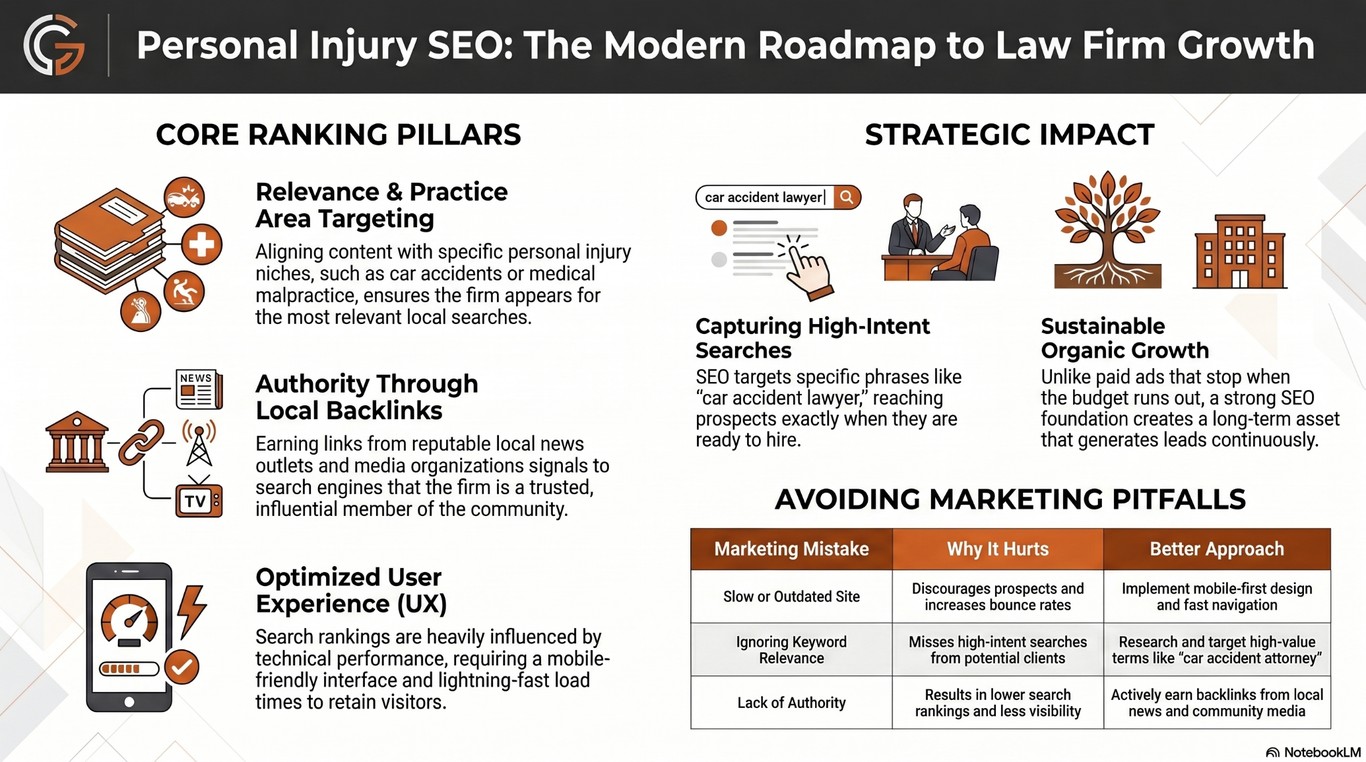
At its core, personal injury SEO helps search engines understand your law firm's website and determine whether it deserves higher search rankings. Google uses complex algorithms that evaluate hundreds of ranking signals. While the exact formula remains private, three major factors consistently influence SEO success: relevance, authority, and user experience.
Relevance means your content aligns with what potential clients search for on Google search. This requires keyword research using tools like Google Keyword Planner and Google Search Console. We recommend targeting relevant keywords tied to your practice areas, such as medical malpractice, car accident, or personal injury claim searches.
Authority reflects how trustworthy your website appears. Google rewards reputable legal websites that earn backlinks from local media, local websites, local news outlets, and other authoritative sources. Strong authority signals help personal injury attorneys compete in crowded search engine results pages.
User experience focuses on how visitors interact with your site. According to the U.S. Small Business Administration, mobile-friendly and easy-to-use websites are critical for modern businesses because consumers increasingly browse online using mobile devices. Fast load times, clear navigation, and well-structured practice area pages improve user engagement and help convert visitors into qualified leads.
It depends on your website's current condition, but even excellent legal representation can go unnoticed online without proper optimization. If your law firm's website is slow, outdated, or difficult to navigate, search engines may rank competing injury lawyers higher. That's why successful personal injury lawyer marketing combines on page optimization, technical SEO, quality content, and local SEO strategies to improve online visibility and generate more qualified leads.
Why Does SEO for Personal Injury Lawyers Matter for Growth?

The answer to why does SEO for personal injury lawyers matter in 2026 is simply because visibility drives growth. Personal injury law firms that ignore SEO risk becoming invisible in search results. In our experience, even highly skilled personal injury attorneys struggle to attract clients if they cannot be found online. SEO helps your firm appear when potential clients search for legal help, creating opportunities to generate qualified leads consistently.
As Juan Reyes, Head of SEO at GLP Marketing, explains, "The best time to reach a potential client is when they are actively searching for answers. SEO puts your firm in front of that client at the exact moment they need help."
One of the biggest benefits of personal injury lawyer SEO is enhanced online visibility. Most potential clients search online before contacting a lawyer. People searching for terms like "best personal injury lawyer," "car accident lawyer," or "car accident attorney near me" often need immediate legal representation. We recommend focusing your SEO efforts on these high-intent searches because they typically produce more qualified leads than broader marketing campaigns.
SEO also aligns with how people find legal services today. Online search remains one of the primary ways consumers find information and services. At the same time, search behavior continues to evolve through Google Maps, AI-powered search experiences, social platforms, and local search results. This means personal injury lawyer marketing must extend beyond traditional search engines.
Another reason personal injury lawyers matter in SEO conversations is cost efficiency. High-intent legal keywords can exceed $200 per click through search engine marketing campaigns. While personal injury lawyer advertising can deliver immediate traffic, those leads disappear when advertising budgets stop. SEO for personal injury creates long-term organic traffic that continues to generate potential personal injury clients without paying for every visit.
For example, one personal injury firm we worked with invested heavily in paid advertising but neglected SEO. After implementing local SEO, technical SEO, and content-focused SEO strategies, organic traffic increased steadily. Within months, contact form submissions became one of the firm's largest lead sources. While results vary, this demonstrates how SEO success compounds over time.
SEO also helps educate and nurture potential clients search activity. Many visitors are not ready to hire an attorney immediately. They first want direct answers about a personal injury claim, medical malpractice case, or car accident situation. Creating content around common questions allows your firm to build trust before the first consultation. We recommend publishing blogs, FAQs, resource guides, and practice area pages that address real client concerns.
Content serves another important purpose. Google evaluates legal websites under strict YMYL standards and rewards content demonstrating E-E-A-T. Strong content helps establish your personal injury firm as a reputable legal authority. It can also attract backlinks from local websites, local media, local news outlets, and other reputable legal sources.
Finally, SEO strengthens credibility. A well-optimized law firm's website, positive client reviews, consistent Google Business Profile optimization, and strong local SEO tactics all influence client decision-making. In some cases, potential clients compare several law firms before making contact. When your firm appears prominently in local search, local pack rankings, and search engine results pages, you create trust before the first conversation even begins.
Important SEO Strategies for Personal Injury Law Firms

A strong SEO strategy is an important aspect of every law firm's marketing plan. In our experience, the most successful personal injury law firms treat SEO as a long-term growth investment. Effective SEO strategies improve online visibility, increase organic traffic, and generate more qualified leads. They also help personal injury attorneys compete in an increasingly crowded personal injury space.
Comprehensive Keyword Research for Personal Injury Law
Keyword research is the foundation of successful personal injury SEO. It helps you understand what potential clients search for before hiring a lawyer. We recommend focusing on high-intent keywords that signal a need for immediate legal help.
Terms like "best personal injury lawyer in California" or "car accident attorney in Los Angeles" often attract highly qualified leads. Long-tail keywords can also uncover valuable opportunities. For instance, searches like "How much does a personal injury lawyer cost?" reveal strong user intent and lower competition.
Competitor analysis is equally important. Reviewing keyword rankings can reveal gaps in your competitors' strategies. Tools like Google Keyword Planner and Google Search Console help identify relevant keywords and track SEO success.
As Chidinma Enemanna, Head of Content at GLP Marketing, explains, "The best-performing legal content starts with understanding the exact questions potential clients are asking. Keyword research gives us that insight."
On-Page SEO Optimization for Personal Injury Lawyer Websites
On page optimization helps search engines understand your content and improves search rankings. It also influences whether users click your listing in search engine results pages.
Title tags and meta descriptions should be clear, compelling, and keyword-focused. Including location-specific terms helps strengthen local search optimization. For example, "Los Angeles Personal Injury Attorney" can improve local search visibility.
Your law firm's website should also contain well-structured content across all practice areas. Practice area pages should answer common client concerns and provide direct answers to legal questions. We recommend creating content that is informative, natural, and easy to understand.
Google evaluates legal content under strict YMYL standards. This means accuracy, expertise, and trust are essential for strong SEO performance.
Local SEO for Personal Injury Attorneys
Local SEO is critical because most personal injury cases are location-based. Potential personal injury clients usually want legal representation from attorneys in their immediate area.
Google Business Profile optimization remains one of the most effective local SEO tactics. A complete profile improves your chances of appearing in local search results and local pack rankings. Make sure your contact details, office hours, services, and photos remain updated.
According to the U.S. Small Business Administration, maintaining accurate business information across online platforms helps customers find and trust local businesses. This makes NAP consistency an important ranking factor.
Local citations also support local SEO strategies. Mentions on reputable legal directories and generic business directories help establish authority. Listings on platforms like Yelp, Avvo, and FindLaw strengthen local search signals.
Client reviews are equally valuable. We recommend encouraging satisfied clients to leave feedback on your Google Business Profile. High-quality client reviews help improve local search rankings while building trust with potential clients.
Content Marketing Strategies for Personal Injury Lawyers
Content marketing supports every aspect of personal injury lawyer marketing. It attracts organic traffic, improves user engagement, and helps establish authority within the legal industry.
As Chidinma Enemanna, Head of Content at GLP Marketing, says, "The firms that consistently create content are often the firms that dominate search results. Helpful content earns trust before the first consultation."
You should create content that answers the questions potential clients ask every day. Topics like "What to Do After a Car Accident" and "How to File a Personal Injury Claim" attract users actively seeking legal help.
FAQ pages are particularly effective because they provide direct answers to common concerns. They can also improve visibility in AI-generated search experiences and traditional search engine results.
Legal guides, case studies, and educational resources help demonstrate expertise. Creating resource libraries can also attract backlinks from local websites, local media, and local news outlets.
Video content deserves attention as well. Many users prefer watching short videos over reading lengthy articles. In some cases, video content generates higher engagement and can appear directly within Google search results.
Technical SEO for Law Firm's Websites
Technical SEO ensures search engines can properly crawl, index, and understand your website. Even the best content can struggle if technical issues exist.
Website speed is especially important. According to the nonprofit World Wide Web Consortium (W3C) Web Accessibility Initiative, users expect websites to load quickly and function properly across devices. Slow pages often lead to higher abandonment rates and lower user engagement.
We recommend regularly testing your website with Google PageSpeed Insights. Small speed improvements can produce meaningful gains in conversions and search rankings.
Mobile responsiveness is equally important. Many potential clients search for legal services from their phones immediately after an accident. If your website is difficult to navigate, visitors may leave before contacting your firm.
Structured data, also known as schema markup, helps search engines better understand your content. Legal-specific schema can highlight attorney profiles, practice areas, reviews, and FAQs. This additional context can improve visibility within search engine results and AI-generated answers.
Building backlinks
Building backlinks from reputable websites remains one of the most effective SEO strategies for personal injury law firms. Backlinks signal trust and authority to search engines, helping improve search rankings and online visibility.
According to Google Search Central Documentation, links from other websites help Google discover content and understand which pages may be valuable to users. While not all links carry equal weight, quality backlinks from trusted sources can significantly strengthen a website's authority.
We recommend focusing on backlinks from reputable legal organizations, local media, local websites, and industry publications. Listings in respected legal directories such as Avvo, Justia, and FindLaw can help strengthen your firm's online presence while improving local search optimization.
Guest blogging can also be an effective link-building strategy. For instance, if a personal injury attorney contributes an article to a reputable legal publication, that content may generate both referral traffic and valuable backlinks. However, quality matters more than quantity. A few authoritative links often outperform dozens of low-quality ones.
You should also look for opportunities through local events, firm news, community sponsorships, and expert commentary. These activities can attract mentions from local news outlets and other trusted websites. In our experience, the strongest backlink profiles are built through genuine authority rather than aggressive link acquisition tactics.
Conversion Rate Optimization (CRO) for Personal Injury Firm
SEO for personal injury brings visitors to your law firm's website, but conversion rate optimization turns those visitors into potential clients. Without CRO, even strong organic traffic may fail to generate meaningful business results.
A well-designed website should make it easy for visitors to take the next step. Clear navigation, fast-loading pages, and prominent contact information improve user experience and encourage action. We recommend reviewing your website regularly to remove unnecessary friction from the client journey.
Trust signals also play an important role. Client reviews, attorney credentials, certifications, awards, and case results help reassure visitors that they are choosing a reputable legal team. This is particularly important in personal injury law, where trust heavily influences decision-making.
Strong calls to action are equally important. Phrases such as "Get a Free Consultation" or "Speak With an Attorney Today" provide direct answers about what visitors should do next. In our experience, firms that place clear CTAs throughout their practice area pages often see higher contact form submissions.
It depends on your audience and practice areas, but CRO should always complement your SEO efforts. The goal is not simply to increase traffic. The goal is to generate more qualified leads, consultations, and signed cases from the traffic you already earn.
Common SEO Challenges for Personal Injury Lawyers and How to Overcome Them
Even the best SEO strategies come with challenges. In our experience, personal injury law firms that anticipate these obstacles achieve stronger long-term SEO success. The key is understanding the problem and implementing practical solutions before rankings are affected.
| SEO Challenge | Why It Matters | How to Overcome It |
|---|---|---|
| High Competition for Keywords | Personal injury law is one of the most competitive sectors in the legal industry. Many law firms compete for the same high-value keywords. | Focus on long-tail keywords and local search optimization. Instead of targeting broad terms, target phrases like "car accident lawyer in Pasadena" or "medical malpractice attorney near me." We recommend using Google Keyword Planner and competitor analysis to uncover untapped keyword opportunities. |
| Managing Reviews and Online Reputation | Client reviews influence local search rankings and client trust. Negative reviews can discourage potential clients from contacting your firm. | Encourage satisfied clients to leave reviews on your Google Business Profile. Respond professionally to all reviews, including negative feedback. Consistent review management strengthens credibility and improves local SEO performance. |
| Balancing PPC and SEO Efforts | Some firms invest heavily in search engine marketing while neglecting SEO. Others focus only on SEO and miss short-term opportunities. | It depends on your goals and budget. We recommend using PPC for immediate visibility while building long-term organic traffic through personal injury SEO. This balanced approach helps generate leads today while strengthening future search rankings. |
| Google Algorithm Updates | Google frequently updates its ranking systems, especially for YMYL industries like legal services. These updates can affect search rankings overnight. | Focus on E-E-A-T, quality content, technical SEO, and user experience. Firms that prioritize helpful content and strong SEO fundamentals typically recover faster from algorithm changes. Avoid shortcuts or outdated SEO tactics. |
| Generating Consistent Content | Many personal injury attorneys struggle to publish content regularly. Without fresh content, search visibility often declines over time. | Create content calendars focused on practice areas and client questions. Topics such as personal injury claims, car accidents, and legal representation often perform well. We recommend publishing consistently rather than chasing volume. |
| Standing Out in Local Search Results | Local search results are crowded, especially in major cities. Ranking in local pack rankings requires more than a website. | Invest in Google Business Profile optimization, local citations, client reviews, and community involvement. Participating in local events and earning mentions from local media can strengthen local authority. |
How to Build Authority in SEO for Your Law Firm

Building authority is one of the most important parts of personal injury SEO. Google rewards firms that demonstrate experience, expertise, authoritativeness, and trustworthiness. In our experience, firms with strong authority often outperform competitors, even in highly competitive markets.
As Juan Reyes, Head of SEO at GLP Marketing, explains, "Authority is not built through one tactic. It's earned by consistently demonstrating expertise, trust, and value across every digital touchpoint."
Here is the step-by-step process we recommend for building authority in SEO for personal injury lawyers;
Step 1: Publish Expert Legal Content Consistently
Start by creating content that answers the questions potential clients search for every day. Focus on practice areas, personal injury claims, legal processes, and case-specific concerns.
For example, topics like "What to Do After a Car Accident" and "How Long Does a Personal Injury Case Take?" can attract valuable organic traffic. Detailed guides, FAQs, and case studies also help establish expertise.
Make sure to update older content regularly. New laws, court decisions, and legal developments can affect content accuracy and search rankings.
Step 2: Earn Backlinks From Reputable Sources
Backlinks remain one of the strongest authority signals in search engine optimization. When reputable websites link to your content, search engines view your website as more trustworthy.
We recommend pursuing guest blogging opportunities with respected legal publications and local websites. Press releases can also generate valuable coverage from local media and local news outlets.
Focus on quality over quantity. A handful of authoritative backlinks often provide more value than dozens of low-quality links.
Step 3: Showcase Your Credentials and Experience
Potential clients want evidence that they are hiring a qualified attorney. Search engines look for these trust signals as well.
Highlight awards, certifications, bar memberships, speaking engagements, and professional achievements throughout your law firm's website. Attorney bios should include years of experience, case successes, and relevant media mentions. According to the American Bar Association, attorney credentials and professional experience play an important role in helping consumers evaluate legal representation options.
Step 4: Strengthen Your Local SEO Presence
Local SEO is essential because personal injury law is highly location-dependent. Most potential clients search for attorneys within their immediate area.
Optimize your Google Business Profile with accurate business information, updated photos, services, and regular posts. Google Business Profile optimization helps improve visibility in local search and local pack rankings.
You should also maintain listings on trusted legal directories such as Avvo, Justia, and FindLaw. These citations strengthen local search optimization and improve your firm's online presence.
Step 5: Build and Manage Client Reviews
Client reviews are one of the strongest trust signals available to personal injury attorneys. Positive reviews influence both search rankings and client decisions.
We recommend creating a process that encourages satisfied clients to leave feedback after successful case outcomes. Responding professionally to every review demonstrates transparency and engagement.
Step 6: Create Thought Leadership Opportunities
Authority grows when others recognize your expertise. Look for opportunities to contribute legal insights through interviews, podcasts, webinars, and industry events.
You can also publish commentary on important legal developments affecting personal injury law. This content helps differentiate your firm from competitors and attracts attention from both search engines and potential clients. For instance, if a major law change affects personal injury claims, publishing an expert analysis can position your firm as a trusted source.
Step 7: Monitor and Improve Your Authority Signals
Authority building is not a one-time project. It requires ongoing effort and measurement.
Use Google Search Console to monitor organic traffic, keyword rankings, and user engagement. Track backlinks, client reviews, and local search performance regularly.
It depends on your market and competition, but firms that consistently invest in authority building typically see stronger SEO success over time. The combination of expert content, reputable backlinks, client trust, and local visibility creates a foundation that supports long-term growth.
How to Measure SEO Success and Track Website Traffic
Tracking performance is essential for long-term SEO success. In our experience, the most successful personal injury law firms regularly measure results and adjust their SEO strategies based on data. Without tracking, it is difficult to know whether your SEO efforts are generating more qualified leads or simply increasing traffic.
1. Monitor Organic Traffic Growth
Organic traffic measures the number of visitors arriving through unpaid search results. This metric helps you understand whether your search engine optimization strategy is increasing visibility and attracting potential clients.
We recommend tracking both overall organic traffic and page-specific traffic. Pay close attention to practice area pages, attorney profiles, and blog content. These pages often generate the most valuable traffic for personal injury lawyers.
Google Analytics remains one of the best tools for monitoring organic traffic trends and user engagement.
2. Track Keyword Rankings
Keyword rankings show how well your law firm's website performs for target keywords. This includes terms related to your practice areas, services, and location.
For example, you may track keywords such as "car accident lawyer," "personal injury attorney," or "medical malpractice lawyer." Improving keyword rankings typically leads to stronger search visibility and increased organic traffic.
However, we recommend focusing on long-term trends rather than daily fluctuations. Search rankings naturally change as competitors update their websites and Google updates its algorithms.
3. Measure Conversion Rates
Traffic alone does not generate revenue. Conversion metrics reveal whether website visitors are becoming potential clients.
Key conversion actions include:
Contact form submissions
Consultation requests
Phone calls
Live chat inquiries
Case evaluation requests
For instance, if organic traffic increases by 30% but conversions remain unchanged, your website may require conversion rate optimization improvements.
4. Evaluate Lead Quality
Not all leads are equally valuable. A smaller number of qualified leads often delivers better business results than large volumes of unqualified traffic.
We recommend reviewing the source and quality of incoming leads regularly. This helps determine whether your SEO for personal injury strategy is attracting people who genuinely need legal representation.
5. Monitor Local Pack Presence
Local SEO performance is especially important for personal injury law firms. Most personal injury clients search for attorneys within their local area.
Track how often your firm appears in local search results and local pack rankings. A strong Google Business Profile and consistent local SEO tactics can significantly improve local search visibility.
You should also monitor client reviews, local citations, and Google Business Profile engagement. These factors influence local SEO success.
6. Use the Right SEO Tools
Successful SEO requires reliable tracking tools. We recommend using the following platforms:
| Tool | What It Measures |
|---|---|
| Google Analytics | Organic traffic, conversions, user engagement, and traffic sources |
| Google Search Console | Search visibility, keyword rankings, click-through rates, and indexing issues |
| Google Keyword Planner | Keyword research and search volume trends |
| Google Business Profile Insights | Local search performance and customer interactions |
| SEO Audit Tools | Technical SEO issues, backlinks, and website health |
According to the National Institute of Standards and Technology (NIST) Small Business Cybersecurity Corner, businesses should use data and analytics to make informed decisions and improve performance over time. The same principle applies to SEO measurement and optimization.
7. Conduct Regular SEO Audits
SEO is not a one-time project. Search engines, competitors, and user behavior constantly evolve.
Regular SEO audits help identify technical SEO issues, content gaps, declining keyword rankings, and missed opportunities. We recommend conducting a comprehensive audit at least quarterly.
For example, an audit may reveal outdated content, broken links, slow-loading pages, or declining performance in key practice areas. Addressing these issues early helps maintain strong search rankings.
8. Adjust Your Strategy Based on Results
The most effective SEO campaigns continuously evolve. If certain keywords drive more qualified leads, create additional content around those topics. If local search performance declines, strengthen your local SEO strategies.
It depends on your goals and market, but successful personal injury lawyer marketing always relies on ongoing testing and improvement. The firms that consistently review data, measure performance, and adapt their strategies are often the firms that achieve sustainable growth.
If you need help tracking performance and improving results, explore our personal injury SEO services to learn how GLP Marketing helps personal injury law firms increase online visibility, attract potential clients, and generate more qualified leads.
Looking for an Effective SEO Strategy for Your Law Firm?
While SEO can drive significant growth for personal injury law firms, certain mistakes can limit results. Avoid keyword stuffing, buying backlinks, and other outdated SEO tactics that violate search engine guidelines. You should also prioritize mobile users because a slow or unresponsive website can hurt user engagement, search rankings, and conversions. In addition, neglecting local SEO, Google Business Profile optimization, and local search visibility can prevent potential clients from finding your firm when they need legal help most.
In our experience, the most successful personal injury lawyers focus on sustainable SEO efforts rather than shortcuts. A strong strategy combines keyword research, on page optimization, technical SEO, content marketing, local SEO strategies, and reputation management. These essential SEO strategies help improve online visibility, attract qualified leads, strengthen credibility, and generate consistent organic traffic. Regularly monitoring keyword rankings, local pack rankings, conversion rates, and search visibility helps ensure continued SEO success.
At GLP Marketing, we have the knowledge, experience, and expertise to help scale your business with SEO. With our local SEO services, we'll make sure that your personal injury firm is found in local search results and ultimately get you more high-intent clients. Get a free audit to see how your firm shows up on ChatGPT and Google.
FAQs Personal Injury Law SEO
EO can be confusing, especially with so many moving parts. To help, we've answered some of the most common questions personal injury lawyers have about SEO, from keyword research to local optimization.
How Can I Find Relevant Keywords for My Personal Injury Firm?
Use keyword research tools like Google Keyword Planner, Google Search Console, or Ahrefs to identify relevant keywords. Focus on high-intent and local search terms that potential clients use when looking for legal help.
How Much Does Law Firm Website Design Cost?
Law firm website design costs vary based on functionality, customization, and SEO requirements. A basic website may cost a few thousand dollars, while advanced websites with SEO integration cost significantly more.
Why Is Local SEO Important for Law Firms?
Most potential clients search for lawyers in their immediate area before making contact. Local SEO helps your firm appear in local search results, Google Maps, and local pack rankings, increasing qualified leads.
How Soon Can You Expect Results From SEO Efforts?
SEO is a long-term strategy that typically takes three to six months to show measurable improvements. Highly competitive markets may require additional time before significant gains appear.
How To Find an SEO Expert for Personal Injury Law Firms
Look for an agency with proven experience in personal injury lawyer SEO and measurable case studies. We recommend choosing a partner that provides transparent reporting and customized SEO strategies.
Why Does SEO For Personal Injury Lawyers Matter?
SEO helps personal injury law firms appear when potential clients search for legal representation online. Without strong SEO efforts, even experienced attorneys may struggle to compete in search results.
Is SEO Dead or Evolving in 2026?
SEO is evolving rather than disappearing. Successful firms now optimize for traditional search engines, AI search experiences, local search, and platforms where users increasingly seek information.
What is the 80/20 Rule for Lawyers?
The 80/20 rule suggests that roughly 80% of results often come from 20% of activities. In legal marketing, a small number of practice areas, referral sources, or SEO pages may generate most leads.
What Percentage of Lawyers Make $250,000?
The percentage varies by location, practice area, and firm size. Attorneys in high-demand fields, including personal injury law, often have greater earning potential than lawyers in many other practice areas.
How Can Personal Injury Lawyers Track SEO Success?
Track organic traffic, keyword rankings, local pack presence, and contact form submissions using Google Analytics and Google Search Console. We recommend reviewing these metrics monthly to measure SEO success and identify opportunities for improvement.