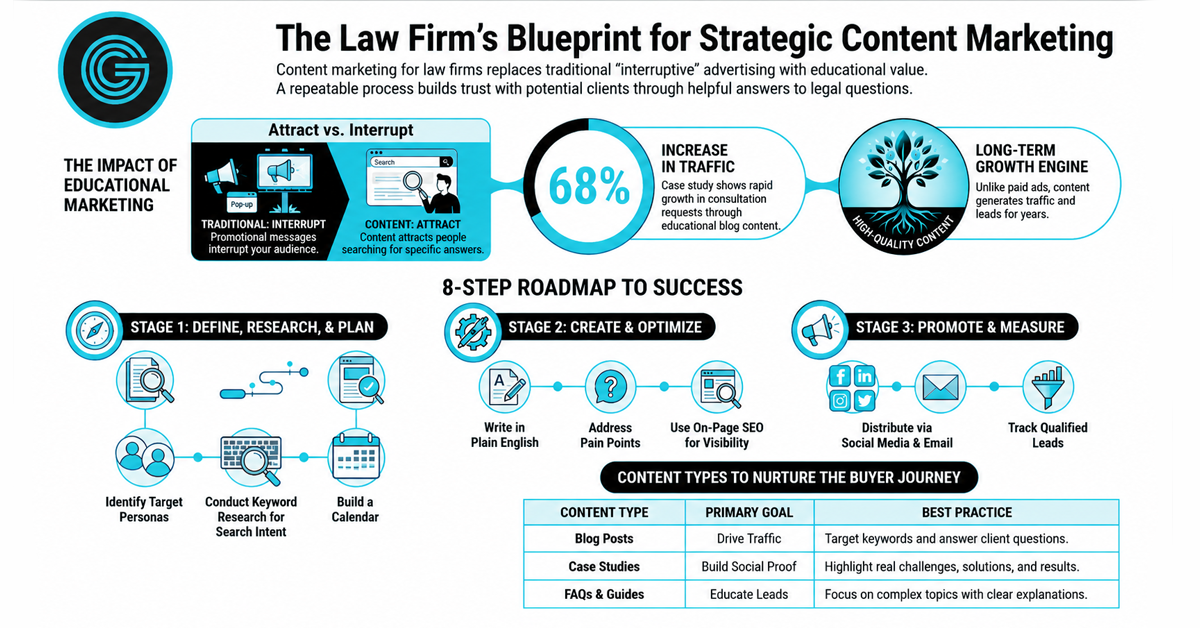
Effective content marketing for law firms uses strategy, consistency, and optimization to attract qualified clients.
In our experience, successful law firms follow a documented legal content strategy. They publish helpful, targeted, and search-focused content consistently.
GLP Marketing, we’ve spent years helping law firms, including
personal injury law firms, develop effective content marketing strategies that drive real results. These include more traffic, better engagement, and measurable content marketing ROI for law firms. If you’re ready to turn your online content marketing into a consistent source of new business,
now!
This guide explains proven strategies, best practices, and common challenges. You will learn how to plan, create, publish, and promote legal content.
What Is Content Marketing For Law Firms?
Content marketing for law firms is the practice of creating and sharing valuable legal information online.
It focuses on educating potential clients rather than directly selling services. In our experience, this approach builds trust faster than traditional advertising. It also supports long-term growth and stronger client engagement. Typically, legal content marketing connects legal expertise with real client needs.
To put it simply, content marketing in the legal industry means producing helpful content that answers legal questions. This includes blog posts, guides, videos, and FAQs. The goal is to position your firm as a reliable source of legal guidance. When you do content marketing well, it attracts qualified leads who already trust your expertise.
Content marketing differs from traditional legal advertising in several important ways. Generally, traditional advertising interrupts people with promotional messages, while content marketing attracts people searching for answers. Instead of saying, “Hire us,” you show clients how you can help. This shift makes content marketing more educational and client-centered.
For instance, a billboard promotes your firm’s name. On the other hand, a blog post explains how to file a personal injury claim. The blog builds understanding and confidence before contact. That difference directly impacts conversion rates.
Law firm content can take many forms. Common examples include blog content, video content, downloadable guides, FAQs, and social media posts. Some firms also use case studies, press releases, and thought leadership articles. Short videos and written content both play important roles. We recommend using multiple formats to reach a broader audience.
When working with our clients, we often help them build content hubs around their main practice areas. Each hub includes new content and supporting articles. This structure improves search engine optimization and user experience. It also helps your firm rank higher in search results.
Why Content Marketing Matters for Law Firms
In our experience, content marketing is no longer optional for law firms. Clients expect answers before they ever make contact. They search, read, compare, and decide based on what they find. Your content often makes the first impression.
One major benefit is trust and credibility
Helpful content shows you understand complex legal topics. It also proves you can explain legal concepts clearly. Over time, this builds confidence in your legal services, and trust turns visitors into prospective clients.
Search engine visibility is another advantage. Search engines reward consistent, high-quality content. Blog posts, guides, and FAQs give search engines more pages to index. This increases your chances to rank higher for relevant keywords. More visibility means more opportunities for new leads.
Content marketing also attracts higher-quality leads
Furthermore, long-term growth is where content marketing truly shines. Paid ads stop working when budgets pause. However, content continues working long after publishing. Trust us when we say that content can generate traffic for years. This creates a consistent flow of future clients.
As Mathew Khorsandi, CEO and Founder of GLP Marketing, explains:
“Great legal content does more than drive traffic. It builds authority, trust, and predictable growth for law firms.”
Content marketing also supports broader digital marketing and legal marketing efforts
Types of Content That Work Best for Law Firms
Using multiple content formats helps law firms reach a broader audience and improve engagement.
Below is a breakdown of the types of content that work best for law firms, including how each supports client engagement, search engine optimization, and lead generation:
| Content Type | What It Includes | Why It Works for Law Firms | Best Practices |
|---|---|---|---|
| Blog Posts and Articles | Educational blog content, legal updates, how-to articles | Drives website traffic and improves search results | Make sure to target relevant keywords and answer common client questions |
| Practice Area Pages | Pages for each legal service or practice area such as employment law family law lemon law , etc. | Converts visitors into prospective clients | Clearly explain services, benefits, and next steps |
| Case Studies and Success Stories | Real client outcomes and results | Builds social proof and credibility | Highlight challenges, solutions, and results |
| Videos and Short-Form Clips | Explainer videos, short videos, attorney tips | Increases engagement across social media platforms | Keep videos simple and under two minutes |
| FAQs and Legal Guides | Question-and-answer pages and downloadable guides | Educates clients and attracts qualified leads | Focus on complex legal topics and clear explanations |
| Email Newsletters | Monthly updates, firm news, legal tips | Nurtures current and prospective clients | Send consistently and personalize when possible |
How Content Marketing Helps Law Firms Get More Clients
One major way content marketing helps is by educating potential clients.
Many people feel overwhelmed by legal issues. But with clear blog posts, guides, and videos, complex legal topics become simplified. Keep in mind that education reduces fear and builds confidence. Confident visitors are more likely to reach out.
- Content also answers common legal questions
- Another benefit is authority building
- Content marketing further nurtures prospects through the buyer journey
For instance, one employment law firm we worked with added educational blog content and short videos to their content marketing strategy. Within six months, website traffic increased by 68 percent, and consultation requests increased by 41 percent. The firm saw consistent growth without increasing ad spend.
We recommend mapping content to each stage of the buyer journey. Awareness content explains problems. Consideration content explains options. Decision content explains why your firm is the right choice. This structure turns content into a predictable source of new leads.
When done correctly, content marketing becomes a client acquisition engine. It attracts, educates, and converts. Over time, it creates a steady stream of new business.
How Does Content Marketing For Law Firms Work?
In our experience, content marketing works best when treated as a repeatable process. Law firms that follow clear steps see better results.
Below is a step-by-step approach you can use:
Step 1: Define Goals and Target Audience:
Start by identifying what you want to achieve. Common goals include more website traffic, more leads, or better client engagement. Next, define your target audience clearly. Consider practice areas, location, and client needs. We recommend creating simple client personas. This keeps your content focused and relevant.
Step 2: Conduct Keyword Research:
Keyword research shows what potential clients search for. Look for relevant keywords tied to your legal services. Focus on search intent, not just volume. For example, “how to file a divorce” signals strong intent. We recommend using keyword research tools and reviewing competitor pages. Choose a mix of short-tail and long-tail keywords.
Step 3: Build a Content Plan:
Content planning turns ideas into action. List content ideas based on keyword research. Group the topics by practice area. Decide which content types you will create, such as blog posts or guides. Then organize everything into a content calendar. This ensures consistent publishing.
Step 4: Create High-Quality Content:
Now it is time for content creation. Focus on helpful, clear, and accurate information. Write in plain language, explain complex legal concepts simply, add internal links and include calls to action. We recommend reviewing content for accuracy and compliance before publishing.
Step 5: Optimize for Search Engines:
Search engine optimization helps content rank higher. Use keywords naturally in headings and body text. Optimize title tags and meta descriptions. Add internal links between related pages. This step is critical for visibility.
Step 6: Distribute and Promote Content:
Publishing content is only the beginning, as you also need to promote your content. You can do this by sharing blog posts on social media platforms and sending content through email newsletters. You should also repurpose articles into short videos or social posts. We recommend using multiple channels for maximum reach.
Step 7: Track Performance with Analytics:
Use analytics tools to measure results. Monitor website traffic, engagement, and conversions. Identify which content performs best and use the data to refine your strategy. Continuous improvement drives long-term success.
Step 8: Refine and Scale:
Content marketing is not a one-time job. You need to update existing content regularly, expand high-performing topics, and add new content types as your firm grows. Over time, this process builds momentum.
What Challenges Do Law Firms Face in Content Marketing?
One major challenge law firms face in content marketing is compliance and content regulation.
Typically, law firms must follow strict advertising and ethics guidelines. According to the
American Bar Association , attorney advertising must avoid misleading statements and unjustified expectations. This means every piece of legal content requires careful review. To overcome this challenge, we recommend building a formal compliance checklist. You should also use disclaimers on informational pages and void guarantees or absolute language. These steps protect both your firm and your reputation.
Another common obstacle is maintaining engagement over time
HubSpot , companies that publish consistent, high-quality content generate significantly more website traffic than those that do not. To keep engagement high, vary your content formats. Combine blog posts, videos, FAQs, and downloadable guides, focus on answering real client questions, and refresh older content regularly. You should also repurpose strong content into social media posts and email newsletters.
Resource limitations also create major challenges. Attorneys are busy serving clients while marketing teams are often small or nonexistent. Many firms struggle to balance billable work with marketing activities. We recommend starting with one primary practice area to build a simple content calendar with realistic publishing goals. Use templates to speed content creation, and outsource writing when needed.
Measuring content marketing ROI
is another frequent concern. Many firms see traffic but struggle to connect it to new business. Marketers increasingly measure success through leads and sales rather than page views. To improve tracking, set up conversion tracking for contact forms and phone calls, use UTM links for campaigns, and review analytics monthly. Tie these leads back to specific content pieces whenever possible.
Lack of strategic planning also limits success. Some firms publish content without a documented strategy. Thus, content becomes scattered and unfocused, making results suffer. We recommend defining clear goals and a target audience. Map topics to specific practice areas, build content hubs around core services, and use a documented plan to guide execution.
Understanding Your Target Audience
In our experience, one of the main reasons that law firm content fails to perform well is simply the fact that content is written for everyone. When you try to speak to everyone, you rarely connect with anyone. Effective content marketing starts with truly understanding your target audience. You need clarity on who they are, what problems they face, and what answers they are searching for.
The first step is identifying your ideal client profiles. These are detailed descriptions of the types of clients your firm wants to attract. Go beyond basic demographics. Consider their life stage, legal situation, emotional state, financial concerns, and decision-making process. A personal injury firm may focus on accident victims seeking immediate legal guidance, while a family law firm may focus on individuals navigating divorce or custody disputes. Each audience has different motivations and fears. We recommend creating two to five client personas and giving each a name. This makes content planning much easier.
For example, one estate planning firm we worked with originally published broad content about wills and trusts. Traffic was steady, but leads were inconsistent. After reviewing their client data, we noticed a pattern. Many of their best clients were adult children helping aging parents. These people were overwhelmed and searching for guidance, not generic legal knowledge. We shifted the firm’s content toward topics like “How to Talk to Your Parents About Estate Planning” and “Signs Your Parent Needs a Will.” Within four months, organic traffic increased by 52 percent and consultation requests doubled. The firm did not change services. Instead, they changed who they were speaking to.
Once you define your audience, map their pain points and legal needs. Pain points are the problems that cause stress. Legal needs are the solutions they are searching for. For instance, a business owner may fear lawsuits, a car accident victim may worry about medical bills, while a parent may worry about losing custody. We recommend listing common fears, questions, and obstacles for each persona. Then connect each item to a content idea. This ensures your content feels relevant and personal.
Choosing topics based on search intent is also important. Search intent explains why someone types a query into search engines. Some users want information, others are comparing options, and some are ready to hire a lawyer. Your content should support all three stages. Informational content answers questions. Comparative content explains choices. Transactional content encourages consultations. When your topics align with intent, you attract better visitors. Better visitors become qualified leads who eventually become clients.
Keyword Research for Legal Content
Strong keyword research connects law firms with real client search behavior.
Keyword research is the foundation of successful legal content marketing. If you do not know what potential clients are searching for, it is almost impossible to create content that attracts them. Keywords connect your law firm to real search behavior. They tell you what questions people ask, what problems they face, and what solutions they want.
Keywords matter in legal SEO because search engines rely on them to understand your content. When you use relevant keywords correctly, your pages have a better chance of appearing in search results. Higher rankings lead to more visibility. More visibility leads to more website traffic. More traffic increases opportunities for new leads. We recommend treating keyword research as an ongoing process, not a one-time task.
Finding relevant keywords starts with understanding your practice areas and audience. Begin by listing your core services. Then brainstorm questions your clients frequently ask. Use keyword research tools to validate these ideas. Look for keywords with solid search volume and realistic competition. We also recommend reviewing competitor websites. Pay attention to pages that rank well. These often reveal valuable keyword opportunities.
It is important to understand the difference between short-tail and long-tail legal keywords. Short-tail keywords are broad phrases like “personal injury lawyer.” They usually have high competition. Long-tail keywords are more specific phrases like “what to do after a car accident in Texas.” These keywords often attract more qualified leads. In our experience, long-tail keywords convert better because they match specific intent.
Using keywords naturally is just as important as choosing the right ones. Keyword stuffing hurts readability and SEO. Search engines favor content written for humans, not algorithms. We recommend placing keywords in headings, introductions, and meta descriptions. Use variations throughout the content and focus on answering questions clearly. If a sentence sounds forced, rewrite it.
A simple rule we follow is that we write for people first and then optimize for search engines second. When your content is helpful, clear, and relevant, SEO improvements follow naturally.
Strong keyword research allows you to create content that ranks. More importantly, it allows you to create content that helps. When you consistently target the right keywords, your law firm attracts better visitors, stronger leads, and more clients.
Creating a Content Strategy for Your Law Firm
The first step is setting clear goals
Next, choose the content formats that best support your goals
Building a content calendar
turns ideas into action. A calendar outlines what you will publish and when. It prevents last-minute scrambling and also ensures consistent publishing. We recommend planning at least three months ahead. Include topic titles, target keywords, format type, and publish dates. A simple spreadsheet works fine. Consistency matters more than volume.
Assigning responsibilities is often overlooked. Someone must own each step of the process. Decide who handles topic research, who creates content, who reviews for accuracy and compliance, and who publishes and promotes. Clear ownership prevents delays and confusion. Even small firms benefit from defined roles.
One firm we worked with struggled because everyone “helped” with content. Nothing moved forward. We helped them assign one attorney as reviewer and one marketing coordinator as owner. Within two months, they began publishing weekly. Traffic and engagement steadily increased.
We recommend documenting your strategy in a short internal guide. Outline goals, formats, publishing frequency, and responsibilities. Review it quarterly and adjust based on results.
Writing High-Quality Legal Content
In our experience, high-quality legal content is what separates average law firm websites from top-performing ones. You can have the best keyword strategy in the world, but poor writing will hold everything back. High-quality content is clear, helpful, accurate, and easy to read. It speaks to real people, not just search engines.
Writing in plain English is essential. Legal topics are already intimidating and complicated language makes them worse. According to
Nielsen Norman Group , users typically read only about 20–28% of the words on a web page. That means clarity matters more than complexity. We recommend using short sentences, common words, and direct explanations. If a sentence sounds like something you would not say out loud, rewrite it.
Structuring content for readability keeps visitors engaged. Large blocks of text feel overwhelming. Thus, break content into logical sections with headings. Using short paragraphs and adding bullet points when appropriate makes scanning easier.
Adding internal and external links strengthens both SEO and user experience. Internal links guide visitors to related pages on your site. They also help search engines understand your site structure. External links to reputable sources increase credibility. We recommend linking naturally within sentences. Avoid forcing links where they do not belong. Every link should add value.
Including clear calls to action is another important step. Many law firms create helpful content but forget to ask for the next step. A CTA tells readers what to do next. Examples include “Schedule a consultation,” “Contact our firm,” or “Download our guide.”
- Here is a simple checklist we use when reviewing legal content:
- Is the language clear and easy to understand?
- Is the content structured for scanning?
- Are there relevant internal and external links?
- Is there at least one strong CTA?
On-Page SEO Best Practices for Legal Content
Great content alone is not enough. If search engines cannot understand your pages, your content will struggle to rank. On-page SEO ensures your legal content is visible, discoverable, and competitive. When done correctly, it improves rankings, click-through rates, and conversions.
Title tags and meta descriptions are the first place to start. Your title tag should clearly describe the page and include your primary keyword. Keep it concise and compelling. Your meta description should summarize the page and encourage clicks. Think of it as your ad in search results. We recommend writing unique titles and descriptions for every page. Avoid duplicating them across your site.
Headings play a major role in both readability and SEO. Your H1 should clearly state the main topic of the page. Use H2 and H3 headings to break content into logical sections. This structure helps readers scan content quickly. It also helps search engines understand hierarchy and relevance. We recommend including keywords naturally within headings, without forcing them.
URL structure is another important factor. Clean, descriptive URLs perform better than long, confusing ones. For example, use /personal-injury-lawyer-los-angeles instead of /page123?id=45. Short URLs with relevant keywords improve both user experience and search visibility. We recommend keeping URLs lowercase and using hyphens between words.
Image optimization is often overlooked by law firms. Large images slow page speed, which hurts rankings. Always compress images before uploading. Use descriptive file names and add alt text that explains what the image shows. Alt text also improves accessibility and provides additional keyword context for search engines.
As Mathew Khorsandi, CEO and Founder of GLP Marketing, often tells the team: